 By
 October 30th, 2026

Image credit: CCTV/Inside Outer Space screengrab
The now-orbiting Shenzhou-23 crew aboard China’s Tiangong space station has recently completed the fifth transfer of material exposure experimental apparatus to the station’s exterior, advancing a series of experiments that have yielded multiple world firsts.
Crew members — Zhu Yangzhu, Zhang Zhiyuan and Lai Ka-ying — were sent into space aboard the Shenzhou-23 spacecraft on May 24, with one of them scheduled to spend a full year in orbit.
Space exposure

Image credit: CCTV/Inside Outer Space screengrab
The trio has also conducted space exposure experiments on a high-performance stainless magnesium alloy, verifying its reliability and stability for potential space applications such as lightweight satellite electronic-control and heat-dissipation components, reports China Central Television (CCTV).
Additionally, the Shenzhou-23 team carried out an extravehicular exposure and bearing tribology experiment on liquid-containing gel lubricants.

Image credit: CCTV/Inside Outer Space screengrab
That work is focused on the design and development of new long-life space lubricating materials, CCTV adds, that may be used in lunar rover motion mechanisms.
Superlubricating materials
Also, a tribological experiment in a vacuum environment evaluated oil-based superlubricating materials with near-zero wear, geared for future applications of lubricating materials with near-zero friction.
“Moreover, exposure experiments on shape-memory polymers and their composites outside the space station has helped China screen preferred substrate materials for deployable structures and locking and release structures,” CCTV reports.
The results of this station work are expected to support space station development, crewed lunar landing and planetary exploration.
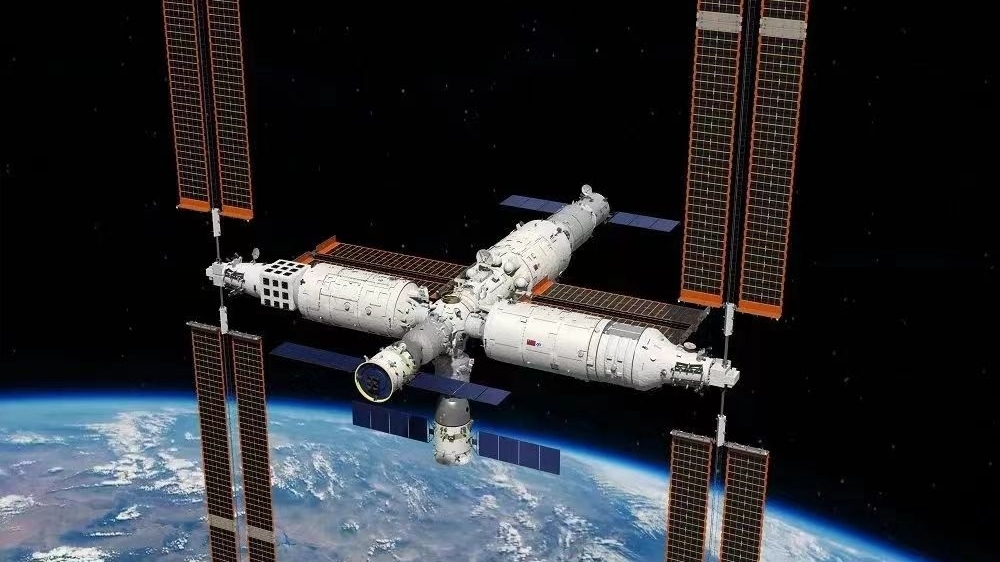
Artwork depicts China’s Tiangong space station.
Image credit: China Manned Space Agency
For an informative video on this work, go to:
 Posted in Space News

