 By
By  October 14th, 2026
Image credit: Virgin Galactic
The suborbital Virgin Galactic’s next generation spaceship is on tap to evaluate sensor systems to collect space weather data during flights.
Under a new Cooperative Research and Development Agreement, Virgin Galactic has joined research interests with the Air Force Research Laboratory’s (AFRL) Space Warfare Directorate at Kirtland Air Force Base, New Mexico.
Under the 24-month agreement, the spaceship will gather direct data at mesosphere and lower thermosphere levels during suborbital excursions – a region often tagged as the “ignorosphere.”
It’s a province not reachable by low-flying Earth orbiting satellites and high-flying aerial vehicles.

Credit: Virgin Galactic
Least-measured regions
“This layer of the atmosphere could shape everything from climate modeling to orbital tracking, yet it remains one of the least-measured regions of our planet,” noted Virgin Galactic President Mike Moses.
“We believe our spaceships can change that,” said Moses in a statement. “Our spaceships are built to fly into the mesosphere and lower thermosphere again and again. Each ship is designed to fly up to twice a week, and with our initial fleet we’re planning for around 125 flights a year, scaling to many more than that as the fleet grows. That’s a research cadence this region has never had,” he added.
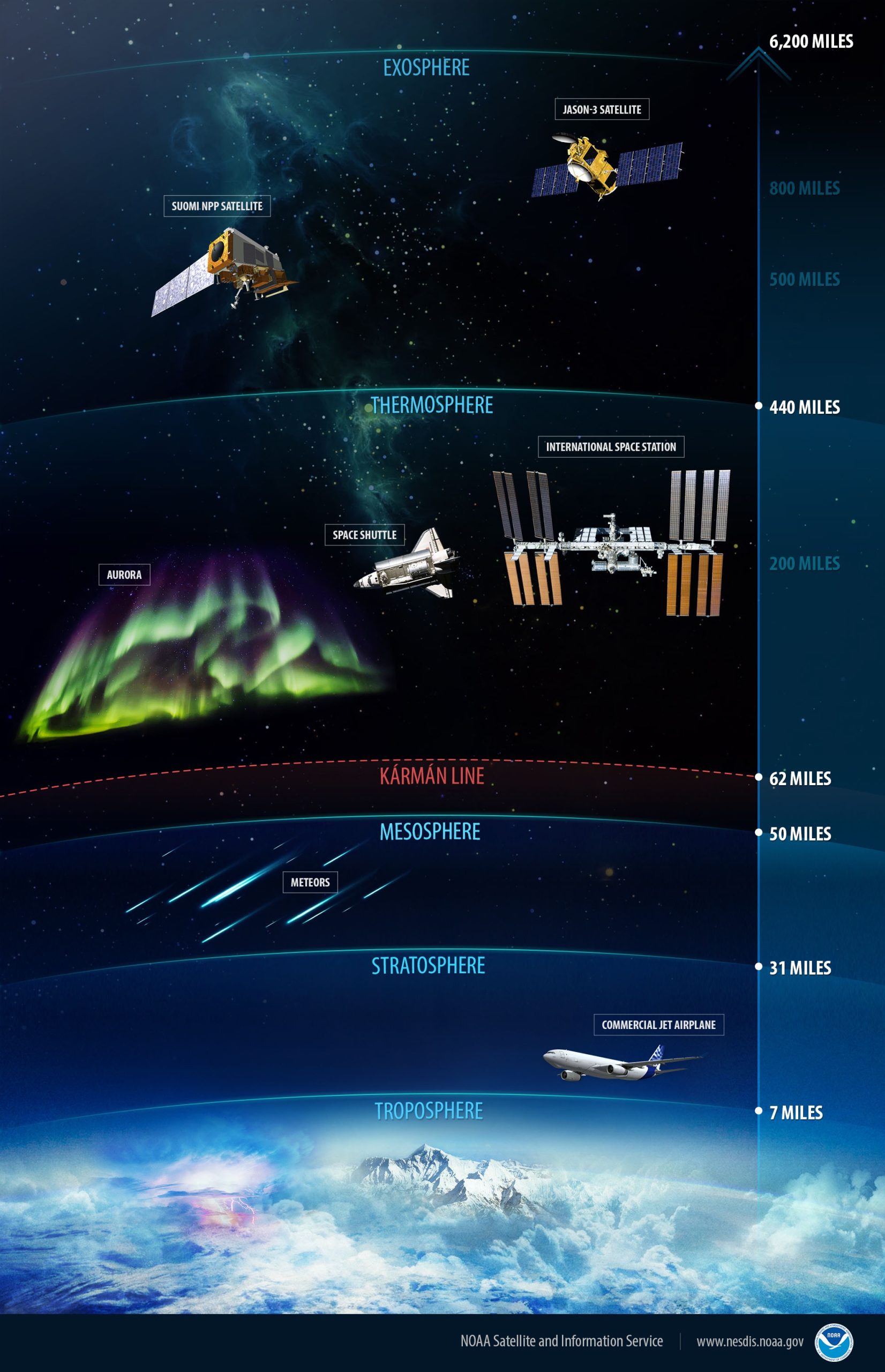
Image credit: NOAA
Fill that gap
According to Shaun Ard, Senior Research Chemist at AFRL: “Understanding space weather dynamics in the mesosphere and lower thermosphere depends on consistent, high-quality observational data, which has remained limited at scale. This collaboration gives our researchers access to a platform particularly well-suited to fill that gap, supporting efforts to protect and advance space-based systems essential to modern infrastructure and exploration.”
Virgin Galactic signed a similar agreement with Lawrence Livermore National Laboratory (LLNL) in December 2025.
Under that agreement, Virgin Galactic and LLNL are assessing the use of sensor systems aboard Virgin Galactic’s launch vehicle with the aim of gathering data and accelerating the development of next-generation high-altitude image-capture capabilities.
 Posted in Space News

