 By
By  September 5th, 2026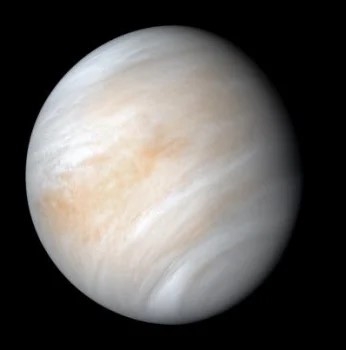
Enigmatic Venus. Cloudy with a scattering of life?
Image credit: NASA
Venus appears pale yellow in visible light, but ultraviolet images reveal dramatic dark and bright patterns moving with the planet’s upper sulfuric acid clouds.
Scientists have known about these markings for roughly a century, yet the chemical identity of the material responsible—the “unknown absorber”—remains unresolved.
An international research team has now placed new quantitative constraints on the properties of this mysterious absorber.
By combining observations of Venus with radiative-transfer modeling, the researchers estimated how strongly the liquid inside Venus’s cloud droplets would need to absorb light to reproduce the planet’s observed ultraviolet and blue reflectance.
New perspective
The study, published in Astrobiology, approached the mystery from a new perspective.
“Our model effectively asks what would happen if we could collect that cloud material into a cuvette and put it into a laboratory spectrometer,” said lead author Jan Spacek of the Foundation for Applied Molecular Evolution, USA. “This is important, as light absorption in a bulk liquid may be correlated with the concentration of light-absorbing material in the solution.”
Spacek noted that the findings of their research does not show that life exists in Venus’s clouds, nor do they demonstrate that the absorber is organic.
Instead, the study establishes quantitative requirements that any candidate—organic or inorganic—must satisfy, including absorption efficiency, concentration, atmospheric distribution, and compatibility with a realistic cloud-particle size distribution.
The newly-released study connects remote observations, laboratory chemistry, and future exploration in a new attempt to solve one of Venus’s longest-standing mysteries.
These constraints can now be tested experimentally and, ultimately, by on-the-sport exploration of Venus.
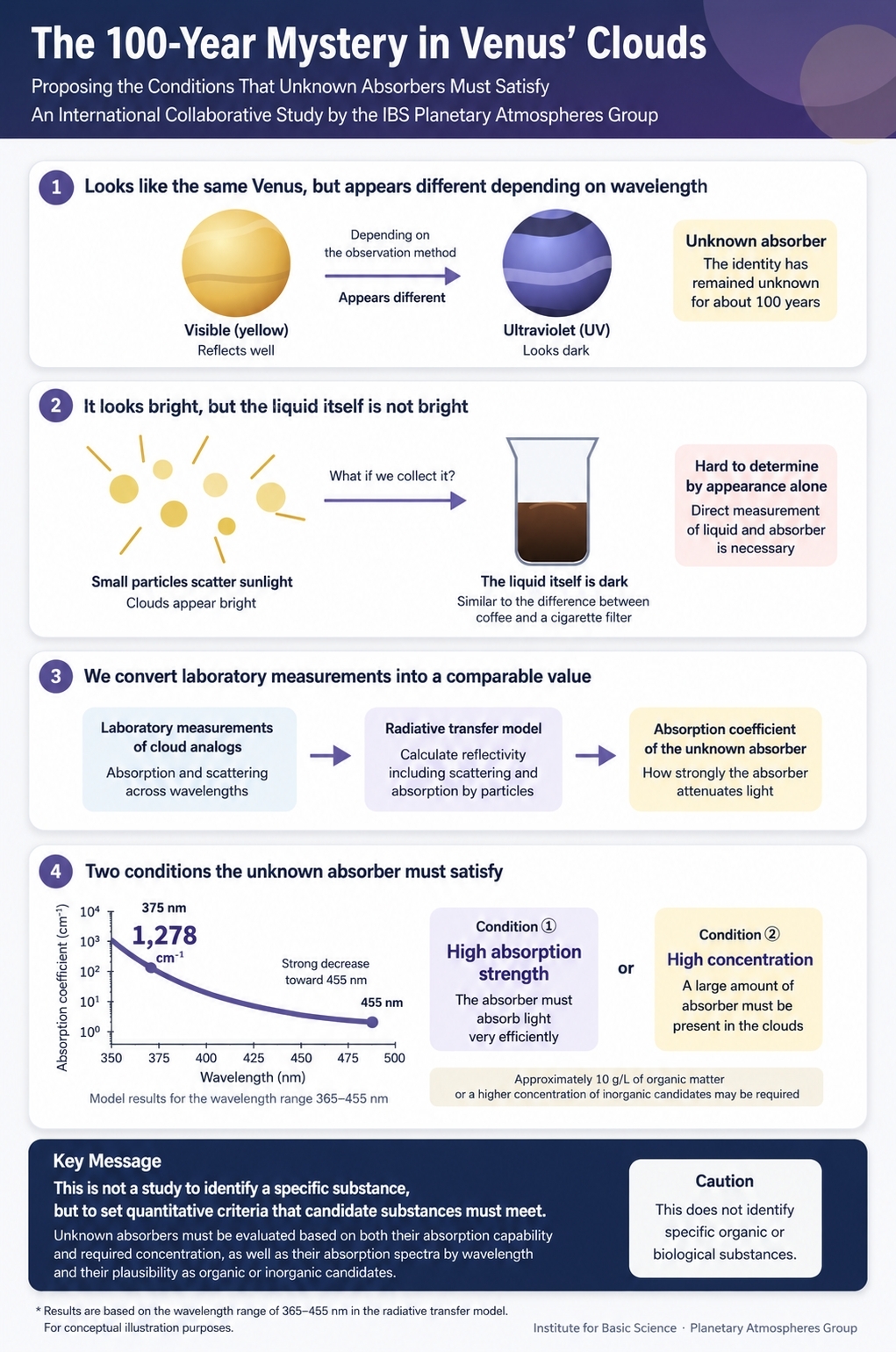
Image credit:: Foundation for Applied Molecular Evolution
Morning Star Missions
The Morning Star Missions to Venus initiative is developing in situ approaches to investigate Venusian cloud chemistry, including searches for complex organic molecules and measurements relevant to the unknown absorber.
On that initial sojourn, the MIT-provided Autofluorescence Nephelometer (AFN) is built to search Venus’s cloud particles for fluorescence that might be associated with organic molecules.
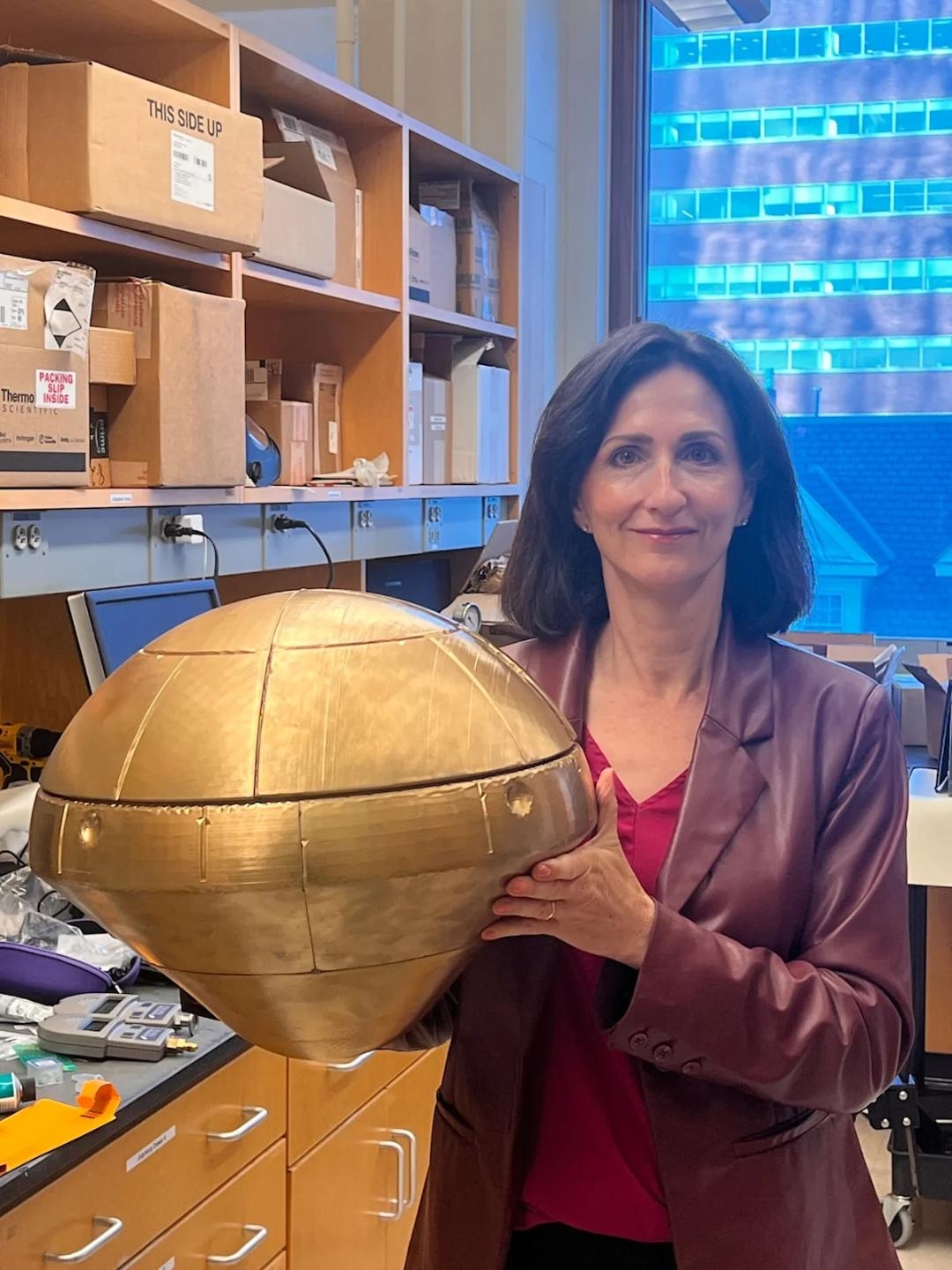
Sara Seager holds a mission to Venus probe to investigate its atmosphere.
Image credit: Sara Seager
However, that mission — as a Rocket Lab-provided departure — is in delay, as noted in this Space.com story:
For more details regarding this line of new Venus research, go to – “A Model of UV–Blue Absorbance in Bulk Liquid of Venusian Cloud Aerosols Is Consistent with Efficient Organic Absorbers at High Concentrations” – at:
https://journals.sagepub.com/doi/10.1177/15311074261477502

Image credit:: Foundation for Applied Molecular Evolution
 Posted in Space News

