 By
By  July 28th, 2026
SpaceX rocket stage.
(Image credit: SpaceX via Project Pluto)
That impending smash hit on the Moon next month of a SpaceX rocket stage has been reviewed by an international research team.
The researchers put to question whether observers on Earth will see anything. Also, will the impact loft a sunlit plume and if so, how much lunar material will be purged, how high could that plume reach, and just how bright the plume may be?
William Jo is a graduate research assistant at University of Texas, Austin that led the analysis.
Last week, they submitted their findings to Geophysical Research Letters and a preprint is just out on arXiv: “Predicted Ejecta Dynamics and Observability of the 2026 Falcon 9 Upper Stage Lunar Impact.”
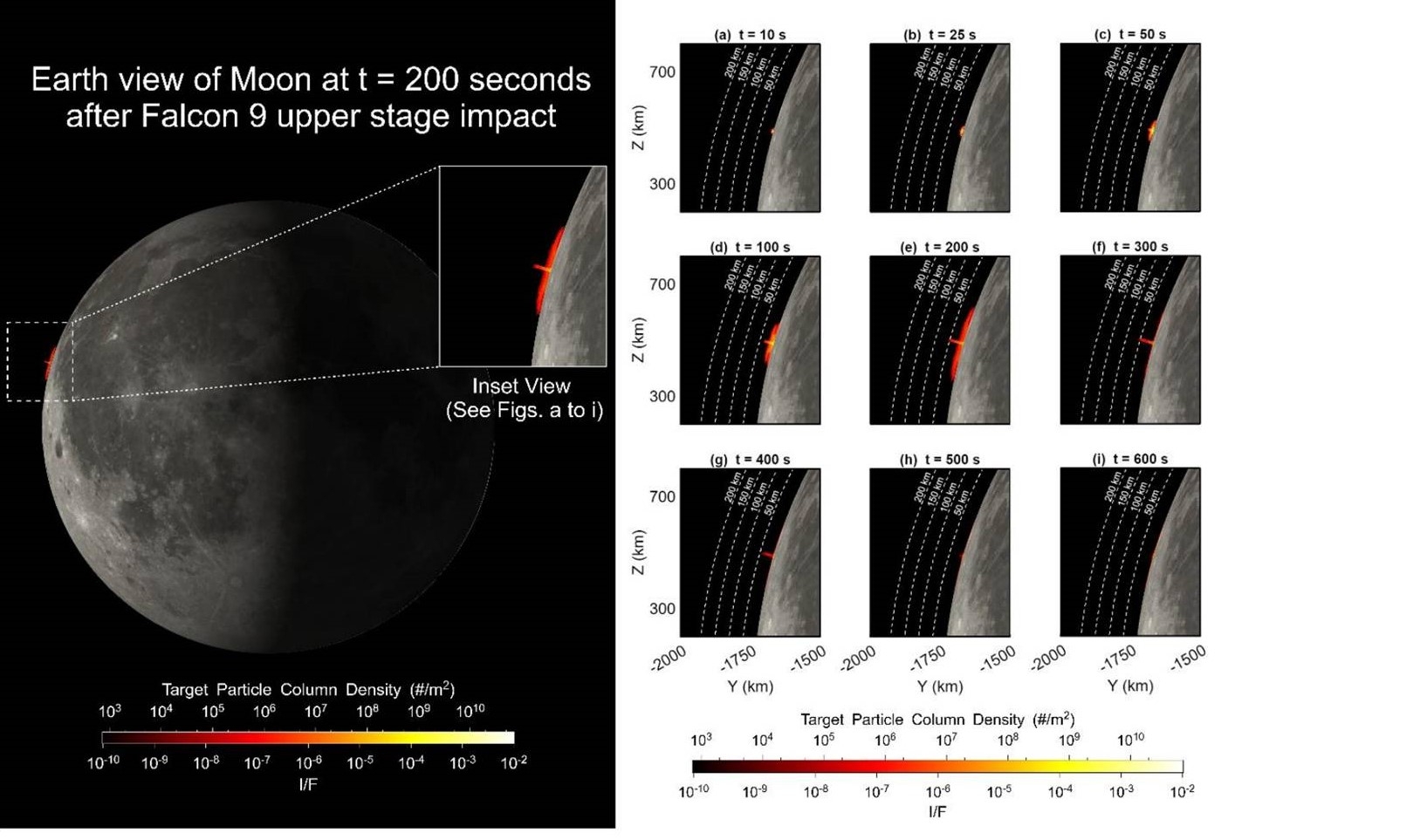
Time evolution of the target ejecta column density, rendered on the lunar surface
at the predicted impact site near Einstein crater.
Image credit: William Jo, et al.
Visible ejecta spike
Using a special shock-physics hydrocode to simulate the impact, among other tools, here’s what Jo and colleagues found.
“We predict the debris plume from the Aug. 5 impact will have the central ejecta spike reaching roughly 75 kilometers to 100 kilometers altitude,” Jo told Inside Outer Space. The curtain of the debris is roughly 15 kilometers to 20 kilometers, and would spread 183 kilometers laterally near the sunlit limb of the Moon.
“Our calculations suggest the plume should be several orders of magnitude brighter than the dark-sky background for the first few minutes after impact,” Jo advised. “So the plume should be visible, though I’d stress this is a single nominal case. The real one will look different, and the numbers are on the optimistic side. But the point worth making is that the flash isn’t really the story here.”
Rare chance
Jo said that a spent rocket stage is a hollow, spacecraft-like body, and there are very few impact models for objects (human-made) like it. They seem to produce very different plumes than “natural impactors,” like asteroids or comets do.

Artwork depicts a small but powerful meteor strike on the Moon.
Image credit: Steve Roy, NASA/Marshall Space Flight Center
“Watching this one gives us a rare chance to open up ejecta-plume science and calibrate those models against a real event, which matters for every future thing we deliver to the Moon,” added Jo. “My concern is that most observers will stop at the sub-second flash and never track down the ejecta, which is the part that should actually be visible, and where the science is.”
As the research paper explains: “Our results predict the size, shape, and brightness of the plume over time, so that astronomers with sufficiently sensitive telescopes will know where to point and what to expect upon observation. We find that the plume may briefly be bright enough to see against the dark sky near the Moon’s edge.”
To access the research paper — “Predicted Ejecta Dynamics and Observability of the 2026 Falcon 9 Upper Stage Lunar Impact” – go to:
 Posted in Space News

