 By
By  July 23rd, 2026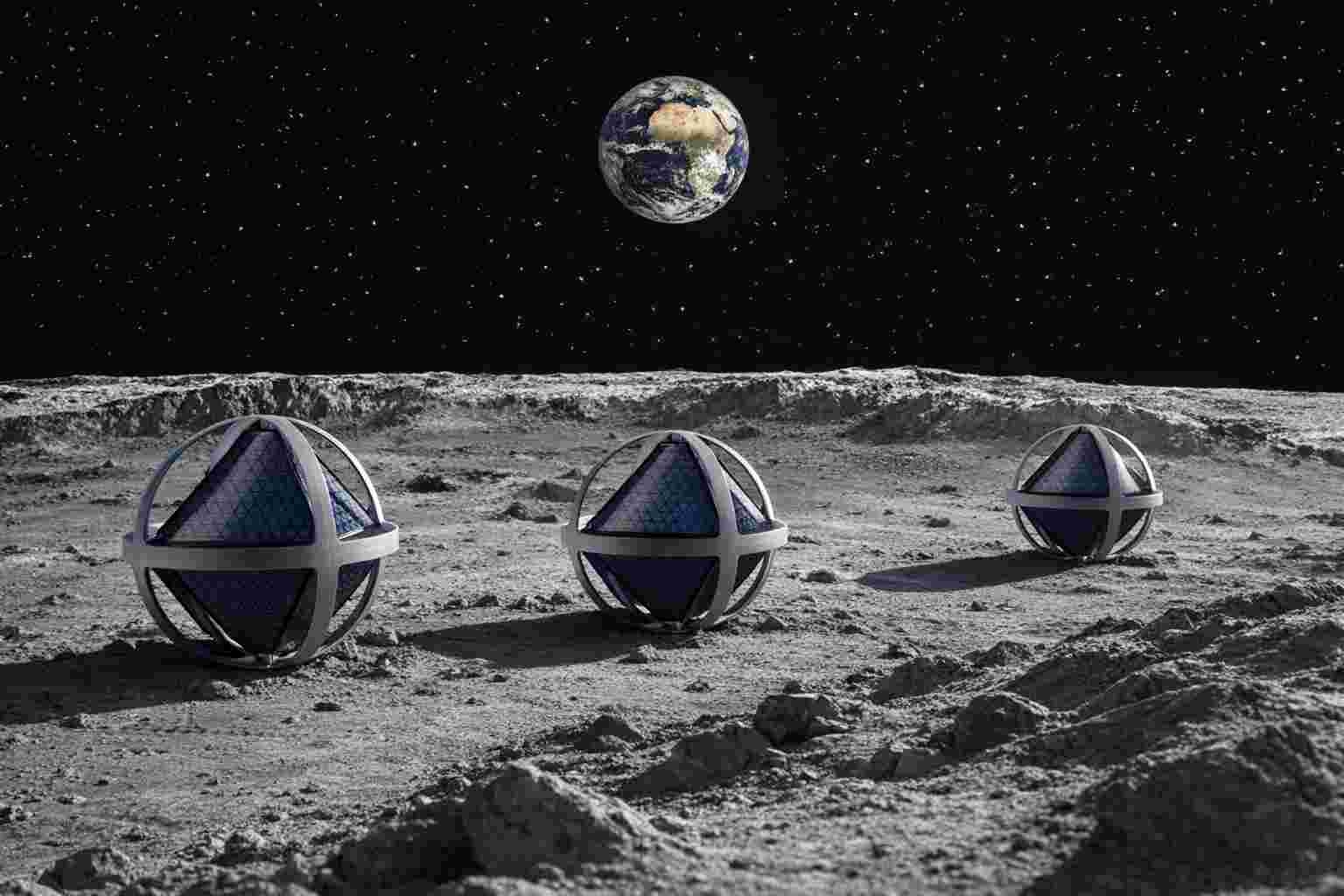
Image credit: Africa2Moon Project
Africa’s first space exploration mission is the Bounced African Low Lunar Sphere, or BALLS for short. It is to be flown on China’s Chang’e-8 Moon lander mission in 2029.
The Africa2Moon project consists of two missions:
- The first mission will deploy the technology demonstrator on the Moon in 2029. Three antennas constitute a radio astronomy array at the Moon’s south pole region.
- The second mission aims to deploy 55 antennas on the far side of the Moon, one for each nation in Africa.
Paperwork to hardware
Carla Mitchell is with the South African Radio Astronomy Observatory (SARAO), detailing the multi-year effort to move from paperwork to hardware at a NASA Solar System Exploration Research Virtual Institute (SSERVI) gathering.
Mitchell took part in a NASA Exploration Science Forum held this week at NASA’s Ames Research Center in Silicon Valley, California.
BALLS will enable observations below 20 megahertz (MHz) that are inaccessible from Earth due to ionospheric distortion and radio interference.

Image credit: Africa2Moon Project
The mission is led by the Foundation for Space Development Africa and a team of volunteers in collaboration with other organizations, Mitchell said, such as the South African National Space Agency, the National Institute for Theoretical and Computational Sciences, as well as institutions in Kenya, Ghana, Botswana and across the continent.
Pathfinder
Teams at Petrawell, Aerospace Systems Research Institute at the University of KwaZulu-Natal and Electronic Systems Laboratory at Stellenbosch University were involved in manufacturing the components of the structural and functional BALLS models. There were assembled in April 2026, to be delivered to China’s Chang’e-8 team for testing.
This three-BALLS array will serve as a pathfinder for future lunar technologies and radio astronomy experiments, Mitchell reported. They also serve as a technology demonstrator for the full Africa2Moon mission consisting of 55 antennas deployed on the far side of the Moon, she said. The night-time lunar farside is the most radio-quiet location in our vicinity.
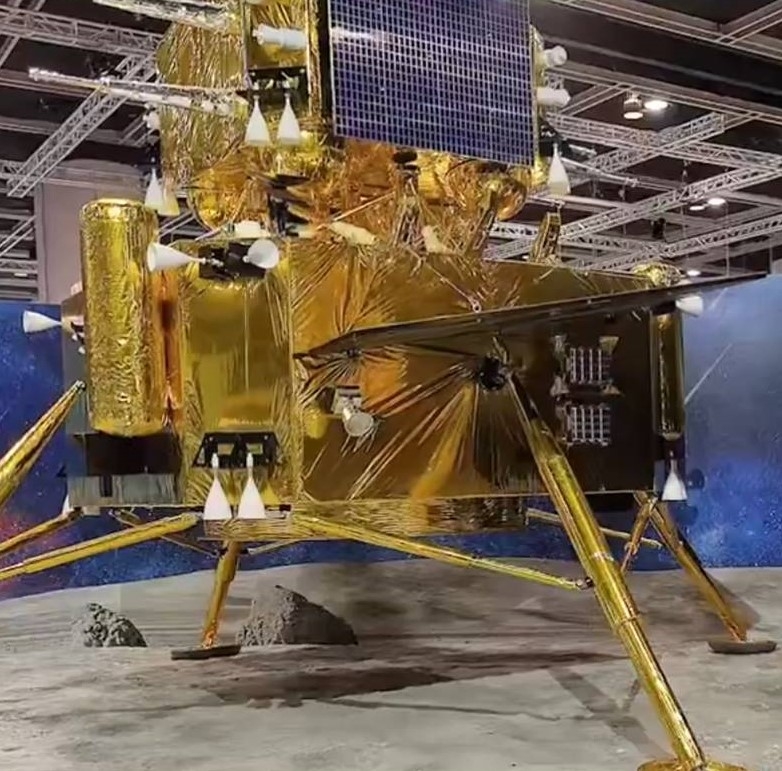
China Moon lander.
Image credit: Africa2Moon Project
Spaced out
Africa2Moon is viewed as a low cost, low mass, low frequency radio astronomy telescope array designed to operate on the lunar farside, perform new science, demonstrate novel African-built technology, said Mitchell, and inspire increased participation in space exploration and science, technology, engineering and mathematics by young people in Africa and the developing world.
The BALLS trio would be spaced out on the lunar surface, on the order of tens of meters apart.
Signals captured from the three BALLS are to be communicated to the Chinese lander and then relayed back to Earth for further processing.

Image credit: Africa2Moon Project
Study the early universe
Each of the BALLS comprises a spherical gyroscope-like frame made of interlocking rings, encasing two large triangular solar panel arrays with a grid-like surface texture.
The panels are oriented in opposite directions — one pointing upward and one downward — giving the structure a tetrahedron-like inner form.
When deployed from the Chinese Moon lander, BALLS are meant to detect very low-frequency radio waves from space and help scientists study the early universe.
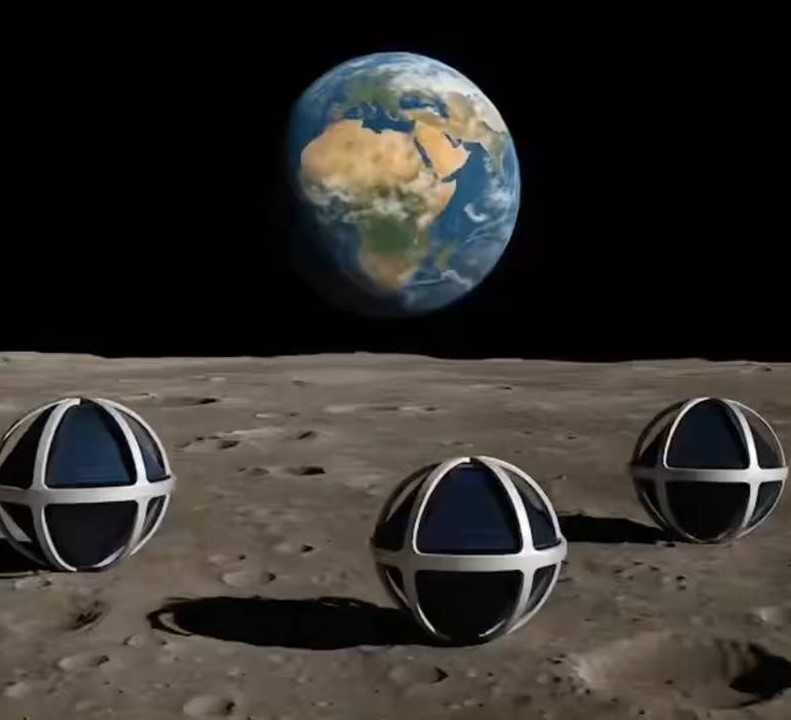
Image credit: Africa2Moon Project
 Posted in Space News

