 By
By  July 16th, 2026
Wait-a-Minute!
Image credit: Barbara David
In true wait-a-minute style, the half-century anniversary of NASA’s Viking missions to the Red Planet is a reflective moment in space, time, and astrobiology.
Is there life on Mars was the driving question for the program.
Now 50 years later, top-notch experts have contributed their thoughts in a special issue of Astrobiology, a SAGE publication, subdivided into three sections: Historical Viking, Transition from Viking to Future Astrobiology, and Future Mission Needs and Concepts.

Image credit: SAGE Publications
Evolutionary descendants
For example, J. William Schopf of the Department of Earth, Planetary and Space Sciences at the University of California, Los Angeles, contributes his “Insights into the Possible Composition of a Martian Biota.”
It seems reasonable to suggest that future searches for extant life on Mars, follow-ups to the pioneering Viking Mission of a half-century ago, Schopf explains, “should focus on predicted evolutionary descendants of microorganisms like those known from Earth’s early fossil record—at present, sulfuretum bacteria, photosynthetic bacteria, methane-producing archaea, and methane-consuming archaea.”
Where to look
Given Mars’ current seemingly inhospitable surface environment, Schopf continues, “such searches should not neglect subsurface settings, for example, regions beneath the polar ice caps, samples obtained by crustal drilling perhaps into regions harboring subsurface liquid water, and samples obtained from seeps, vents, and/or caves, if such features are identified.”
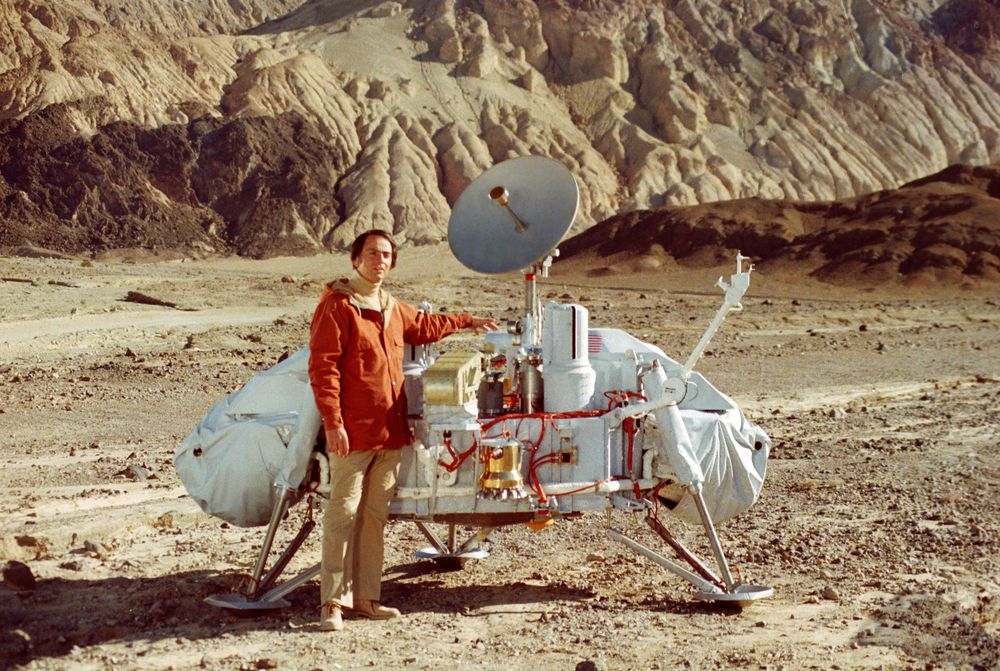
Carl Sagan stands by Viking Mars lander model in desert location. His call continues to ring true that “extraordinary claims need extraordinary evidence.”
Image credit: NASA
Indeed, if a diverse microbiota had once become established on Mars—as seems possible, judging from the similarities of the early environments of Mars and Earth—Schopf writes “it is difficult to imagine that the evolutionary descendants of such a biota would not have evolved in tandem with the slowly changing martian environment and survived to the present, as they have on Earth.”
Range of themes
Among a range of themes advanced in the journal:
- Viking at 50: Rediscovering the People and Ideas That Formed Astrobiology
- NASA Viking Mission: A Perspective of the Labeled Release Biological Experiment on Mars
- How Viking Changed Science Communication
- “20 Years Later: The ALH 84001 Debate in Context with Viking’s Results. Lessons Learned and Portals Opened”
To access this special issue, go to:
https://journals.sagepub.com/toc/asba/26/1_suppl

Wait-a-Minute!
Image credit: Barbara David
 Posted in Space News


I read through the Astrobiology special Viking issue. Not one paper addressed or referenced my 1997 book Mars The Living Planet which was the first time Gil Levin rendered in print that the LR experiment discovered living microorganisms in the soil of Mars. I find that very peculiar. Was the book too controversial? Too conspiratorial? If so, I got all the information it contains from interviews I did with Gil Levin himself. Recently Chemist Dr. Steven Benner has made some excellent insights on all this about a 50 year old Viking GCMS error that ended the search for extant life on Mars.
I notice Michael Meyer is the editor of the new Astrobiology issue. According to Dr. Gil Levin it Meyer who directly told him that extant life detection instruments would no longer be accepted on future Mars missions after Viking.So far, it looks like that has been true.
One of the interesting true stories in MTLP was the tale of MOx, a JPL fiber optic sensor experiment designed to identify the mysterious “oxidant(s)” that were “mimicking microbial life” in Gil’s LR instrument on Mars. MOx (Mars Oxidant Experiment) has a very interesting back story in MTLP in that the Russians offered to place Gil’s updated chiral LR on their ill-fated Mars 96 mission free. But, when NASA found out about it, they told Gil he couldn’t legally export his LR technology to Russia, which Gil thought was total crap. So instead of Gil’s updated chiral LR, NASA bought the space from Russia to send the JPL built MOx instrument. NASA astrobiologists Harold Klein and Chris McKay were both PI’s on the project and instrumental in implementation of MOx to the Russian 96 mission. Knowing full well that MOx replaced the chiral LR on Russia’s Mars 96 Gil began an in-house protest about it to the point where NASA finally offered Gil a position on the MOx team (to shut him up) as a co-experimenter. At this time it was NASA policy not to allow any type of life detection instrument to go to Mars. The question has always been why in Gil’s mind. Anyway as work proceeded on selecting the fiber optic chemical sensors MOx would use, Gil covertly and quietly talked Chris McKay into putting two fiber optic sensors that could render a chiral response. However, as work progressed on the final Mox configuration, Harold Klein discovered the chiral fiber optic sensors and a MOx team fight broke out where Klein accused Levin and McKay to trying to turn MOx into a life detection instrument against the new policy of NASA. In the end, MOx was sent to Russia with the chiral fiber sensors included. Gil was happily out in Chesapeake Bay in his yacht listening to the radio the day the Russian Mars 96 probe was launched. However, as it almost reached Earth orbit a catastrophic explosion occurred onboard and Mars 96 plunged into the Pacific ocean although debris from it including two canisters of plutonium 238 (designed to survive atmospheric reentry) came down over South America and were thought to have come down in somewhere in Bolivia (although no one has found them to date?). It almost caused an international incident and President Clinton was prompted to address the media about it to calm things down and assure everyone the plutonium canisters were being searched for. The worry was that any terrorists finding the Mars 96 plutonium canisters could use it to make a dirty bomb by grinding it up and spreading it out over any city.
It is interesting little stories like this which pepper Mars The Living Planet, that give the reader a perspective from the Gil Levin’s point of view and offer perhaps a clue as to why NASA was so against sending other life detection experiments to Mars. Has NASA known all along about the false GCMS narrative that Steven Benner et al so lavishly describes in their 2025 Astrobiology paper? While Steven’s narrative correctly mentions this 50 years after the fact, he does not fully explain why life detection instruments were “forbidden” (Gil’s words) by NASA at this point and the story of the “chiral MOx” on Mars 96 is seldom ever mentioned by anyone in the media. If you don’t believe it you can ask NASA/Ames Astrobiologist Dr.Chris McKay his version of the MOx story.
Sincerely,
Barry E. DiGregorio – Author of Mars The Living Planet