 By
By  July 12th, 2026
Image credit: Reflect Orbital
Last week, the Federal Communications Commission (FCC) granted Reflect Orbital a license to launch into Earth orbit its demonstration satellite, Eärendil-1.
Reflect Orbital has manifested Eärendil-1 on a SpaceX rideshare mission, currently scheduled to launch this year.
“Our inaugural mission will be a key moment in our journey, providing the opportunity to validate our technology and the safeguards we have developed, and to collect real-world data to inform our future plans,” explains Reflect Orbital.
Targeted areas
Reflect Orbital is exploring a new way to extend the utility of sunlight: reflecting sunlight from orbit to precise, targeted areas on Earth.
The FCC approval is only for one satellite, dubbed Eärendil-1 – a steerable thin-film reflector measuring some 60 feet by 60 feet.
“Our goal is to deliver light and energy to help make existing solar infrastructure more useful beyond the hours when direct sunlight is available, reduce fossil-fuel dependence, increase energy resilience, and support critical operations,” explains Reflect Orbital.
“We’re grateful to the FCC for recognizing our responsible approach to development and deployment, and we’re so excited to have the opportunity to start demonstrating the significant benefits of our technology to the world,” the space group adds.

Image credit: Reflect Orbital
Long-term vision
The long-term vision of Reflect Orbital is to operate more than 50,000 satellites by 2035.
What’s possible with a spot of light? According to Reflect Orbital:
Response: Illuminate disaster zones and search-and-rescue missions.
Industrial: Extend working hours, improve safety, light remote sites.
Agriculture: Tailor growth cycles, extend seasons, boost yields.
Civilizational: Replace streetlights, reduce light pollution, enhance urban life.
Defense: Uninterrupted solar power and lighting for critical defense operations.
Experience: Unforgettable nighttime experiences for events and public spaces.
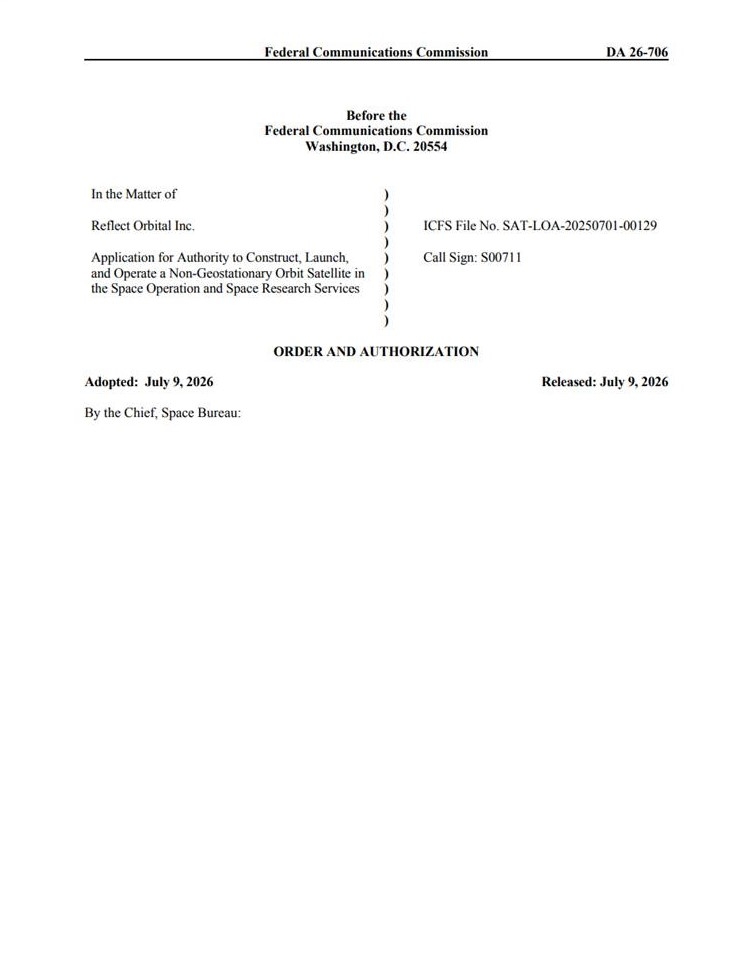
Image credit: FCC
Public interest
“After review of the record, we find grant of Reflect Orbital’s application, with conditions, serves the public interest, notes the FCC.
“Earendil-1 is a single satellite and a limited, short-duration technology test exercise designed to evaluate the feasibility of Reflect Orbital’s proposed concept and to identify any challenges associated with future iterations of the technology,” explains the FCC. “The results of this single-satellite mission will inform whether the concept is viable and will assist the company, its prospective customers, and other stakeholders in assessing any future largerscale deployment.”
Go to this FCC document that provides the go-ahead for the test satellite launch at:
https://docs.fcc.gov/public/attachments/DA-26-706A1.pdf
For more information on Reflect Orbital’s plans at:
 Posted in Space News

