 By
By  June 22nd, 2026

Image credit: Michael Carroll
GOLDEN, Colorado – Scientists are engaged in research with an eye toward transforming the cold climes of Mars into a far more humane place for Earthlings in the future.
One notion proposed is dispersion of an aerosol meant to motivate the warming of Mars’s atmosphere. The idea is projected to be a first step toward terraforming the Red Planet.
Emerging recently as a new field of study is “applied astrobiology” – to appraise what would be needed to create sustainable habitats and biospheres beyond Earth.
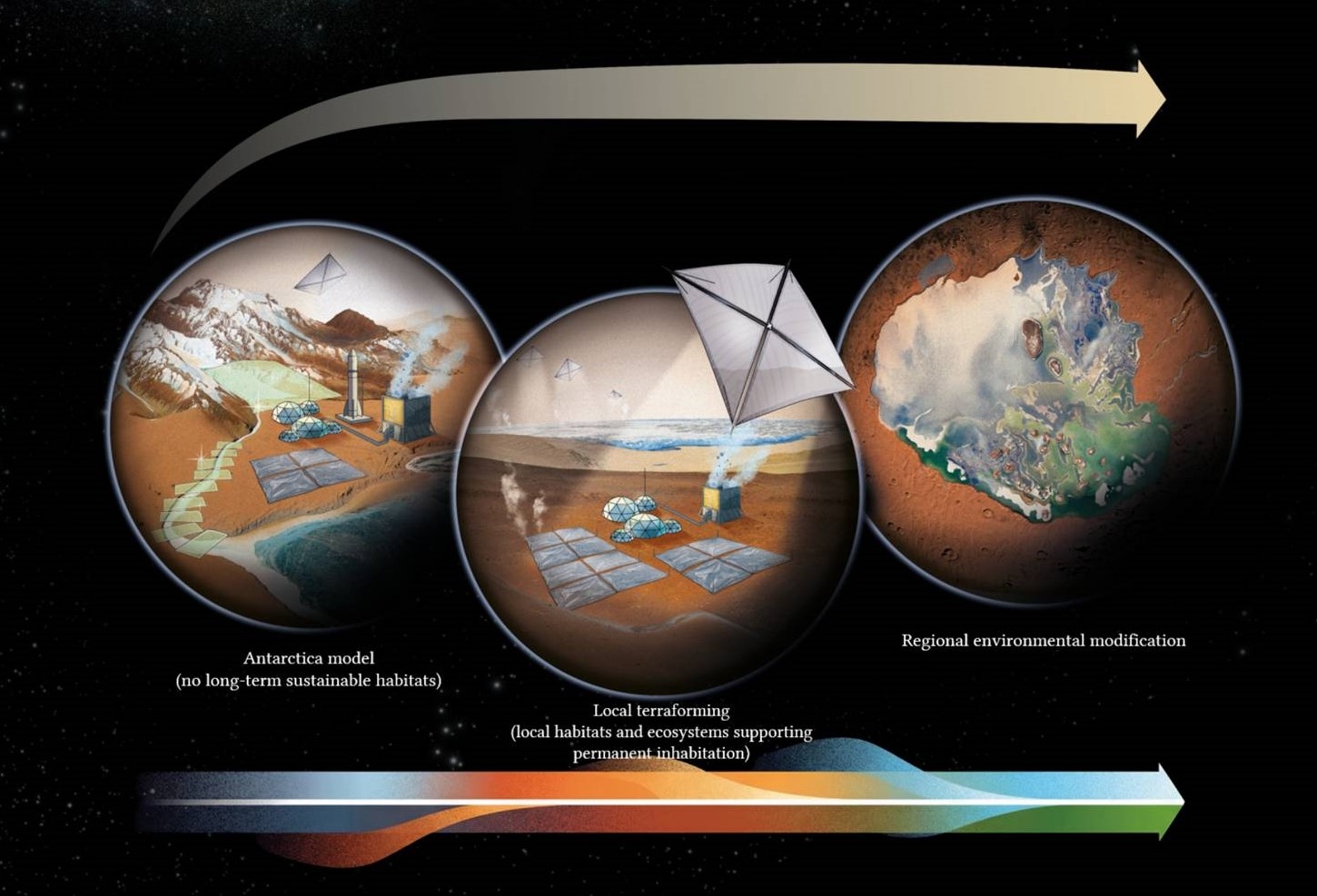
Artistic view shows potential choices for the scale of human involvement in the future of Mars. Early on, warming occurs only close to human bases. Solid-state greenhouse membranes harvest liquid water from subsurface ice. Orbiting reflectors augment sunlight, and a pilot factory makes engineered aerosols.
(Image credit: E. S. Kite et al.)
“Relatively modest research investments would keep open the option of extending life beyond Earth as Mars’ scientific exploration continues,” explains a leading researcher.
A blueprint for assessing the viability of warming the Red Planet has been drawn up by scientists, outlining what it might take to make Mars a place in space where life can thrive.
For more details, go to my new Space.com story – “Could we actually terraform Mars? Scientists are trying to find out” – at:
 Posted in Space News

