 By
By  June 21st, 2026
Image credit: NASA/Inside Outer Space screengrab
New studies have helped identify what the Moon’s South Pole-Aitken (SPA) basin has to offer – a massive impact structure on the Moon’s far side.
Regions near SPA are also potential landing sites for NASA’s Artemis missions.
Rare opportunity
SPA is considered one of the Moon’s oldest surviving features, providing insight into the early solar system.
“The basin offers scientists a rare opportunity to study the Moon’s earliest history,” said William Bottke, director of the Center for Lunar Origin and Evolution (CLOE). “The collision struck the lunar surface with such force that it may have excavated material from deep inside the Moon, including portions of the lunar mantle.”
CLOE is confab of Southwest Research Institute (SwRI) experts in NASA’s Solar System Exploration Research Virtual Institute. Bottke is also executive director of SwRI’s Science Directorate in Boulder, Colorado.

Image credit: NASA
Excavated deposits
Simulation modeling suggests the SPA impactor was not a simple, uniform body but a differentiated object with an iron core surrounded by rock, such as a small protoplanet or differentiated asteroid. Impacts within the SPA basin appear to have excavated underlying mantle deposits.
Those impacts hurled some of this material to the surface, where it could be readily sampled by robotic rovers or astronauts during future missions, explains a SwRI release.
Powerful roadmap
“The combination of impact and gravity modeling gives us a powerful roadmap,” Bottke said. “It tells us not just how SPA formed, but where to look for the rocks that can answer some of our biggest questions about the Moon’s origin and evolution.”
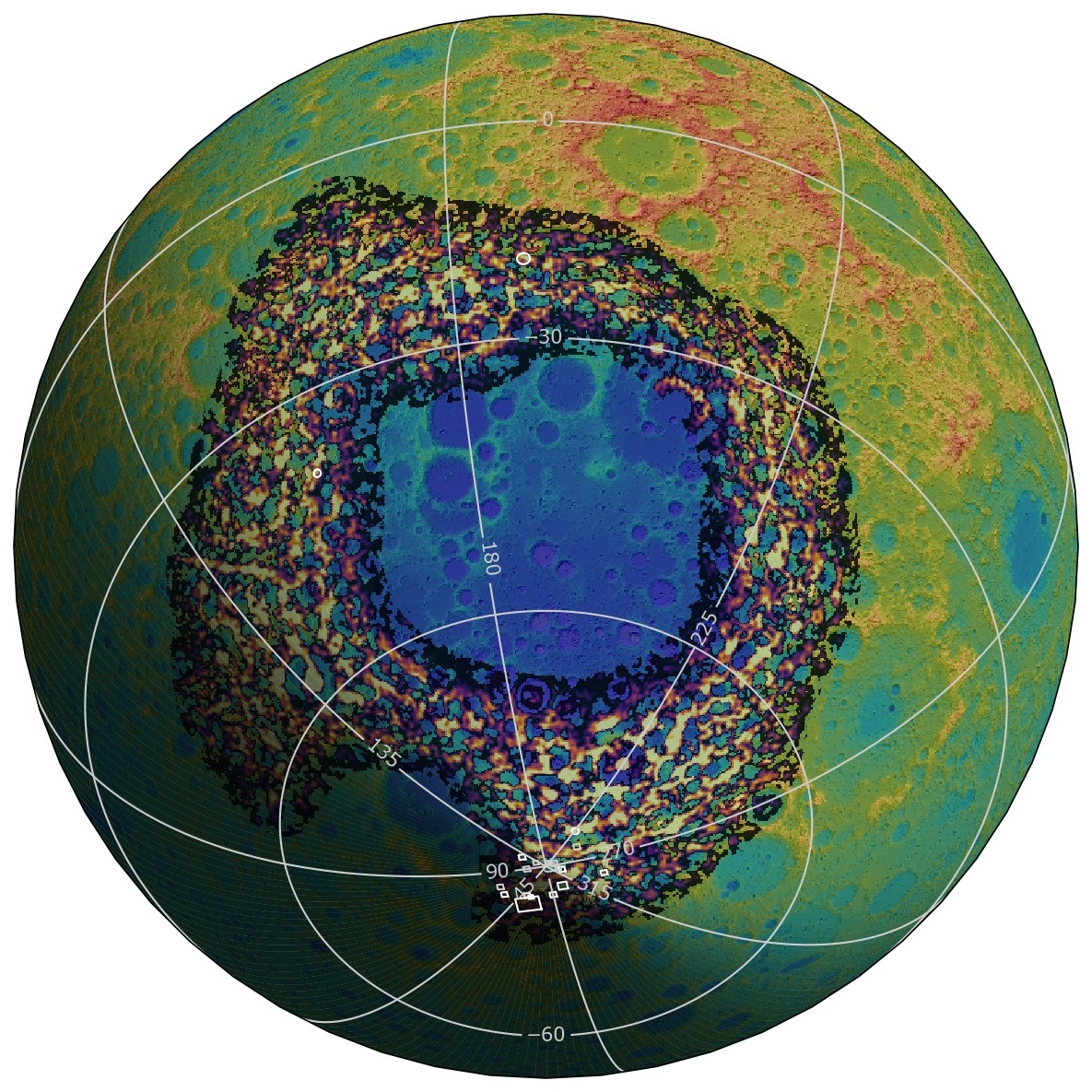
A large impactor created the ancient South Pole-Aitken (SPA) basin (blue), a massive structure on the Moon’s far side. Two complementary studies determined that SPA’s surrounding area contains mantle-derived rocks (orange and black), offering information about the interior of the Moon and its earliest history. Proposed landing sites (white squares) for upcoming Artemis missions to the lunar south pole lie within the region, allowing astronauts access to study these materials.
Credit:
Courtesy of NASA/JPL-Caltech/Goddard/Gabe Gowman-U. Arizona. Data from NASA’s GRAIL mission and NASA’s Lunar Reconnaissance Orbiter Laser Altimeter.
That modeling tells us not just how SPA formed, Bottke concludes, “but where to look for the rocks that can answer some of our biggest questions about the Moon’s origin and evolution.”
Earlier theories suggested that the deepest ejecta might be confined to parts of the basin far from proposed south polar exploration zones.
However, the new simulations and gravity modeling work indicate that key deposits of mantle-bearing ejecta may blanket portions of the lunar south polar region – including areas that Artemis astronauts could visit for field studies.
Gravity data
In the companion gravity study, researchers analyzed how SPA ejecta is distributed beneath and around the basin. That research team compared high-resolution gravity data with models that include both crustal and mantle material, determining that SPA likely contains substantial amounts of mantle-derived rocks within its interior and mixed into the ejecta blanket surrounding the basin.
“The precise distribution of mantle material has been a big unknown,” said Gabriel Gowman of the University of Arizona, lead author of the gravity-based study.
“Our models indicate that the SPA impact ejected enough deep material to form a significant deposit that should still be accessible today,” Gowman reports.

Nine candidate landing regions for NASA’s Artemis III mission The background image of the lunar South Pole terrain within the nine regions is a mosaic of LRO (Lunar Reconnaissance Orbiter) WAC (Wide Angle Camera) images.
Image credit: NASA
Most importantly, Gowman adds, some of that material at a trace level may exist in regions being considered for the Artemis landings.
Go to papers
For further information, go to these research papers:
“A southward differentiated impactor forms the tapered shape of the South Pole-Aitken impact basin on the Moon” at:
https://www.science.org/doi/10.1126/sciadv.aea1984
The companion study on the gravity and ejecta structure of the SPA basin — “Gravity Mapping of Lunar Mantle Material in South Pole-Aitken Basin Ejecta” – is available at:
https://agupubs.onlinelibrary.wiley.com/doi/10.1029/2026JE009665
 Posted in Space News

