 By
By  June 6th, 2026
Image credit: SpaceX
Question: Who Owns the Most Satellites?
SpaceX leads all operators. Commercial networks now outscale legacy public and state-backed space operators by about 12-to-1.
Satellites are becoming the backbone of the modern space economy. From broadband internet to Earth observation, orbital infrastructure now supports industries far beyond aerospace.
Those are among key takeaways from Cody Good at Visual Capitalist using data from AEI Space Data Navigator and in partnership with Global X Canada.
Ranking order
A snapshot of space assets was taken on May 12th showing SpaceX dominates the global satellite count with 10,262 operational satellites at that time. That’s more than 16 times OneWeb’s 632 satellites, the next-largest named operator.
Rank Satellite Operator Fleet Count
1 SpaceX 10,262
2 OneWeb 632
3 National Reconnaissance Office 285
4 US Military 244
5 Chinese Military 168
6 Planet Lab 144
7 Russian Military 107
8 NASA 90
9 Iridium 80
10 Globalstar 26
— Other 3,409
Source: AEI Space Data Navigator.
According to Good, “the ranking shows how quickly private networks have scaled since the beginning of the space race. Public organizations like NASA and national militaries now operate a minor portion with just 894 satellites among the named owners in the dataset.”

Credit: SpaceX/Starlink
Starlink: a defining example
SpaceX operates Starlink, the largest satellite fleet ever deployed. Its scale alone accounts for about two-thirds of the 15,447 satellites shown in the dataset.
“Instead of launching a handful of high-value satellites,” says Good, “Starlink relies on scale. As a result, the network has become a defining example of commercial orbital infrastructure.”
“The gap between SpaceX and legacy operators signals a major turning point,” Good notes. “Businesses now own and operate satellite networks at a scale once reserved for governments. This matters because satellites are no longer niche government research assets. Instead, they are becoming critical infrastructure for connectivity, data, and national resilience.”

Image credit: Planet Labs
Investment theme
As for investing in space, as commercial networks grow, orbital infrastructure may become a larger investment theme. “Satellites, launch systems, and space-enabled services all sit within this expanding ecosystem,” Good says. “The space economy is already moving into logistics, agriculture, defense, and communications. As a result, investors may increasingly look for exposure to companies enabling these trends.”
Investors looking to learn more can explore the Global X Space Tech Index ETF (ORBX), which provides exposure to companies at the forefront of the space economy.
Go to:
https://www.globalxetfs.com/funds/ORBX
Check out Visual Capitalist at:
https://www.visualcapitalist.com/
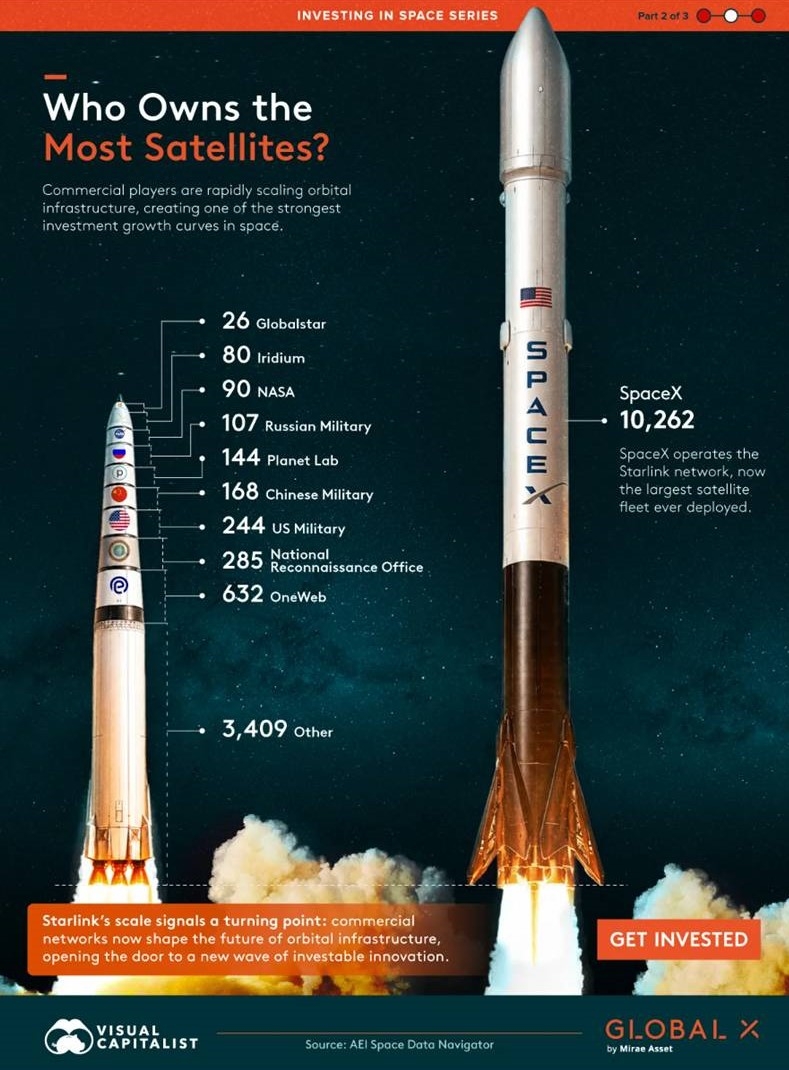
Image credit: Visual Capitalist
 Posted in Space News

