 By
By  March 31st, 2026
Image credit: CCTV/Inside Outer Space screengrab
The first Kinetica-2 launch vehicle (LiJian-2 Y1) was launched from the “Dongfeng Commercial Space Innovation Experimental Zone” at the Jiuquan Satellite Launch Center, China, on March 30, 2026.
According to official sources, the mission “The Global Capital of Textile” successfully placed into their target orbits: the Qingzhou prototype cargo spacecraft, also known as the New March 01 Technology Demonstration Satellite, the New March 02 Satellite, and TS 01 Educational Satellite.
According to CAS Space, Kinetica-2 is 53 meters tall, has a 4.2-metre payload fairing, and is “capable of delivering 8 metric tons to a 500 km Sun-Synchronous Orbit (SSO) or 12 metric tons to a 200 km Low Earth Orbit (LEO)”.
Milestone
Lian Jie, deputy chief designer of Lijian-2 Y1 carrier rocket, told China Central Television (CCTV): “In the future, the Lijian-2 Y1 carrier rocket will realize our ‘cluster one-piece recovery.’ By that I mean that traditionally, we recover the core stage of the rocket, but now, we fasten the boosters together with the rocket’s core stage as one piece,” said Lian.
Saving the booster separations, this approach also helps reduce risks that may occur during the rocket’s ascent phase, said Lian.
“Saving the step of booster separation, our Lijian-2 Y1 carrier rocket is highly reliable in its powered flight phase, because we reduce the number of times of separations,” Lian added.
Lian said the successful launch of the Lijian-2 Y1 carrier rocket marks a milestone in China’s commercial rocket development.
Cargo spacecraft test
The prototype for China’s next-generation, lower-cost cargo spacecraft, is in Earth orbit following its launch atop the Lijian-2 Y1 carrier rocket on Monday.

Image credit: CCTV/Inside Outer Space screengrab
The Qingzhou Cargo Spacecraft Test Vehicle is a prelude to the launch of a full model, designed as a lightweight, agile and cost-effective freighter to resupply China’s Tiangong Space Station.
The prototype spacecraft now in orbit weighs 4.2 tons. It carries 27 projects with a total payload of 1.02 tons, and will conduct in-orbit tests at altitudes ranging from 125 miles to over 370 miles (200 to 600 kilometers).
Light Ship
Qingzhou translates to “light ship” and was developed by the Innovation Academy for Microsatellites of the Chinese Academy of Sciences.
According to CCTV, the Qingzhou test vehicle’s structure features a main pressurized module for crew supplies and science experiments, and an unpressurized aft section capable of carrying external payloads and space exposure experiments.
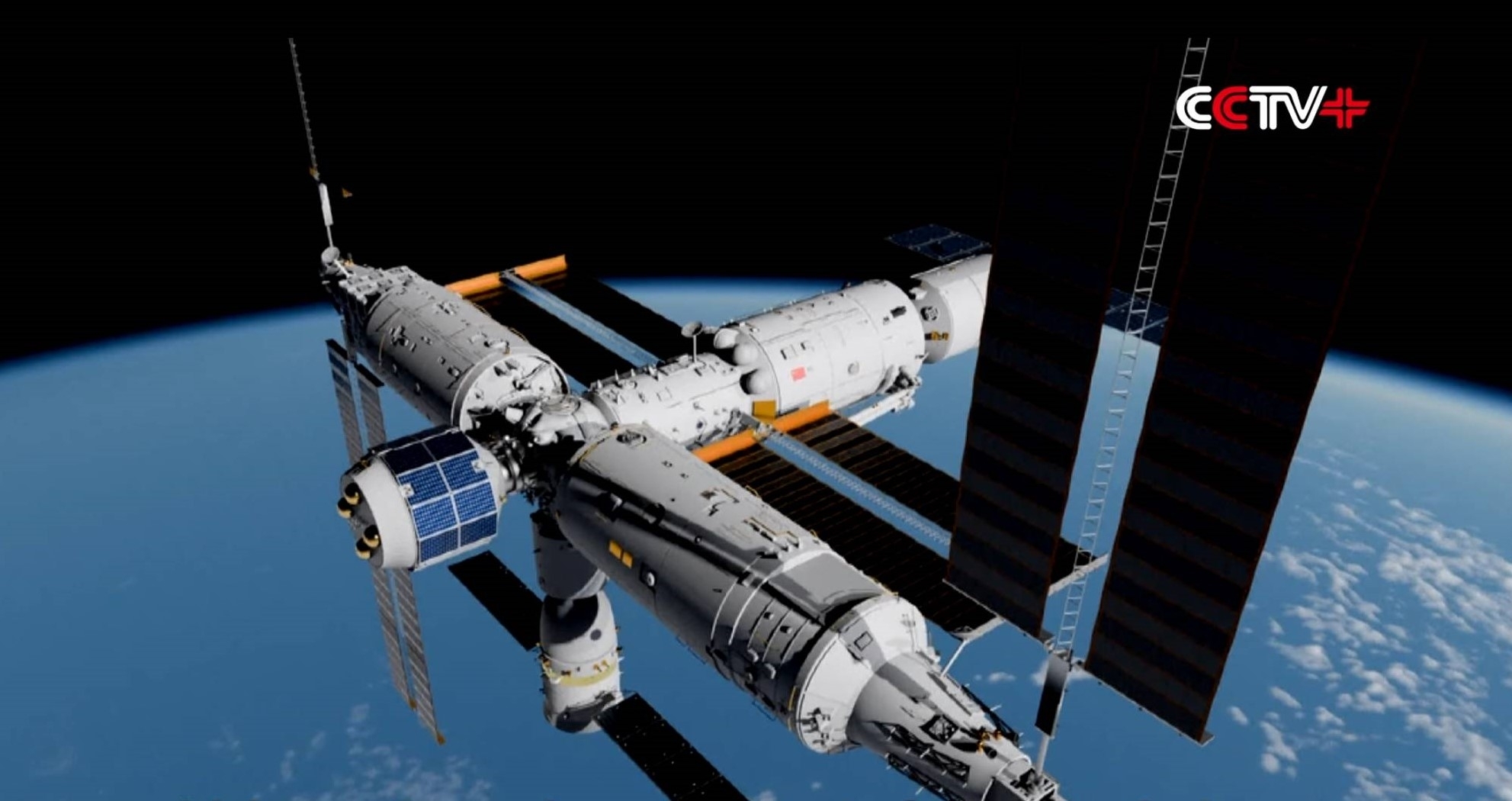
Artwork depicts Qingzhou cargo spacecraft (left) docked to Chinese space station, leading to growth of the orbiting outpost.
Image credit: CCTV/Inside Outer Space screengrab
The vehicle’s available volume for cargo is 27 cubic meters. For the storage of special supplies, the spacecraft is equipped with five modular “space refrigerators” — temperature-controlled containers each with a volume of 60 liters.
CCTV adds that Qingzhou is seen as a lower-cost complement to China’s existing Tianzhou cargo spacecraft, which has been carrying out delivery missions to the Tiangong Space Station.
Go to these CCTV videos at:
https://www.facebook.com/reel/1710498954059747
https://www.facebook.com/reel/1469872668196092
Also, go to this CAS Space (Beijing Zhongke Aerospace Exploration Technology Co., Ltd.) video at:
https://youtu.be/ZieEGm6jDjg?list=PLpGTA7wMEDFjz0Zx93ifOsi92FwylSAS3
 Posted in Space News

