 By
By  February 8th, 2026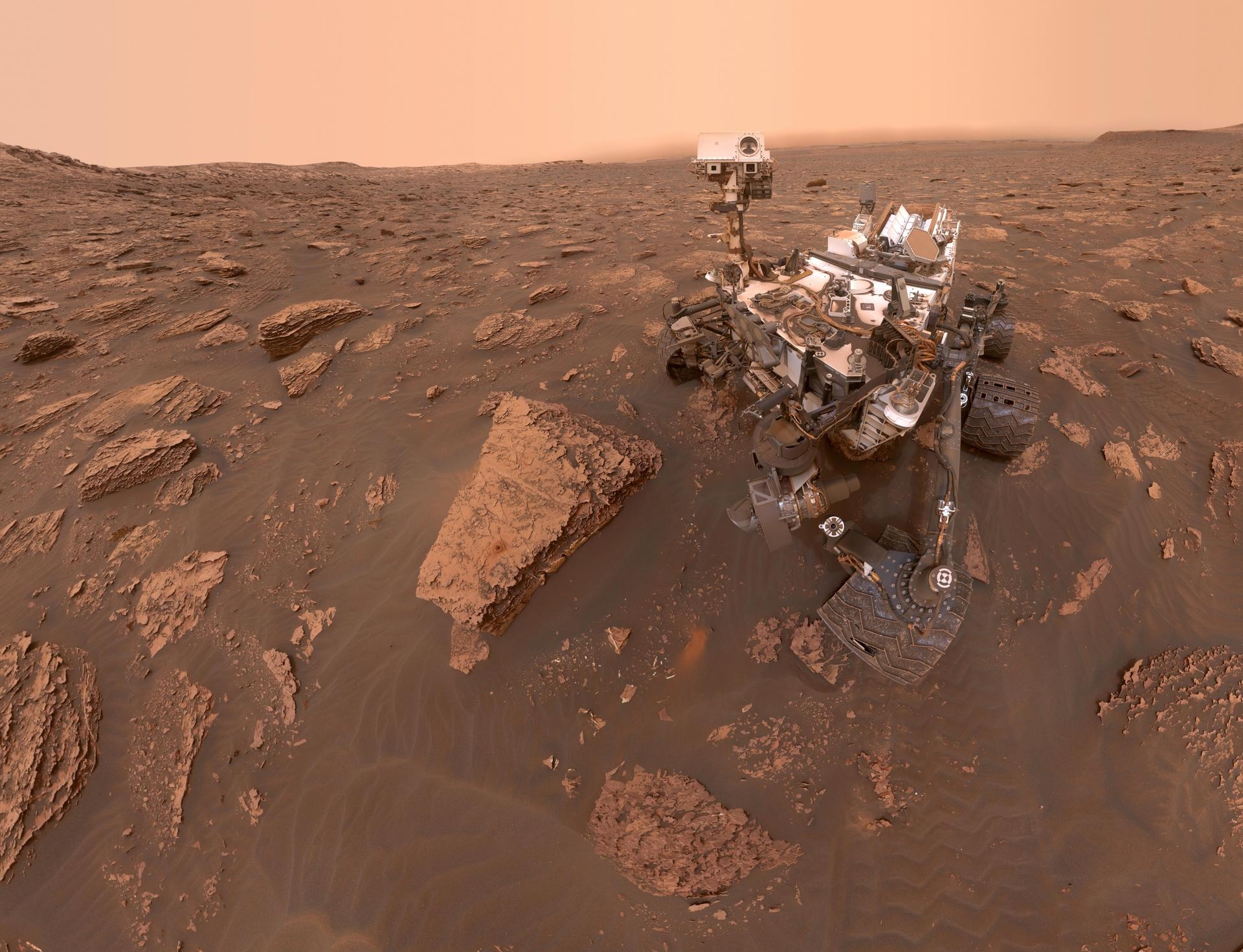
Curiosity Mars rover on the prowl.
Image credit: NASA
In the journal Astrobiology, researchers report on the prospect that NASA’s Curiosity Mars rover may have found evidence for life on the Red Planet.
Curiosity’s Sample Analysis at Mars (SAM) instrument analyzed the “Cumberland” rock sample back in May 2013.
Investigators now say that non-biological sources could not fully account for what SAM found in that Curiosity sample.
Fatty acids
The new work is led by Alexander Pavlov within the Solar System Exploration Division of NASA’s Goddard Space Flight Center in Greenbelt, Maryland.
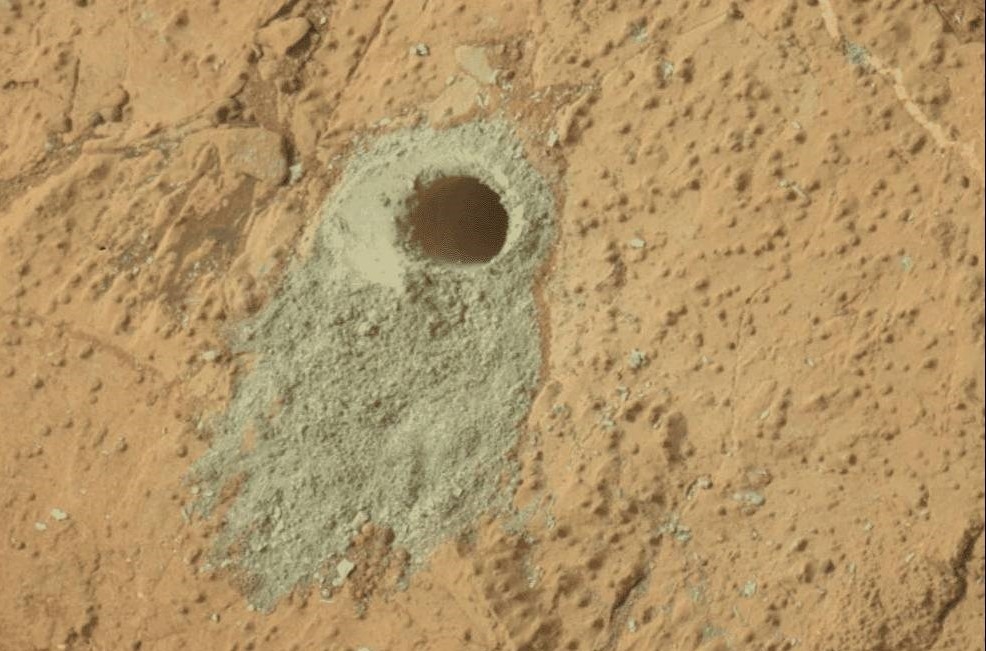
The Curiosity landing site at the base of Aeolis Mons (Mount Sharp) at Gale crater NASA’s Curiosity rover drilled into this rock target, “Cumberland,” during the 279th Martian day, or sol, of the rover’s work on Mars (May 19, 2013) and collected a powdered sample of material from the rock’s interior.
Image credit: NASA/JPL-Caltech/MSSS
Reporting on Feb. 4 in the journal Astrobiology, in revisiting the SAM data, Pavlov and colleagues say it is reasonable to hypothesize that living things could have formed organic compounds detected. They conjecture that they could be fragments of fatty acids preserved in the ancient mudstone in Gale Crater.
Here on Earth, fatty acids are produced mostly by life, though they can be made through geologic processes, too.
Rewind the clock
“To reach their conclusion, scientists combined lab radiation experiments, mathematical modeling, and Curiosity data to ‘rewind the clock’ about 80 million years — the length of time the rock would have been exposed on the Martian surface,” explains a NASA blog on the work.
“This allowed them to estimate how much organic material would have been present before being destroyed by long-term exposure to cosmic radiation: far more than typical non-biological processes could produce,” a NASA blog reports.

Image credit: Utah Geological Survey
“The team says more study is needed to better understand how quickly organic molecules break down in Mars-like rock under Mars-like conditions — and before any conclusions can be reached about the absence or presence of life,” the blog adds.
Mudstone makeup
The Astrobiology report – “Does the Measured Abundance Suggest a Biological Origin for the Ancient Alkanes Preserved in a Martian Mudstone?” — has led the scientists to estimate that the Cumberland mudstone conservatively contained 120–7700 ppm of long-chain alkanes and/or fatty acids before exposure to ionizing radiation.
“We argue that such high concentrations of long-chain alkanes are inconsistent with a few known abiotic sources of organic molecules on ancient Mars, namely delivery of organics by IDPs [interplanetary dust particles] and meteorites, atmospheric fallout and deposition from photochemical haze, and organic production from serpentinization and Fischer–Tropsch reactions on the Red Planet.
The Fischer–Tropsch process is a collection of chemical reactions that converts a mixture of carbon monoxide and hydrogen, known as syngas, into liquid hydrocarbons.

The Sample Analysis at Mars (SAM) instrument onboard Curiosity analyzes samples of material collected by the rover’s arm.
Credit: NASA-GSFC
Absence or presence of life?
The team says more study is needed to better understand how quickly organic molecules break down in Mars-like rock under Mars-like conditions — and before any conclusions can be reached about the absence or presence of life.
In the paper, Pavlov and colleagues note: “We agree with Carl Sagan’s claim that extraordinary claims require extraordinary evidence and understand that any purported detection of life on Mars will necessarily be met with intense scrutiny. In addition, in practice with established norms in the field of astrobiology, we note that the certainty of a life detection beyond Earth will require multiple lines of evidence.”
To that end, Pavlov and his fellow researchers recommend experimental studies that determine the radiolytic degradation rates of kerogens, alkanes, and fatty acids in Cumberland-like Mars analogs under Mars-like conditions.
To access the research paper — “Does the Measured Abundance Suggest a Biological Origin for the Ancient Alkanes Preserved in a Martian Mudstone?” – go to:
 Posted in Space News

