 By
By  December 17th, 2025
Artist’s concept shows Blue Origin’s Blue Moon Mark 1 lander and NASA’s VIPER (Volatiles Investigating Polar Exploration Rover) on the lunar surface.
Image credit: Blue Origin
A few months ago, NASA announced that the Volatiles Investigating Polar Exploration Rover (VIPER) has been green-lighted to set down at the Moon’s south pole region. The space agency awarded Blue Origin a CLPS (Commercial Lunar Payload Services) task order to deliver the Moon machinery.
Blue Moon’s MK1 lander, which is in production, would be used to deploy VIPER.
Headed for a late 2027 landing, NASA’s VIPER is designed to search for volatile resources, such as ice, on the lunar surface and gather science data to support long-term human exploration of the Moon.
Major milestone
VIPER’s lunar journey has reached a major milestone via the Sandia National Laboratories in Albuquerque, New Mexico.

Testing of the VIPER rover at Sandia’s Superfuge
Image credit: Sandia/Craig Fritz
Sandia’s Large Centrifuge, or Superfuge, has been used to help certify VIPER for its mission, validating that the rover’s structure can undergo a launch environment.
The 29-foot underground centrifuge can subject test items to inertial forces up to 300 Gs — 300 times the force of the Earth’s gravity — while integrating vibration, spin, thermal and shock environments simultaneously, mimicking flight conditions.
The Superfuge team spent months preparing for the NASA tests, explains a Sandia press statement.
Testing process
“This is a 1,000-pound article and it has to be oriented in a number of ways throughout the testing process,” said Ben Quasius, VIPER lead stress analyst.
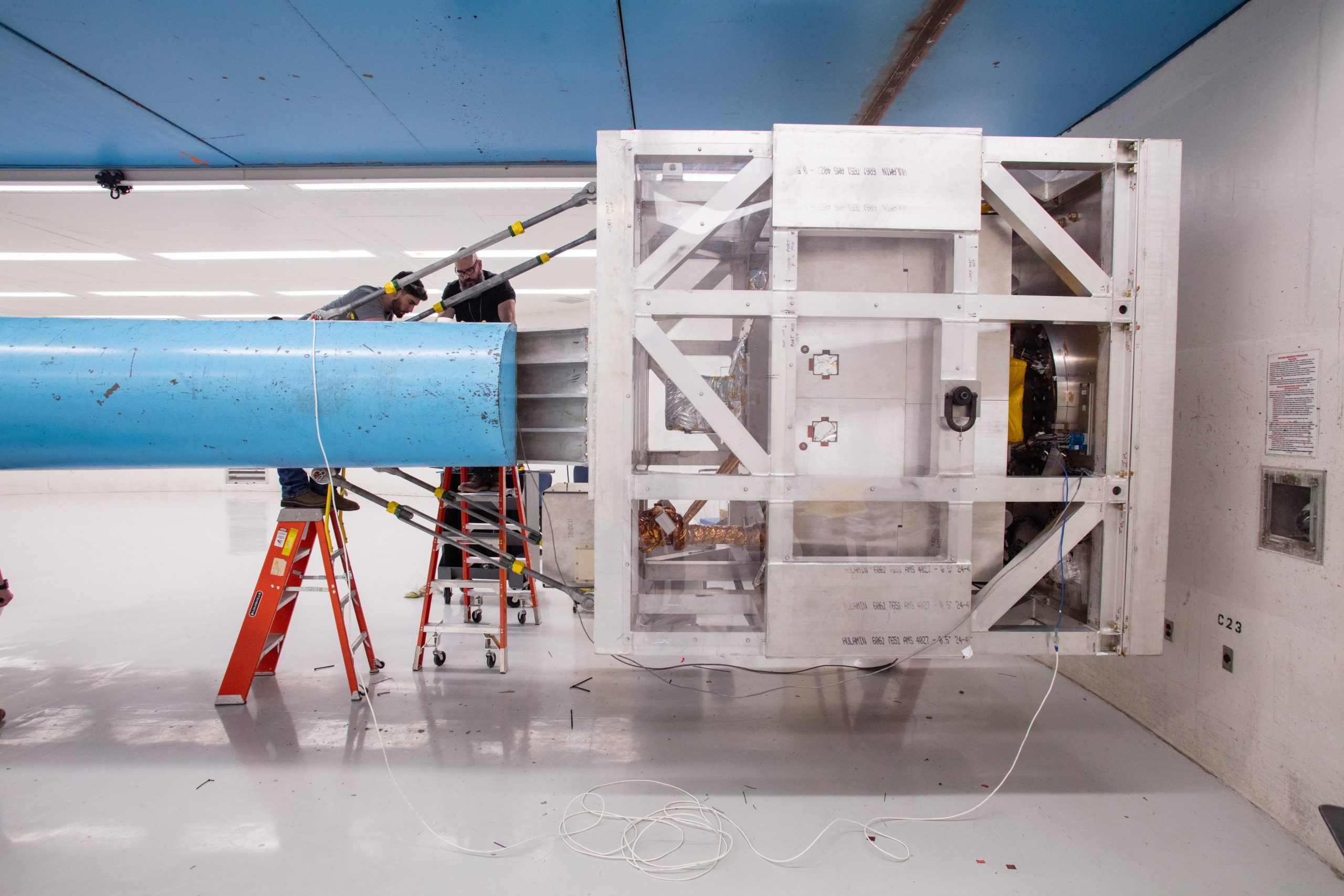
VIPER rover is suspended in a cage at the end of the Superfuge arm at Sandia National Laboratories.
Image credit: Sandia/Dave Linneman
“In many cases we would do a static qualification test where we use pistons to push on certain locations of the article to test flex of the body,” Quasius added, “but there are sensitive things in the way. You have solar panels in prime locations and a drill in the middle that can’t be compromised during flight.”
On the VIPER rover, there were 48 different points of data to be collected and analyzed by the Sandia testing.
Concentrations of water
VIPER is equipped with three scientific instruments: a mass spectrometer, a near-infrared spectrometer and a neutron spectrometer. An onboard drill is capable of reaching one meter beneath the lunar surface to pull up samples of any existing water remnants.
The rover’s mission is to investigate the Moon’s south pole, an expanse of real estate where permanently shadowed craters are believed to contain large concentrations of water. Such a resource could be transformed into oxygen, drinkable water by future crews, as well as rocket fuel.
 Posted in Space News

