 By
By  December 10th, 2025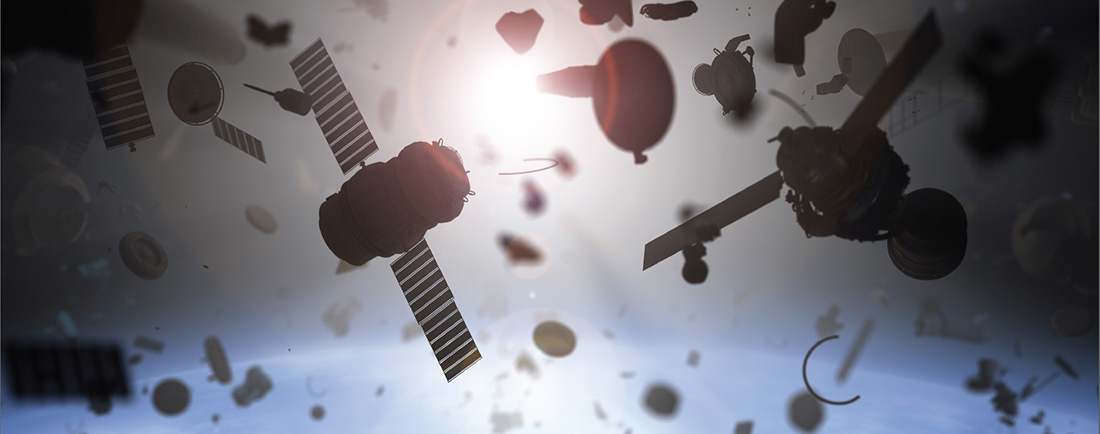
Credit: The Aerospace Corporation/CORDS
A university team has found that small orbital debris hits can emit radio bursts when they collide or approach each other in space. The signal can be detected with large radio dishes on Earth, as well as satellites in orbit.
One upshot of the research is to help monitor the onset of the “Kessler syndrome”- a chain reaction of collisions in space that, in turn, generates more space debris. That situation makes it far harder for satellite operators to navigate around and avoid hazardous clouds of high-speed rubble.

Data useful for gauging tiny space debris is being gleaned from the radio frequency sensor onboard the U.S. Defense Department’s STPSat-6 in geostationary orbit.
Image credit: Northrop Grumman
The work on using hypervelocity impact signals to track and characterize space debris is being led by Nilton Rennó, a professor of climate and space sciences and engineering at the University of Michigan in Ann Arbor.
For more details, go to my new SpaceNews story – “Colliding space debris produces radio bursts, raising prospect of ‘debris weather’ alerts” – at:
 Posted in Space News

