 By
By  August 24th, 2025
X-37B (OTV-8) military space plane being readied for flight, with its service module not shown in photo.
Image credit: U.S. Air Force/U.S. Space Force
That secretive U.S. Space Force X-37B space plane in Earth orbit is under surveillance by amateur satellite trackers.
The Orbital Test Vehicle-8 (OTV-8), also labeled as USSF-36, was lofted on August 21 and has deployed in Earth orbit a payload dubbed Limasat, probably ejected from the space plane’s service module.
That’s the take from sky sleuth Marco Langbroek in the Netherlands.
The craft is in a preliminary orbit of 327 x 334 kilometers, in a 49.5 degree inclined orbit, Langbroek posted on his SatTrackCam Leiden website.

OTV-6 was the first mission to introduce a service module that expanded the capabilities of the spacecraft.
Image credit: Staff Sgt. Adam Shanks
Observables
“This morning (early 24 August 2025) weather finally cooperated and I managed to observe both of the USSF-36 payloads, two days after launch: the X-37B spaceplane OTV-8 (2025-183A) and LIMASAT (2025-183B)” Langbroek explains. “Limasat was about half a minute in front of OTV-8.”
Also posted by Langbroek is footage of both objects taken during the overhead pass. “The footage was obtained from my home in Leiden, the Netherlands, using a WATEC 902H2 Supreme camera with a Samyang 1.4/85 mm lens filming at 25 frames/second. This was an early twilight pass low in the south-southwest (27 degrees maximum elevation).”
Shortly after launch, Kevin Fetter, another satellite tracker in Canada, observed the OTV-8, posting on August 23 that “something came by roughly 15 seconds ahead of OTV. It took the same path as OTV 8 took. The object didn’t have a stable magnitude.”

Artwork depicts X-37B in Earth orbit with deployed solar panel. Image credit: Boeing/Inside Outer Space screengrab
Laser communications
According to a pre-launch Boeing statement, OTV-8 is flying with a service module. Doing so expands the capacity for experiments for mission partners, which include the Air Force Research Laboratory and the Defense Innovation Unit.
OTV-6 was the first mission to introduce a service module.
“The mission will host demonstrations of high-bandwidth inter-satellite laser communications technologies,” Boeing explains, “as well as the highest performing quantum inertial sensor ever tested in space. The U.S. Space Force will leverage insights from this mission to inform future space architectures.”
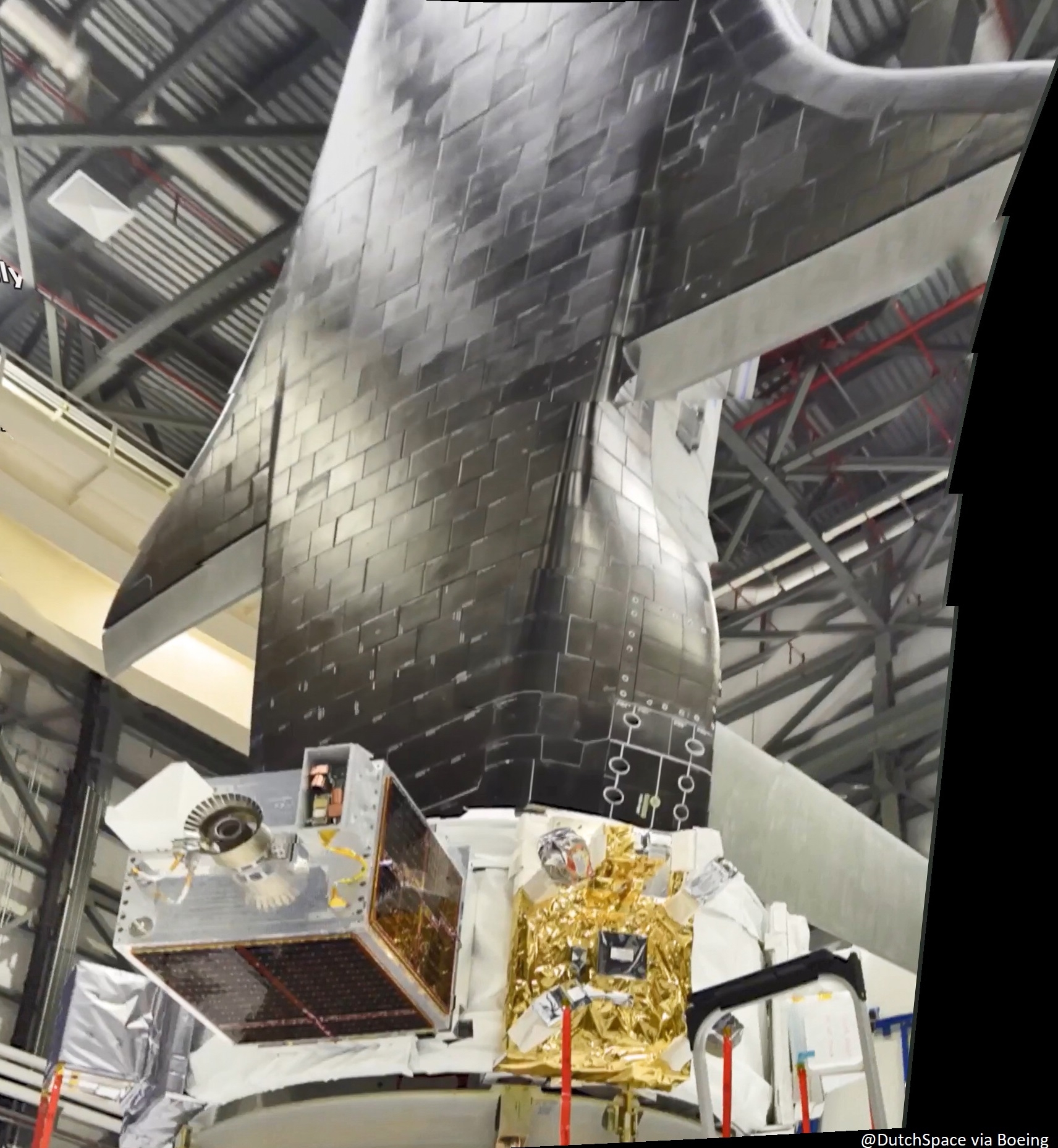
Image of Falconsat 8 mounted on the X-37B OTV-6 service module..
Image credit: Boeing via DutchSpace
Mission-focused innovation
In an X posting by DutchSpace, “for those wondering about the additional satellite, called limasat, on X-37B OTV-8, my guess would be that it was on the service module,” also posting an image of Falconsat 8 mounted on the X-37B OTV-6 service module.
“OTV-8 exemplifies the X-37B’s status as the U.S. Space Force’s premier test platform for the critical space technologies of tomorrow,” said Air Force Rapid Capabilities Office (AFRCO) Acting Director, William Blauser, in an August 14 press statement. “Through its mission-focused innovation, the X-37B continues to redefine the art of the possible in the final frontier of space,” he stated.
Langbroek’s video can be viewed at:
 Posted in Space News

