 By
By  August 22nd, 2025
Mini-rover imagery of Chang’e-6 lander/ascender.
Image credit: CNSA/CLEP
China’s Chang’e-6 Moon sampling mission continues to provide key information on the formation of the Apollo Basin – a huge impact basin on the lunar far side.
The new research could help explain the apparent early impact flux during the Late Heavy Bombardment (LHB) period of the Moon and the solar system.
It has been determined that the Apollo Basin formed approximately 4.16 billion years ago, pushing back the date at which the LHB began on the Moon by at least 100 million years.

Chang’e-6 scooping operation on Moon’s far side.
Image credit: CNSA/CLEP
Geological clock
According to the study published in the journal Nature Astronomy, the research also revealed that the LHB impact flux followed a trend of gradual decay – “a fact which does not support the hypothesis of a sudden surge between 3.8 billion and 4 billion years ago,” reported China’s Central Television (CCTV).
A team from the Chinese Academy of Sciences’ (CAS’) Guangzhou Institute of Geochemistry, led by CAS academician Xu Yigang, worked with other Chinese and international researchers. The work integrated remote sensing, geological, geochemical and petrological data.
Examined were three unusual clasts measuring 150 to 350 micrometers in size. They were among the lunar far side samples retrieved by the Chang’e-6 mission, rocketed to Earth back in June 2024 with the mission’s return capsule landing by parachute in Inner Mongolia.

Chang’e-6 drilling into lunar far side landscape.
Image credit: CNSA/CLEP
A clast is a fragment of pre-existing rock or mineral that has broken off from a larger rock mass.
The three samples in the study are impact-melt fragments that formed during the formation of the Apollo Basin, serving as a “geological clock” for the impact event.
Crucial insights

Chen Jingyou, researcher, Guangzhou Institute of Geochemistry, CAS.
Image credit: CCTV/Inside Outer Space screengrab
“Prior to our discovery, scientists believed that a basin-forming ‘impact storm’ occurred on the Moon between 3.8 billion and 4 billion years ago. Accurately dating the Apollo Basin gives us crucial insights to help unravel the mysteries of this ‘impact storm,’” said Chen Jingyou, a researcher at the institute.
By studying the Chang’e-6 lunar samples the evolution of the Earth-Moon system can be better understood, the research team adds. “The early impact flux recorded by the Moon, especially the first billion years during the basin-forming epoch, is pivotal to understanding the evolution of inner Solar System bodies,” Chen and colleagues report.
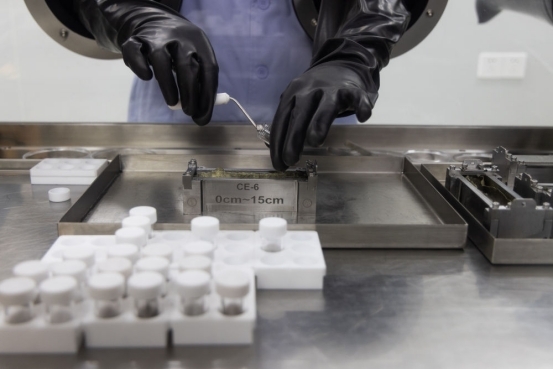
Image credit: CLEP
Earlier work
This latest data follows earlier work by Chinese scientists on the Chang’e-6 samples, published in March of this year, confirming that the South Pole-Aitken Basin formed approximately 4.25 billion years ago.
In July, China also released other findings gleaned from the Chang’e-6 far side samples, covering categories such as volcanic activity, ancient magnetic fields, water content, and geochemical characteristics of the lunar mantle.
To access the new research – “KREEP-like lithologies in the South Pole–Aitken basin reworked by the Apollo basin impact at 4.16 Ga” – go to:
 Posted in Space News

