 By
By  July 18th, 2025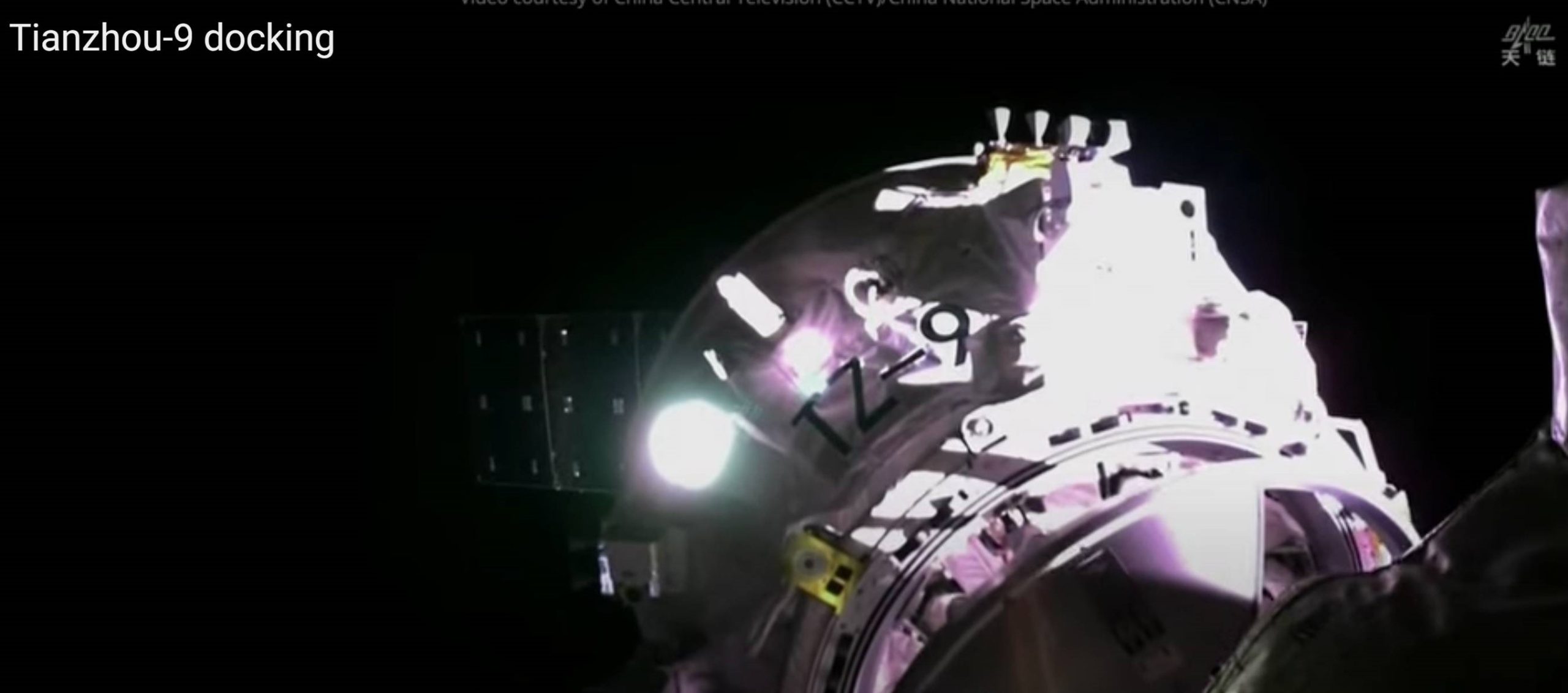
Image credit: CCTV/CMSA/Inside Outer Space screengrab
The Tianzhou-9 cargo spacecraft that recently docked to China’s space station is helping shape the country’s human Moon landing effort.
China employs a three-level positioning approach to rendezvous and dock with the space station. The BeiDou Navigation System first brings the spacecraft within 3 miles (five kilometers) of the space station. The two spacecraft then close the distance to within roughly 330 feet (100 meters). Finally, laser radar achieves millimeter-level positioning when they are 65 feet (20 meters) apart.
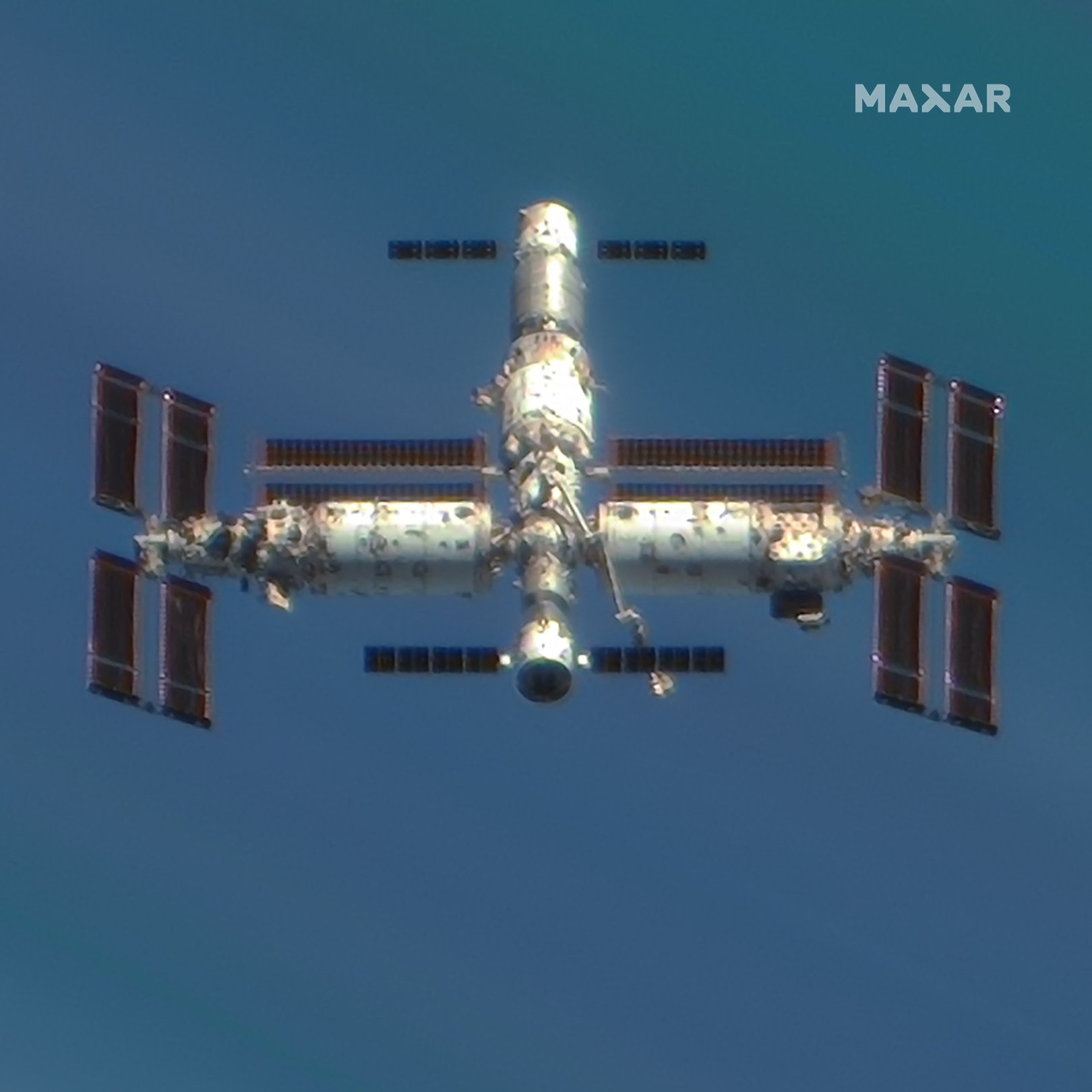
Satellite photo of China’s space station. Image credit: MAXAR
Similarly, China’s lunar robotic return sample missions — Chang’e-5 and 6 — conducted rendezvous and docking in lunar orbit, returning with lunar samples.
Upcoming crewed missions are set to include multiple rendezvous and dockings in lunar orbit, China Central Television (CCTV) reports.
Advanced EVA suits
Also tied to sending crews to the Moon is delivery of two advanced Feitian spacewalk suits to China’s orbital outpost, “marking a technological leap in extravehicular equipment for the country’s space station program,” adds CCTV.
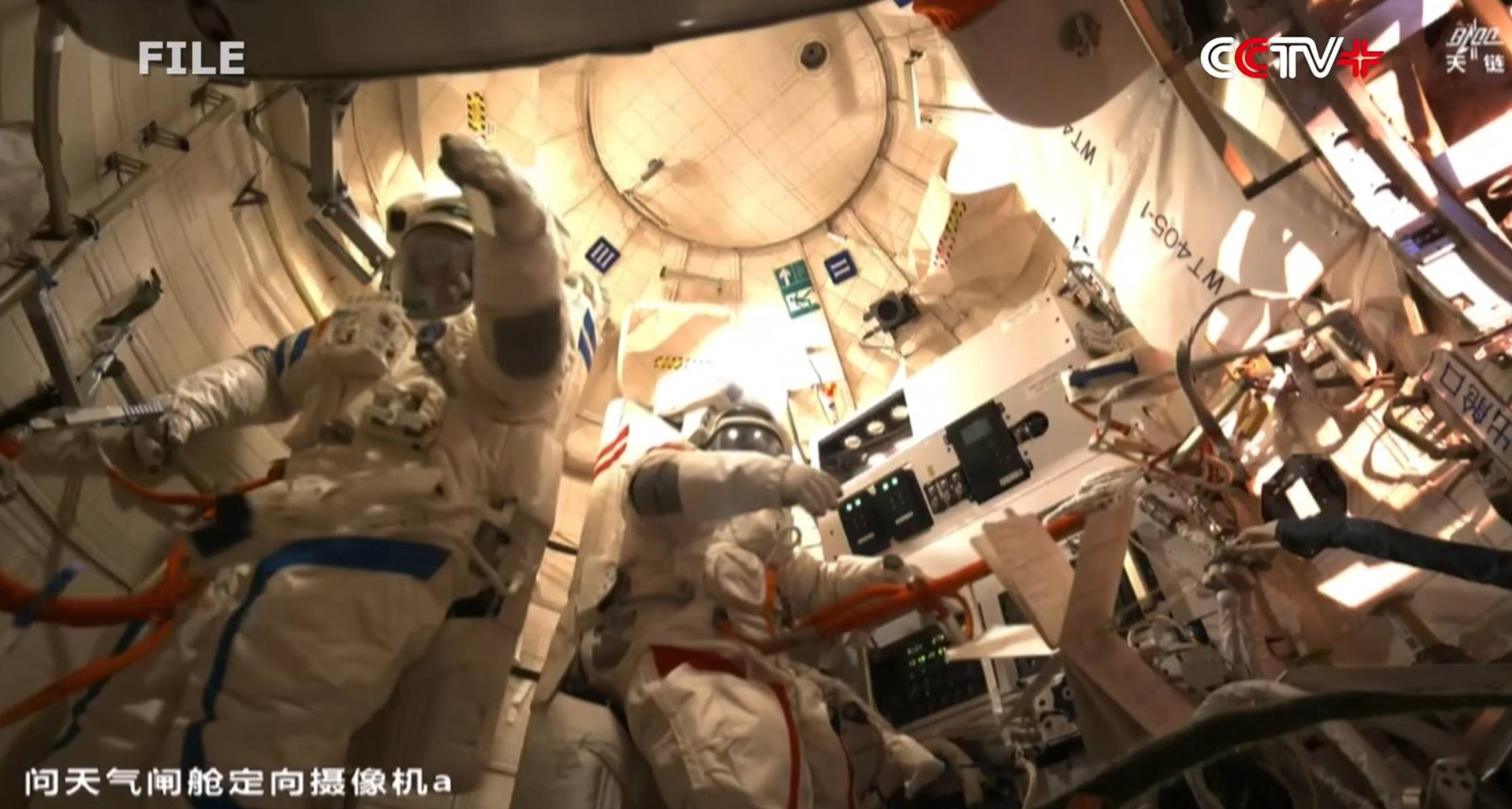
Image credit: CCTV/CMSA/Inside Outer Space screengrab
Tianzhou-9, the fourth cargo spacecraft in the application and development phase of China’s space station, was loaded with about 6.5 tons of supplies — consumables, propellants, science experiments and equipment – to support the in-orbit life and working of China’s now orbiting Shenzhou-20 crew and a future trio of Shenzhou-21 astronauts.
Muscle exercise device.
Also carried to the facility was a core muscle exercise device.
Li Yinghui, a researcher at the China Astronaut Research and Training Center told CCTV: “The stronger (our astronauts are), the longer and farther we can go. Core strength is crucial not only for space station operations but also for future missions to the Moon.”
Li added, “when we first arrive on the Moon, maintaining postural stability is crucial, and core muscles play a key role in that. So this is also part of our preparation to ensure astronauts have the physical control and motor ability required for future lunar exploration.”
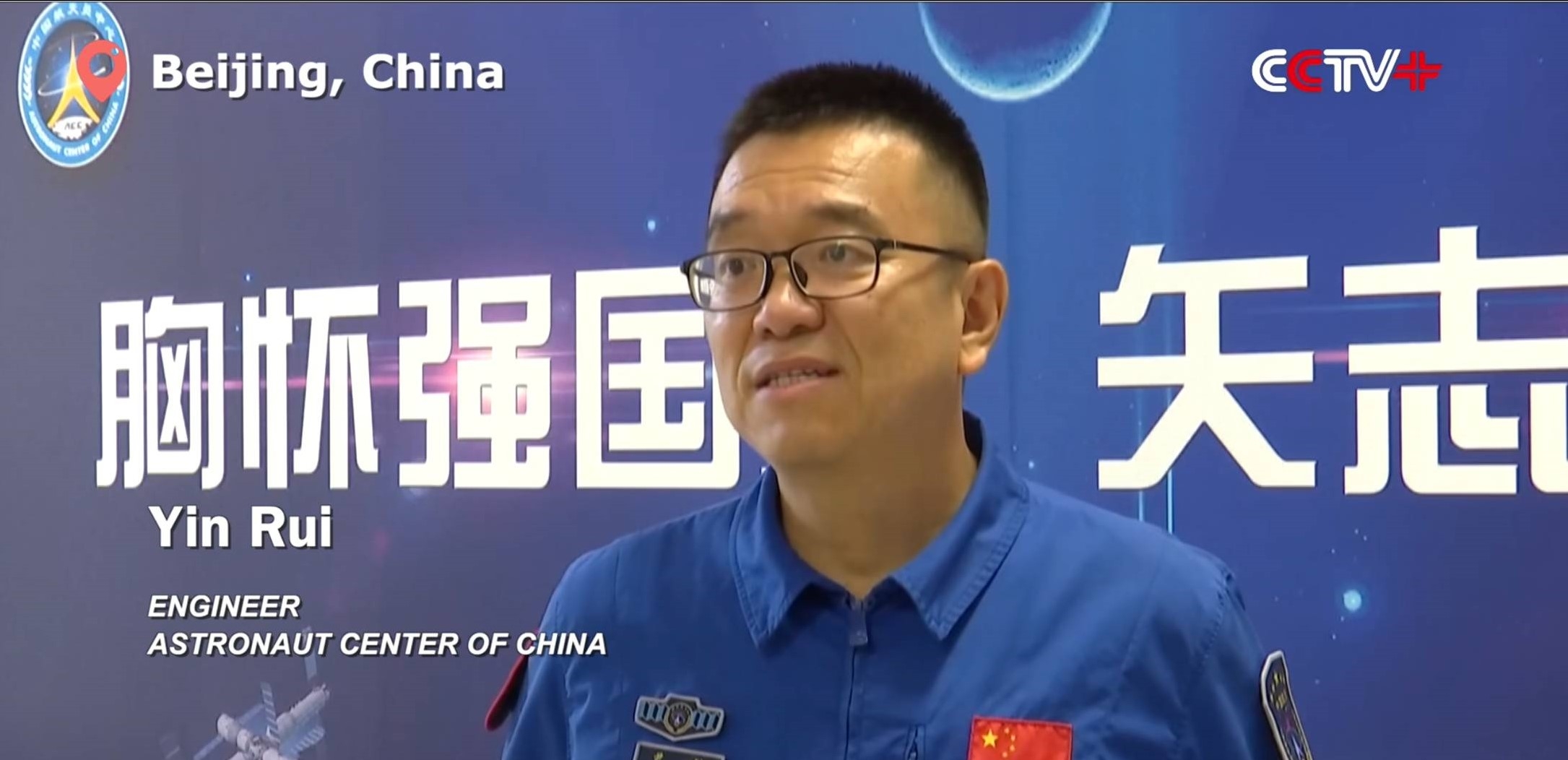
Image credit: CCTV/Inside Outer Space screengrab
Increased performance metrics
Regarding the two new sets of Feitian extravehicular spacesuits, Yin Rui, an engineer at the Astronaut Center of China, said the upgraded space walking suits have increased performance metrics. “These new suits now last four years and can support 20 spacewalks, compared to the previous three-year, 15-mission lifespan,” Yin said.
“Following our principle of continuous design optimization,” Yin added, “we’ve established China’s first space suit lifespan evaluation system based on data from 42 astronaut participations across 21 spacewalks, combined with extensive ground testing.”

Image credit: CCTV/CMS/Inside Outer Space screengrab
According to CCTV, the suit refinements come as China develops its next-generation “Wangyu” moonwalking suits for future lunar missions, with researchers making strides in life support systems and space suit ergonomics.
Emergency response
Li Zhiyong, a researcher with the China Aerospace Science and Technology Corporation noted that “Tianzhou-9 is the first cargo spacecraft capable of emergency launch, able to be launched to the space station within three months if required. This is the significance of an emergency response spacecraft.”
The rendezvous and docking duration has been shortened from the initial two days to 6.5 hours, and to the current three hours, said Li. “The three-hour approach helps us reduce fuel consumption and takes relatively less time, plus we have a lot of autonomous control to ensure the reliability of the rendezvous and docking.”
Tianzhou-9 was lofted on July 15 (local time) by a Long March-7 Y10 rocket that departed from the Wenchang Spacecraft Launch Site in the southern island province of Hainan.
Go to this CCTV video at: https://www.facebook.com/share/v/18tztGuUDF/
Image credit: CCTV/CMSA/Inside Outer Space screengrab
 Posted in Space News

