 By
By  July 14th, 2025
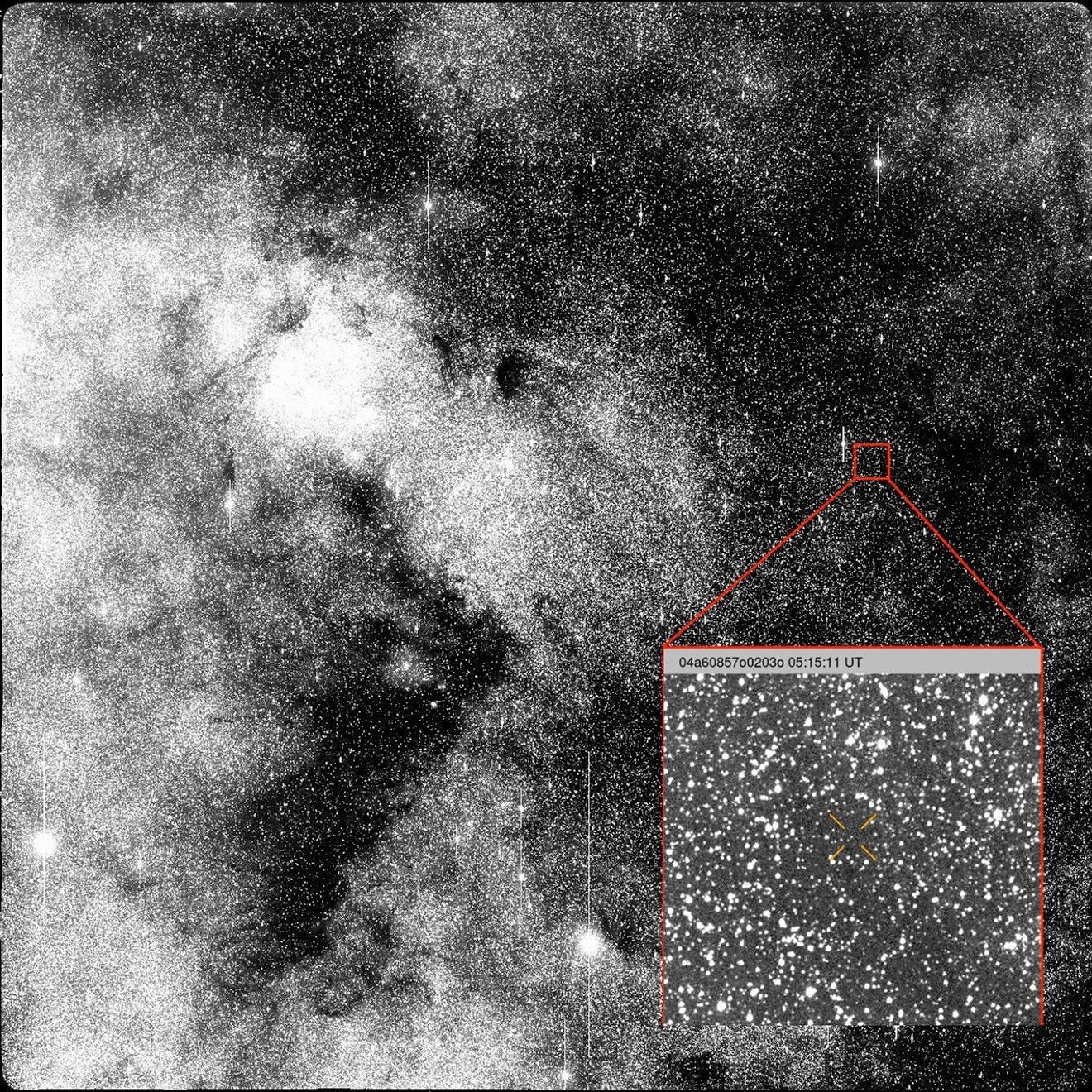
This image shows the observation of comet 3I/ATLAS when it was discovered on July 1, 2025. The NASA-funded ATLAS survey telescope in Chile first reported that the comet originated from interstellar space.
Image credit: ATLAS/University of Hawaii/NASA
Is the new interloper in our solar system — 3I/ATLAS — a comet or something else?
That’s an intriguing question posed by Avi Loeb, head of the Galileo Project, a founding director of Harvard University’s Black Hole Initiative, and director of the Institute for Theory and Computation at the Harvard-Smithsonian Center for Astrophysics.
Never shy about probing and questioning the cosmos, Loeb has looked at new observational data of 3I/ATLAS, calling attention to several factoids.
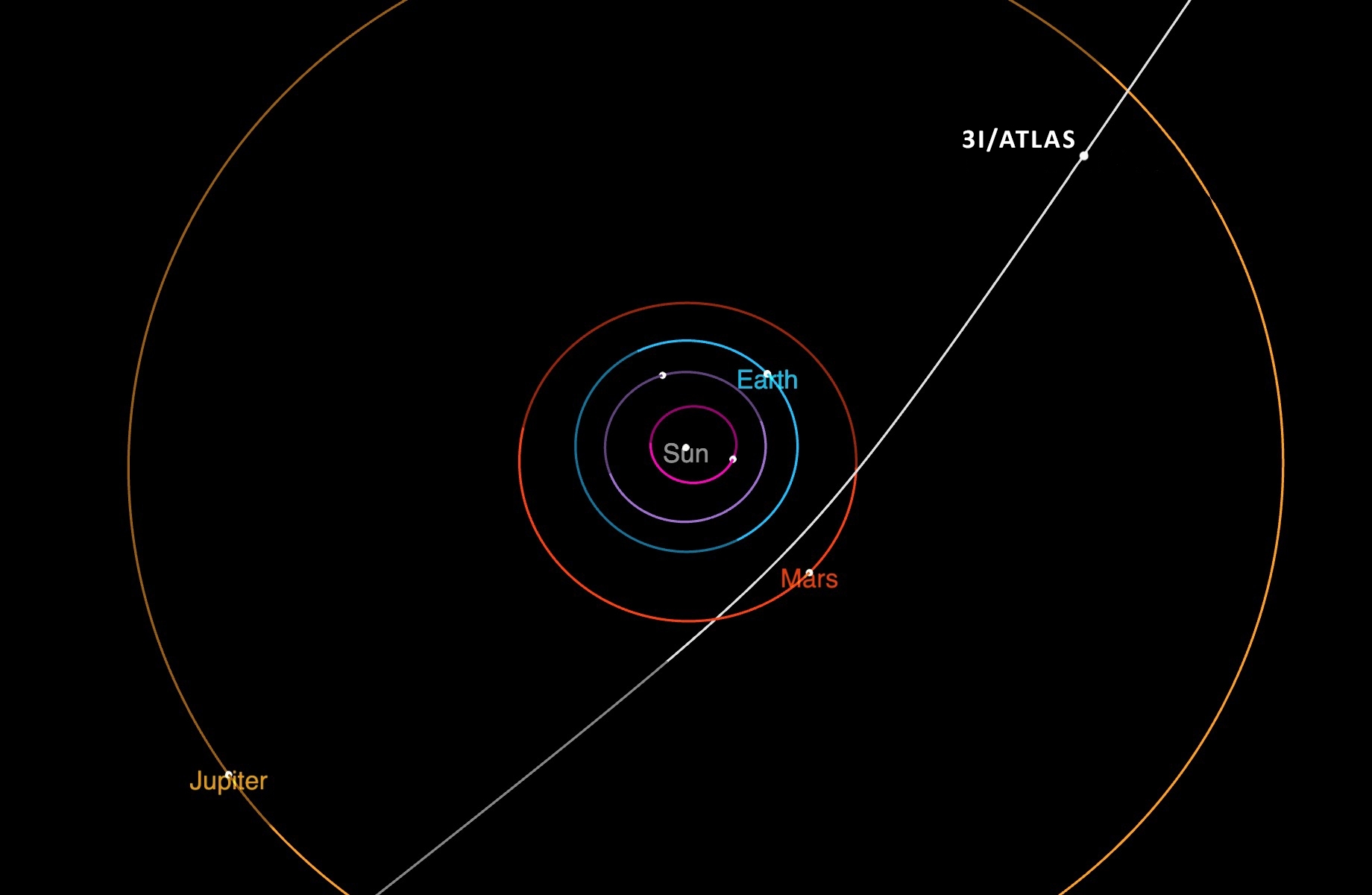
This diagram shows the trajectory of interstellar comet 3I/ATLAS as it passes through the solar system. It will make its closest approach to the Sun in October.
Image credit: NASA/JPL-Caltech
Puzzling size
For one, the total brightness of 3I/ATLAS remained nearly constant over a period of a few days, suggesting that either the object is hidden beyond the veil of dust or it is nearly spherical, Loeb explains.
“Future observations of 3I/ATLAS as it comes closer to the Sun will provide a key opportunity to witness the evolution of its activity, infer the size of its solid nucleus, study its composition, test predictions for the abundance and velocity dispersion of its population, and compare 3I/ATLAS to Solar System comets,” Loeb explains in a recent essay.
The fundamental question, Loeb adds, “is whether 3I/ATLAS is a comet with a kilometer-scale nucleus or a solid object that is 20 kilometers in diameter which shows very limited evaporation? In the latter case, the large size of 3I/ATLAS is puzzling.”
3I/ATLAS, expected to get more prominent as the object is heated along its path to closest approach from the Sun (perihelion), is anticipated to occur on October 29, 2025.

Avi Loeb
(Image Credit: Chris Michel, National Academy of Sciences, 2023)
Forrest Gump effect
Loeb advises stay-tuned for future spectroscopic data from space-based telescopes — like the James Webb or Hubble space telescopes, including the state-of-the-art ground-based Vera C. Rubin Observatory.
If those instruments demonstrate that 3I/ATLAS has a solid core with a diameter of order 12 miles (20 kilometers) or more, “then the limited interstellar reservoir of rocky materials would suggest that its trajectory favored a plunging orbit towards the inner Solar system, perhaps by technological design,” Loeb speculates.
Concludes Loeb, paraphrasing Forrest Gump: “Science is like a box of chocolates, you never know what you’re going to get.”
Go to Loeb’s new research paper in draft– “Comment on Discovery and Preliminary Characterization of a Third Interstellar Object: 3I/ATLAS” at:
 Posted in Space News


“then the limited interstellar reservoir of rocky materials would suggest that its trajectory favored a plunging orbit towards the inner Solar system, perhaps by technological design,”
It is irresponsible for a scientist to make such wild speculations and it is more likely to be just an asteroid. I think he is saying this to get publicity.