 By
By  January 5th, 2025
Image credit: Citizen TV
There is a possible candidate for that large metallic ring that fell from the sky on December 30 in Africa, reportedly crashing “red-hot” into Mukuku village, in Makueni county – in the country’s south.
Investigators with the Kenya Space Agency (KSA) officials in Nairobia reported that the object, which is roughly 8 feet (2.5 meters) in diameter and weighing some 1,100 pounds (500 kilograms), is a piece of rocket debris. But the question remains from where?

Image credit: KSA
KSA officials said the leftovers came crashing down, reportedly within the village at roughly 3 p.m. local time.
Preliminary assessment
The KSA “secured the area and retrieved the debris, which is now under the Agency’s custody for further investigation.”
“Preliminary assessments indicate that the fallen object is a separation ring from a launch vehicle (rocket),” the KSA stated in a January 1st official statement.
There is discussion regarding possible rocket launch hardware associated with the Indian Space Research Organization’s (ISRO) Space Docking Experiment (SpaDeX) launch on December 30.

Image credit: ISRO/Inside Outer Space screengrab
Polar satellite launch vehicle
The SpaDeX payload flew atop ISRO’s Polar Satellite Launch Vehicle (PSLV-C60), lifting off at 10:00:15 PM local time from the Satish Dhawan Space Centre, Sriharikota.
The SpaDeX mission deployed two spacecraft—SDX01 (Chaser) and SDX02 (Target) — to carry out a series of complex maneuvers, leading to their docking in Earth orbit.
India’s mastering of autonomous docking technology, reports ISRO, is vital for future human spaceflights, lunar missions, and the construction of India’s proposed space station, Bharatiya Antariksh Station.
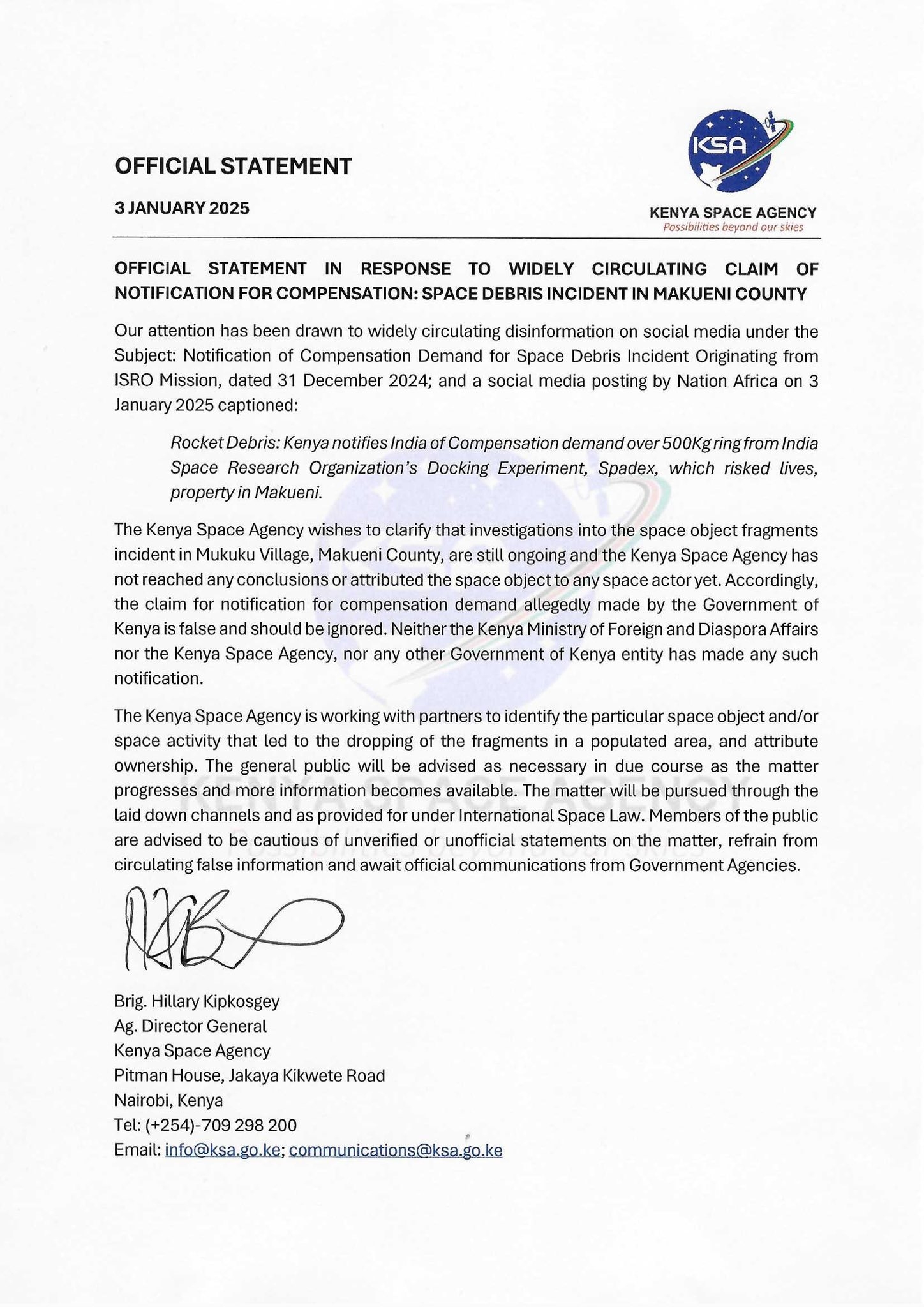
Image credit: KSA
Report dismissed
Meanwhile, the Kenya Space Agency has dismissed a media report by Nation Africa that the country had demanded compensation for the debris dumping from India.
In a post on X on Friday, the KSA stressed that “investigations into the object’s origin are still ongoing, and no official statement has been issued linking the debris to the Indian Space Research Organization or any specific space mission.”
KSA advised the public to “await official findings.”
 Posted in Space News

