 By
By  October 10th, 2024
Artist rendering of the X-37B performing an aerobraking maneuver using the drag of Earth’s atmosphere.
Image credit: Boeing Space
The Air Force has announced that the classified X-37B robo-plane is soon to start a series of “novel maneuvers” prior to reentry to a designated landing site – likely Kennedy Space Center.
This U.S. space plane was launched to a highly elliptical high Earth orbit aboard a Falcon Heavy rocket back on December 28, 2023.
That aerobraking term means that the space plane is to change its orbit around Earth and “safely dispose of its service module components,” in accordance with recognized standards for space debris mitigation, according to a Secretary of the Air Force Public Affairs posting today.

X-37B space plane. Image credit: Boeing/Inside Outer Space screengrab
In the statement, Secretary of the Air Force Frank Kendall explained that this novel series of maneuvers by the Orbital Test Vehicle-7 (OTV-7) mission “demonstrates the Space Force’s commitment to achieving groundbreaking innovation as it conducts national security missions in space.”
Series of passes
The announcement also noted that this is the first time the U.S. Space Force and the X-37B have attempted to carry out a dynamic aerobraking maneuver, “leveraging six successful missions of operating the space plane safely, as well as decades of general lessons learned from the scientific community conducting Moon and Mars missions.”
The use of the aerobraking maneuver allows the craft to carry out a series of passes using the drag of Earth’s atmosphere. Doing so enables the spacecraft to change orbits while expending minimal fuel.

OTV-6 was the first mission to introduce a service module that expanded the capabilities of the spacecraft.
Image credit: Staff Sgt. Adam Shanks
“Once the aerobrake maneuver is complete, the X-37B will resume its test and experimentation objectives until they are accomplished, at which time the vehicle will de-orbit and execute a safe return as it has during its six previous missions,” the statement adds.
There was no specific time noted as to actual return of the craft to a landing strip.
Distinctive mission
The Air Force Rapid Capabilities Office (AFRCO) has managed the X-37B program since 2010, meant to push forward the next generation of reusable space capabilities for the United States Space Force.
This OTV-7 mission of the U.S. military’s unique X-37B robotic space plane is decidedly distinctive.
For the first time, the Boeing-built craft was hurled spaceward atop a SpaceX Falcon Heavy booster, “with a wide range of test and experimentation objectives,” explains a U.S. Space Force press statement. Reportedly OTV-7 is the fourth flight of this particular craft; there are believed to be only two vehicles for the program.

Image credit: SpaceX
Service module
As explained in the Air Force statement, the last space plane flight, OTV-6, was the first mission to introduce a service module that expanded the capabilities of the spacecraft.
That module hosted more experiments than any of the previous space plane missions. In the OTV-6 flight, the service module was detached in orbit from the space plane before its landing, necessary due to the aerodynamic forces seen by the X-37B vehicle upon re-entry.
Once detached, the free-floating service module from that previous mission was disposed of “in compliance with best practices,” according to the Air Force.

X-37B Air Force space plane.
Credit: Boeing/Inside Outer Space Screengrab
First use technologies
Flight roster
Here’s a listing of previous flights of the space plane:
OTV-1: launched on April 22, 2010 and landed on December 3, 2010, spending over 224 days on orbit.
OTV-2: launched on March 5, 2011 and landed on June 16, 2012, spending over 468 days on orbit.
OTV-3: launched on December 11, 2012 and landed on October 17, 2014, spending over 674 days on-orbit.
OTV-4: launched on May 20, 2015 and landed on May 7, 2015, spending nearly 718 days on-orbit.
OTV-5: launched on September 7, 2017 and landed on October 27, 2019, spending nearly 780 days on-orbit.
OTV-6: Launched on May 17, 2020 and landed on November 12, 2022, circling Earth for 908 days.
OTV-7: Lofted on December 28, 2023. Landing date and where/TBD.
First use in space
In past Boeing-supplied information, the company says the X-37B is designed to operate in low-Earth orbit, 150 to 500 miles above the Earth.
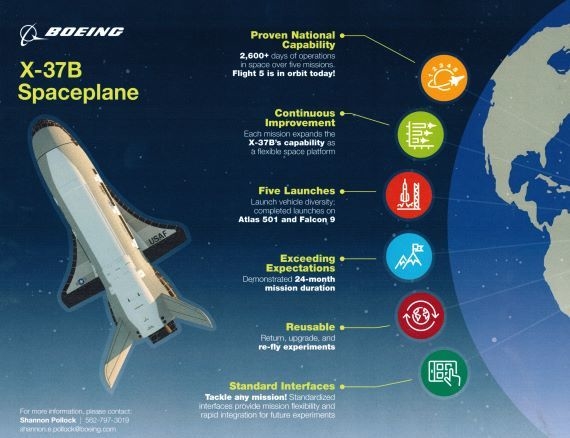
X-37B handout.
Credit: Boeing
Additionally, the vehicle makes use of several “first use in space” technologies including:
— Avionics designed to automate all de-orbit and landing functions.
— Flight controls and brakes using all electro-mechanical actuation; no hydraulics on board.
— Use of a lighter composite structure, rather than traditional aluminum.
— New generation high-temperature wing leading-edge tiles and toughened uni-piece fibrous refractory oxidation-resistant ceramic (TUFROC) tiles and advanced conformal reusable insulation (CRI) blankets.
Chief of U.S. Space Operations, General Chance Saltzman, said in the new posting that “this first of a kind maneuver from the X-37B is an incredibly important milestone for the United States Space Force as we seek to expand our aptitude and ability to perform in this challenging domain.”

Image credit: Felix Schöfbänker
China’s space plane
Considered by many as a copycat version of X-37B, China’s experimental space plane recently rolled to full stop in September on a landing strip. Little is known about the craft.
It was hurled into orbit on December 14, 2023 atop a Long March 2F rocket from the Jiuquan Satellite Launch Center in northwest China.
The whatever it is and does spacecraft touched down after 268 days of in-orbit operation, making its touchdown on September 6, 2024.
 Posted in Space News

