 By
By  October 3rd, 2024
NASA’s Artemis program wants to establish a sustainable presence on the Moon.
Image credit: NASA
As nations rocket forward plans to “reboot” the Moon with crews, what that celestial destination needs is real-time monitoring and emergency response.
For example, there are high-risk situations in remote areas like the lunar south pole – the currently preferred place for planting long-term expeditions.
A team of international scientists wants to make lunar exploration safer. To do so, they are proposing a distress monitoring and rescue system for that off-Earth and challenging environment.

Image credit: University of South Australia
Safety alerts
A project led by the University of South Australia (UniSA) is looking into the critical need for an emergency system capable of providing safety alerts, incident reporting, and location tracking of astronauts in distress.
At the system’s core, the idea is based on Cospas-Sarsat technology, the international humanitarian search and rescue system here on Earth. Cospas-Sarsat now includes 45 nations and two independent search and rescue (SAR) organizations.
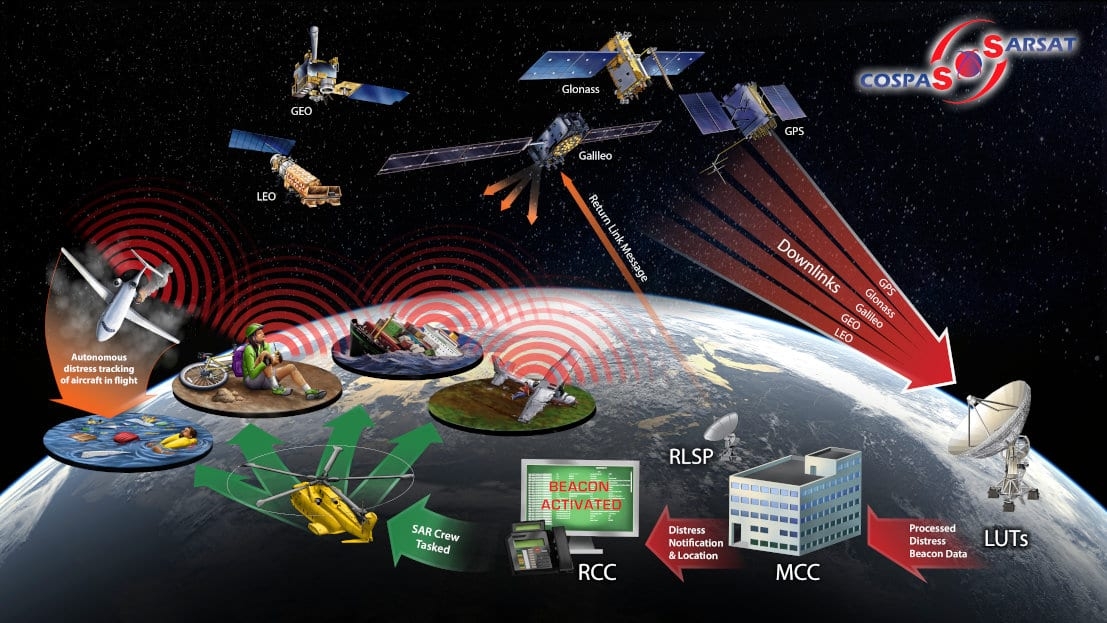
Image credit: COSPAS-SARSAT
On planet Earth, Cospas-Sarsat brings together a worldwide network of satellites, ground stations, mission control centers, and rescue coordination centers.
Network of satellites
According to Mark Rice, a UniSA adjunct researcher and founder of Safety from Space, the Moon-based distress system could allow continuous communication with astronauts for up to 10 hours, even in tough terrain, such as craters or lunar mountains.
“Our team has also developed a waveform that supports low-power emergency beacons, ensuring that communication remains possible with minimal infrastructure and energy consumption,” Rice points out in a UniSA statement.
Researchers from Adelaide and the US are designing a satellite constellation that prioritizes communication and geo-location on the Moon’s surface. Once in place, Moon exploring astronauts would be able to send distress signals to a network of satellites that will relay the information back to Earth or other lunar bases.

Image credit: NASA
Frequency approvals
Safety from Space was founded in 2018 with the support of UniSA’s Innovation and Collaboration Center. The startup recently was awarded $100,000 from the South Australia government to help drive the Lunar Search and Rescue project, with an anticipated field trial with NASA in 2025.
A Safety from Space study has scoped out lunar search and rescue services. During this study, NASA’s Search and Rescue Mission Office served as a technical consultant regarding lunar distress message contents, lunar surface considerations, and insight into international frequency approvals as they evolved over the technical study.
Trial-run technology
Safety from Space is using the $100,000 for the LunaSAR project which will trial advanced satellite communications designed to be lighter and more reliable than current devices on the market, with a longer battery life.
The project will be conducted in collaboration with NASA, The Mars Society (US and Australian arms) and several Australian partners including SmartSat CRC, UniSA and Flinders University.
“This innovation is a critical advancement for space exploration. As humans venture further into space, the ability to quickly locate and rescue individuals in distress is vital,” explains Rice. “By creating a robust search and rescue system for the Moon, this research sets the foundation for similar systems on other planets, potentially revolutionizing how we approach human safety in space exploration.”
 Posted in Space News

