 By
By  May 4th, 2024
Image credit: CCTV/Inside Outer Space screengrab
China’s second robotic mission to the Moon’s far side – Chang’e-6 – is en route to an impact crater known as the Apollo basin, located within the South Pole-Aitken (SPA) Basin, selected as the primary target landing and sampling site for the lunar lander mission.
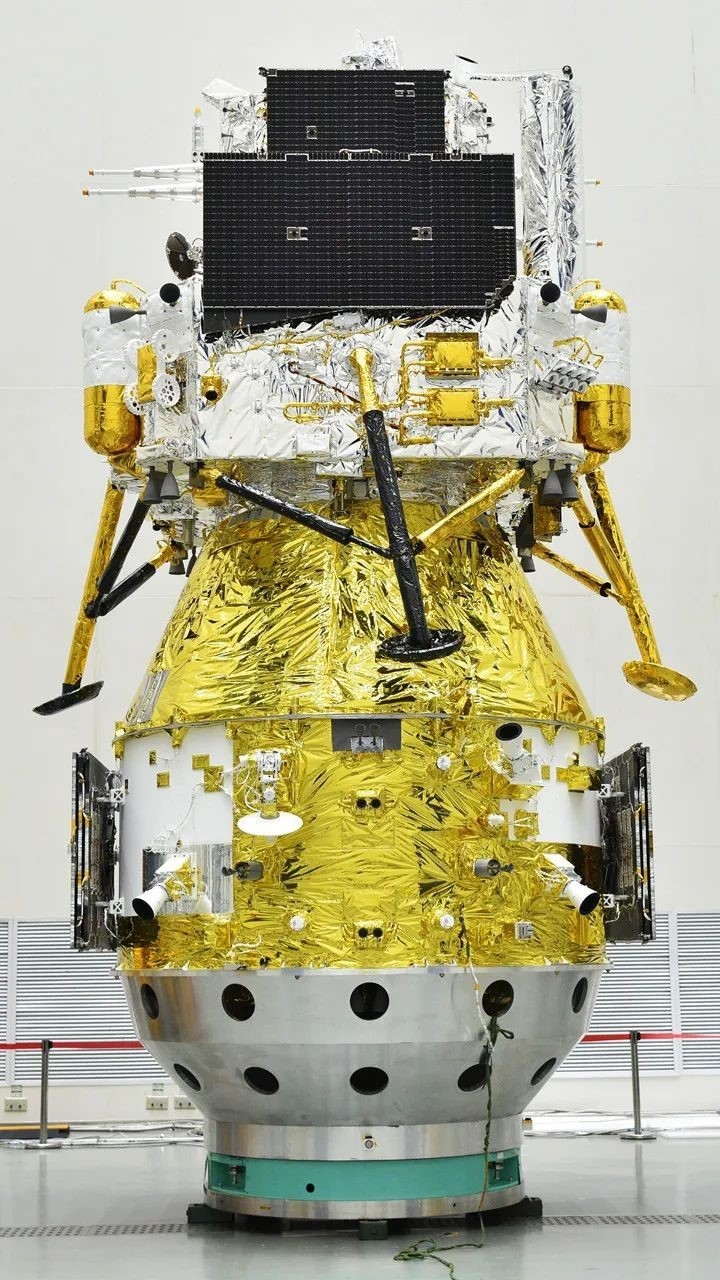
Now en route to the Moon, China’s Chang”e-6.
Image credit: CNSA
After launch last Friday, Chang’e-6 is on track for a flight expected to last about 53 days, according to the China National Space Agency (CNSA).
Meanwhile, at the ready are relay satellites to provide communication services to facilitate data transmission between Chang’e-6 and the Earth.
China launched the Queqiao-2, or Magpie Bridge-2, relay craft on March 20. Subsequently, it has completed check list testing with the Moon’s far side-based and still active Chang’e-4 lander/rover, as well as performing a pre-launch link-up with Chang’e-6, reports China Central Television (CCTV).
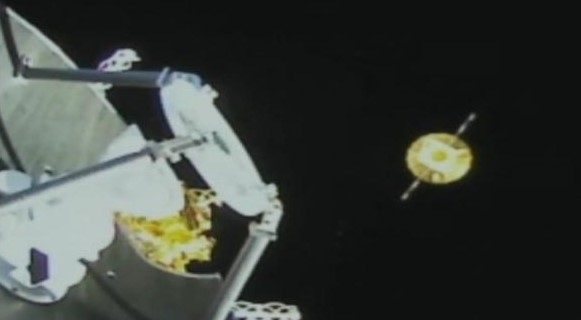
China’s Queqiao-2, or Magpie Bridge-2, is released from a Long March 8 carrier rocket last March.
Image credit: CNSA
China’s Chang’e-4 lander/rover was the first to visit the Moon’s far side in 2019.
Relay support
Queqiao-2 is circling the Moon in a large elliptical orbit to ensure data transmission efficiency and long-term effective communication with the lander’s far side touchdown spot of the Moon. Chang’e-6 is outfitted with special antenna gear.

Lu Yuntong, CAST. Image credit: CGTN/Inside Outer Space screengrab
“The main difficulty in landing on the Moon’s far side is that the terrain on the far side is actually more rugged. So we need to do terrain identification to choose a better area for it to land on the Moon,” explained Lu Yuntong, an engineer of China Aerospace Science and Technology Corporation.
“With the support of relay satellite Queqiao-2,” Lu told CCTV, “we will then implement our sampling and packing mission on the far side of the Moon.”

Image credit: CNSA
Tianlian system
“The position of Queqiao-2 relative to our lander is actually changing all the time, unlike the lander on the near side where it was facing the Earth,” Lu continued.
“So in order to adapt to such a wide range of pointing requirements for relay satellites, we added a directional antenna on Chang’e-6. At the same time, our two directional antennas are designed with autonomous tracking functions, which can be well aligned with our relay satellites at all times and better adapt to the communication conditions on the far side of the Moon,” Lu said.
Two relay satellites, carried along with Queqiao-2, are part of the “Tianlian system” that offer communication services for the Chang’e-6 mission. However, the Queqiao-2 will handle the spacecraft entering an elliptical orbit around the Moon, the probe’s landing, and the ascent module’s departure from the lunar far side.

Image credit: CNSA
Orbiter, lander, ascender returner
The Chang’e-6 spacecraft, like its predecessor Chang’e-5, consists of an orbiter, a lander, an ascender and a returner.
Within 48 hours after Chang’e-6 landing, the plan calls for its robotic arm to be extended, then scoop up rocks and soil from the lunar surface, as well as perform drilling duties to probe below the lunar topside.
Following sample placement in a sealed container, the ascender will take off from the Moon then dock with the Chang’e-6 orbiter circling the Moon. The returner is to haul the lunar samples to Earth, landing in north China’s Inner Mongolia Autonomous Region.
The entire flight is expected to last about 53 days, the CNSA said.

China’s Chang’e-6 lunar sample return mission elements.
Credit: CNSA
International payloads
The Chang’e-6 mission is carrying four payloads developed through international cooperation. Scientific instruments from France, Italy and the European Space Agency/Sweden are aboard the Chang’e-6 lander.
Also, a small satellite from Pakistan is attached to the orbiter, the ICUBE-Q CubeSat satellite. It was designed and developed by Pakistan’s Institute of Space Technology in collaboration with China’s Shanghai Jiao Tong University and Pakistan’s national space agency, SUPARCO.

Image credit: Xingguo Zeng, et al.
Moon’s origin and evolution
Chang’e-6’s landing within the Aitken Basin in the south pole of the Moon is expected to provide invaluable science data.
“The Aitken Basin is one of the three major terrains on the Moon and has significant scientific value,” Ge Ping, deputy director of the Center of Lunar Exploration and Space Engineering with CNSA told China Global Television Network (CGTN).
Finding and collecting samples from different regions and ages of the Moon is crucial for our understanding of Earth’s natural satellite, Ge said. When the sample is returned, there will be systematic, long-term laboratory research on the lunar stash, including analysis of its structure, physical properties and composition.
“These would further study of the Moon’s origin and its evolutionary history,” Ge said in an interview before the launch.

Vacuum-sealed collectibles
Like its predecessor, the Chang’e-6 spacecraft is designed and built by the Beijing-based China Academy of Space Technology. The Moon mission now underway will basically mimic that of the Chang’e-5 return sample mission carried out in December 2020.
After Chang’e-6 reaches lunar orbit, its components will separate into two parts, with the orbiter and reentry capsule remaining in orbit, while the lander and ascender depart for lunar surface tasks.
If everything goes according to plan, up to 4.4 pounds (2 kilograms) of lunar bits will be collected, stashed and packed in a vacuum-sealed metal container inside the ascender.
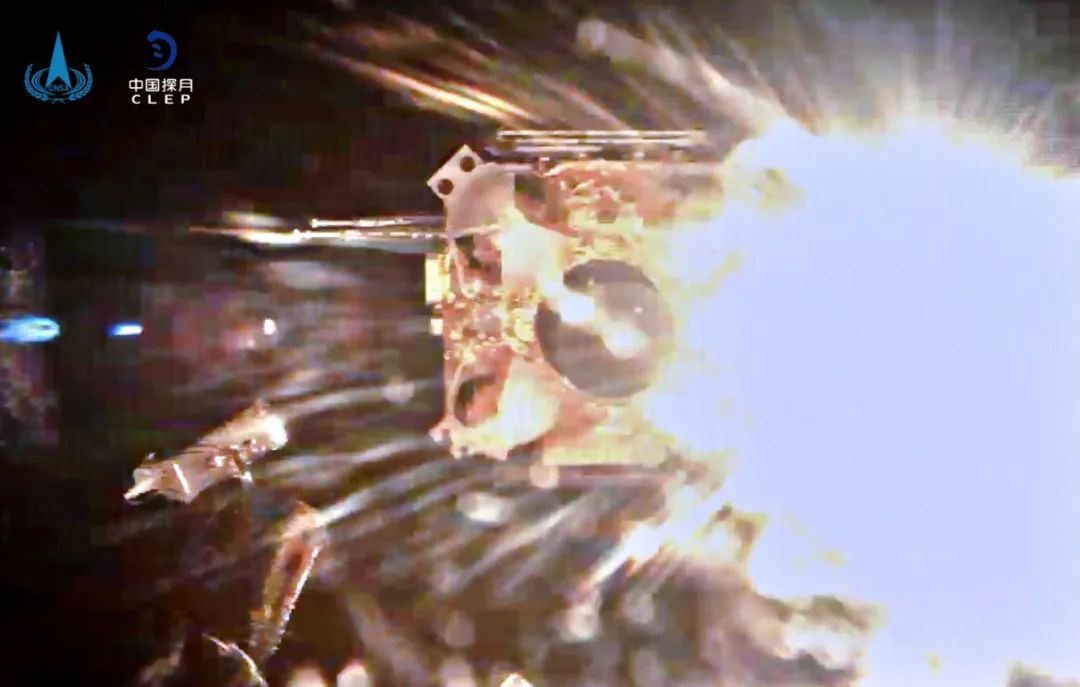
Departing ascender imaged by the Chang’e-5 lander.
Credit: CCTV/CNSA/CLEP
Parachute landing
After lunar collection duties are done, the engines of the ascender will rocket that Chang’e-6 mission element into lunar orbit for docking with the reentry capsule. The vacuum-sealed container carrying the samples will then be transferred to the Earth-returning segment before the ascender undocks.
The combination of orbiter and reentry capsule then departs lunar orbit and returns to the vicinity of Earth where the pair separate.
Blazing through Earth’s atmosphere the reentry capsule toting lunar specimens will perform a set of maneuvers, ending in a parachute landing at the Siziwang Banner Landing Site in the Inner Mongolia autonomous region.

Wang Qiong, deputy chief designer of the Chang’e-6 mission.
Image credit: CCTV/Inside Outer Space screengrab
Challenges and uncertainties
Wang Qiong, a deputy chief designer of the Chang’e-6 mission, said there will be a host of challenges and uncertainties while the 53-day robotic expedition of the Moon is underway.
“During the Chang’e-5 mission, the probe worked on the near side, so we could monitor its work processes and send control signals to it anytime. But in the case of Chang’e-6, we will have to depend solely on the Queqiao-2 relay satellite to transmit data and signals. The satellite has a limited coverage over the landing site, which will consequently restrict our communication with the Chang’e-6 probe,” he said.

Photo taking during Chang’e-5 surface sampling.
Credit: CCTV/Inside Outer Space screengrab
Wang said that engineers have applied some new advanced technologies in the now en route to the Moon mission, such as a rapid sampling system and a smart data-analysis mechanism. Those abilities will ensure that the sample-collection tasks are effectively and efficiently completed on the lunar surface within shorter operating time.
In the case of a communications blackout, Wang added that the Chang’e-6 probe is capable of conducting some key maneuvers in accordance with preset programs.
Go to this informative video at:
 Posted in Space News

