 By
By  March 17th, 2024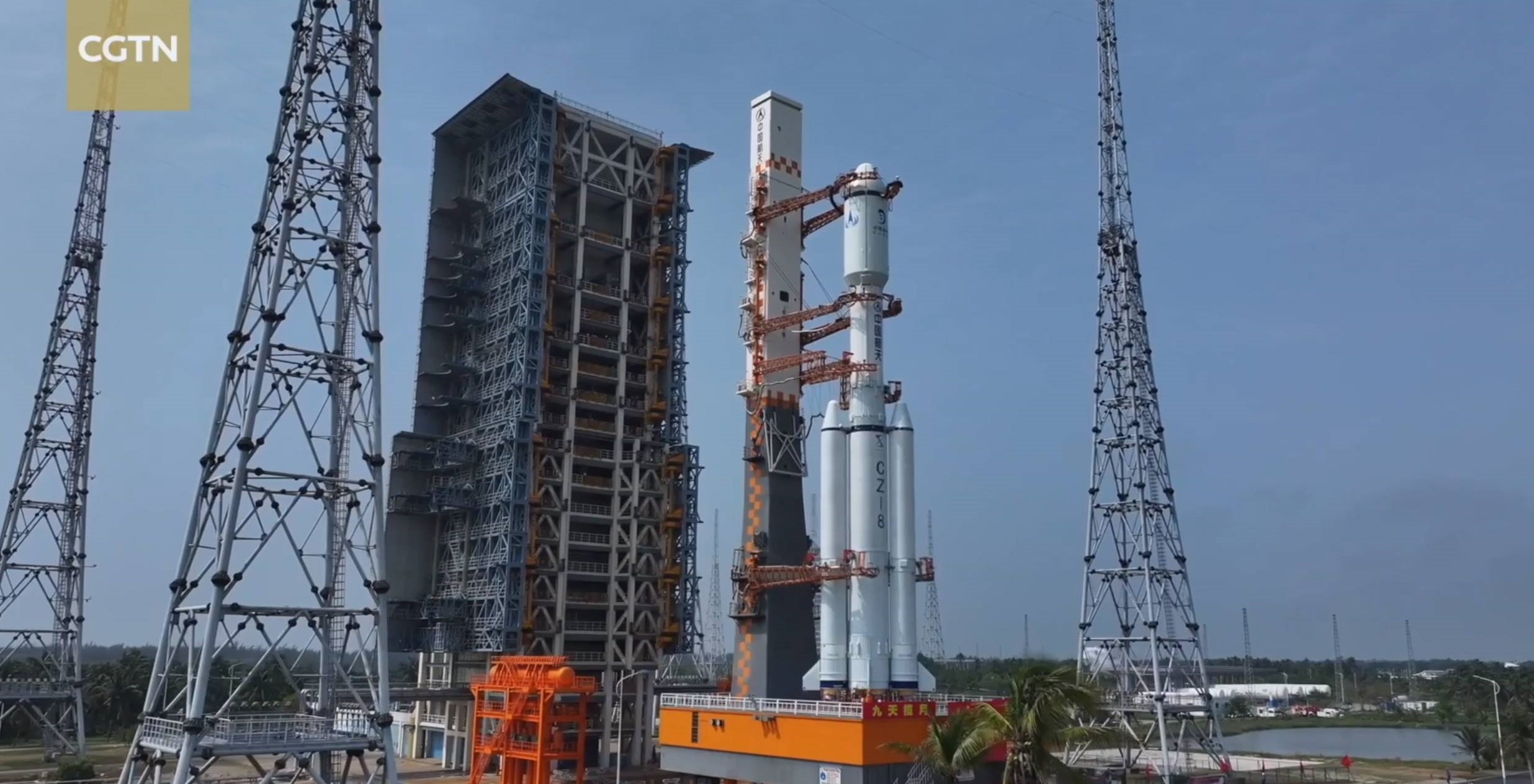
Image credit: CGTN/inside Outer Space screengrab
A Long March-8 Y3 booster is being prepped for sendoff at China’s Wenchang Space Launch Center in south China’s Hainan Province.
The Queqiao-2 spacecraft is expected to be launched in the next several days, states the China National Space Administration (CNSA).
If successfully lofted, Queqiao-2 — or Magpie Bridge-2 – is built to serve as a relay platform and is an element of China’s fourth phase of the country’s lunar exploration program.
Frozen orbit
To achieve better visibility of the Moon’s south pole region, the Queqiao-2 relay spacecraft is to be stationed in a stable, “frozen” elliptical orbit around the Moon.

Image credit: CNSA
Once in place, the relay craft will operate from a Distant Retrograde Orbit (DRO) of the Moon and support communications services for the already lunar-situated Chang’e-4, as well as the upcoming Chang’e-6, Chang’e-7, and Chang’e-8 Moon missions.
Once on duty, Queqiao-2 will make use of a 4.2 meter parabolic antenna to enable communication between China’s lunar surface operations and ground controllers.
Upgraded sentinel
This new and upgraded relay sentinel follows Queqiao-1, launched in May 2018. It supported China’s Chang’e-4 mission. That robotic lander and Yutu rover mission made the first soft landing on the far side of the Moon back in January 2019.
Queqiao-2 also totes a trio of scientific payloads: An extreme ultraviolet camera, an array neutral atom imager, and an Earth-Moon Very-long-baseline interferometry (VLBI) system.
This new lunar relay capability reportedly has a lifetime of more than 8 years.
 Posted in Space News

