 By
By  February 17th, 2024
Curiosity Left B Navigation Camera on Sol 4099, February 16, 2024.
Image credit: NASA/JPL-Caltech
NASA’s Curiosity Mars rover at Gale Crater is now performing Sol 4100 duties – wheeling toward 20 miles of distance from its touchdown location on August 5, 2012 Pacific Daylight Time (morning of August 6 EDT).
Abigail Fraeman, a planetary geologist at NASA’s Jet Propulsion Laboratory reports that the newly shaped weekend plan calls for Curiosity to continue to support two sets of long-term science campaigns.
“First, we want to understand the processes that built Mt. Sharp’s sulfate-bearing (salty) unit,” Fraeman notes, “and what that can tell us about Mars’ past changing climate and habitability.”

Curiosity Left B Navigation Camera on Sol 4099, February 16, 2024.
Image credit: NASA/JPL-Caltech
Fraeman continues, pointing out that the second aspect of the long-term science objective is trying to understand how Gediz Vallis channel formed, “and by extension, what the ‘last gasps’ of surface water in Gale crater might have been like.”
Hugging the edge
The robot has been hugging the edge of Gediz Vallis channel for the past few drives, Fraeman notes, “getting as close as we can in order to image the rocks within the channel, but we had to turn ever so slightly east today, away from the channel, where the terrain is a little easier for Curiosity to navigate.”
Last Wednesday’s southeastern drive placed Curiosity right at the edge of a “dark band” (as characterized in orbital data) of the sulfate-bearing unit.
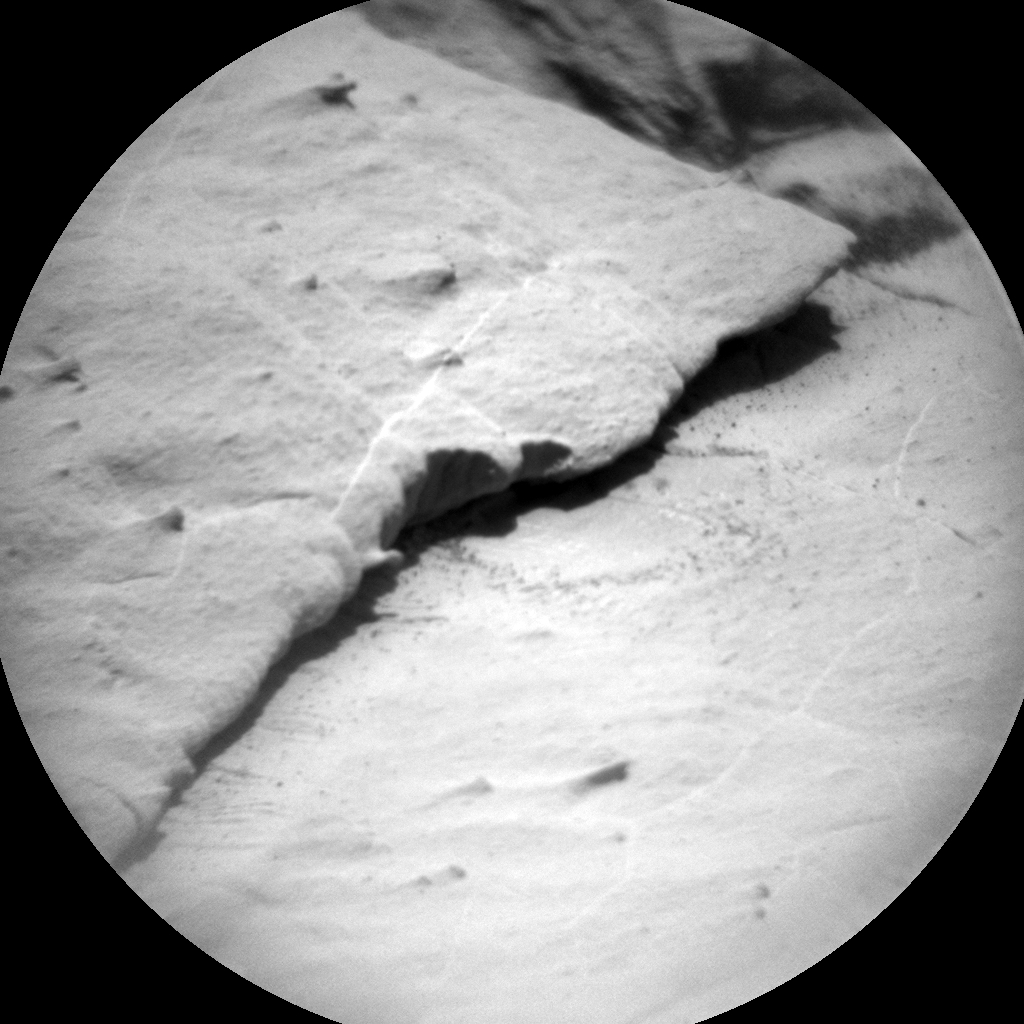
Curiosity Chemistry & Camera (ChemCam) Remote Micro-Imager (RMI) photo acquired on Sol 4099, February 16, 2024.
Image credit: NASA/JPL-Caltech/LANL
On the hunt
“In addition to still collecting lots of images of Gediz Vallis channel, we’re also now on the hunt for another possible drill target that will help us continue to characterize the rocks in the sulfate-bearing unit,” Fraeman adds.
“We’ll assess the textures and compositions of rocks in this and an upcoming dark band to help us determine whether there’s anything we’d like to sample.”
To cover the upcoming U.S. holiday on Monday, four sols of robot work were planned.

Curiosity Right B Navigation Camera imate taken on Sol 4099, February 16, 2024.
Image credit: NASA/JPL-Caltech
Methane measurement
The first sol of the plan is mainly devoted to getting ready for a Sample Analysis at Mars (SAM) Instrument Suite atmospheric observation that will take place just after midnight on the first sol and will measure methane in the Martian atmosphere.
We’ll also have some remote sensing observations on the first sol, with Chemistry and Camera (ChemCam) Laser Induced Breakdown Spectroscopy (LIBS) observations of dark bedrock in front of the rover (“Red Kaweah”) and Mastcam images of Gediz Vallis channel.
Science action
Remote sensing will continue on the second sol of the plan, with more Mastcam observations and a ChemCam LIBS observation of “Muro Blanco,” a light-colored piece of bedrock.

Curiosity Right B Navigation Camera imate taken on Sol 4099, February 16, 2024.
Image credit: NASA/JPL-Caltech
Curiosity’s Mars Hand Lens Imager (MAHLI) and the Alpha Particle X-Ray Spectrometer (APXS) will get in on the science action on the sol as well, Fraeman explains, with observations of two targets on dark toned rocks in front of us named “Thunderbolt Peak” and “Tenderfoot Peak.”
Drive to the south
“We’ll snag one more LIBS observation on the third sol of the plan on Tenderfoot Peak, then we’ll drive roughly 25 meters [82 feet] to the south, towards a rock we are interested in assessing as a possible drill target,” Fraeman reports.

Curiosity Right B Navigation Camera imate taken on Sol 4099, February 16, 2024.
Image credit: NASA/JPL-Caltech
The fourth sol of the plan will be relatively quiet, with Rover Environmental Monitoring Station (REMS) observations to characterize the weather only, Fraeman points out.
Mastcam, Navcam, the Radiation Assessment Detector (RAD) and the Dynamic Albedo of Neutrons (DAN) will also make observations throughout the plan to characterize the Martian environment, Fraeman concludes.
 Posted in Space News

