 By
By  January 3rd, 2024
Enigmatic Venus holds tight its secrets under thick clouds. Image shows the night side of Venus glowing in thermal infrared, captured by Japan’s Akatsuki spacecraft.
Credit: JAXA/ISAS/DARTS/Damia Bouic
Hellish Venus is blistering hot, not only temperature-wise. It’s also a hot topic for scrutinizing whether or not the cloud-enveloped world might be a haven for high-altitude life.
Sara Seager, professor of planetary sciences at the Massachusetts Institute of Technology (MIT) is principal science investigator for the privately launched Rocket Lab Mission to Venus. This January 2025 mission is a first step towards exploring the mysterious chemistry that might be a sign of life, under a series of projected Morning Star Missions to Venus.
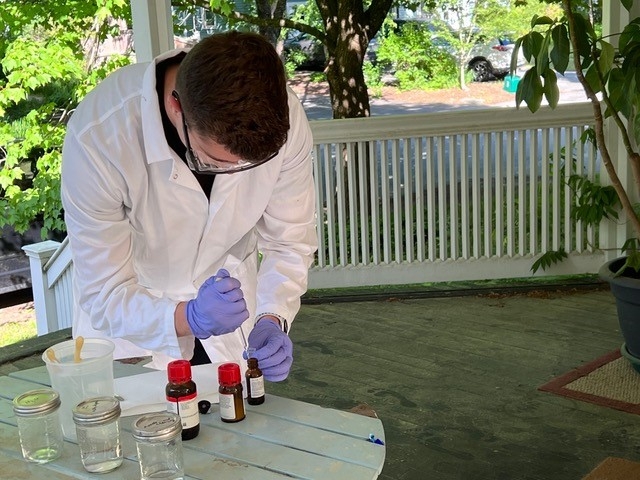
Vile work! Max Seager engages in sulfuric acid studies starting in an outdoor lab the summer 2022, with work now being done in an MIT laboratory.
Image credit: Sara Seager
Biochemistry
Last year, Seager and colleagues, including her university son, authored the research paper with a tell-all title: “Stability of nucleic acid bases in concentrated sulfuric acid: Implications for the habitability of Venus’ clouds.”
That work appeared in the Proceedings of the National Academy of Sciences (PNAS), a peer reviewed journal of the National Academy of Sciences.
“We’re trying to look into the possibility that sulfuric acid droplets could host a biochemistry, not our personal biochemistry, but a different biochemistry,” Seager told Space.com. “We have a lot of lab experiments ongoing and some are coming to fruition.”
For more information, go to my new Space.com story – “1st private mission to Venus will search for alien life in clouds of sulfuric acid” – at:
https://www.space.com/venus-private-mission-alien-life-sulfuric-acid

 Posted in Space News

