 By
By  October 2nd, 2023
In the early morning hours of September 24, NASA’s first sample return mission of bits and pieces of an asteroid successfully parachuted into the Department of Defense Dugway Proving Ground in the Utah Test and Training Range, roughly 80 miles west of Salt Lake City, Utah.
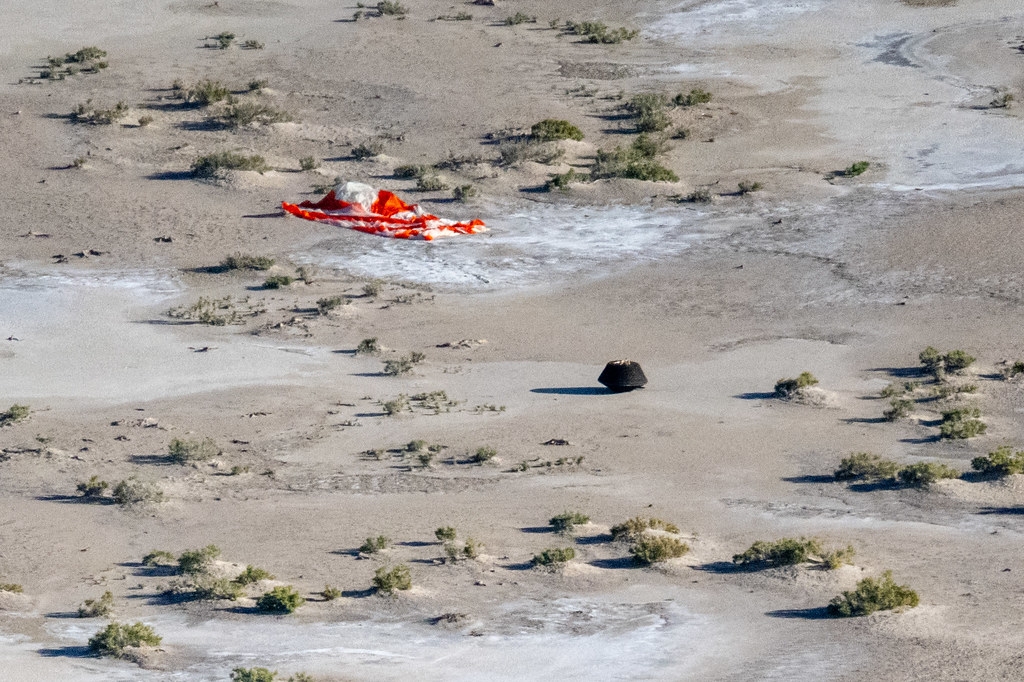
Following its high-speed re-entry, the OSIRIS-REx sample return capsule served as an artificial meteor before parachuting into the desert landscape of the Department of Defense’s Utah Test and Training Range.
Image credit: NASA/Keegan Barber

Diagram indicates the various stages of a sample return capsule flight (not to scale). Infrasound and seismic stations, depending on their location, can detect acoustic signatures generated by the re-entry. The arrow indicates direction of travel.
Image credit: Elizabeth Silber, et al.
That extraterrestrial freight from afar came capsule-contained courtesy of the Origins Spectral Interpretation Resource Identification Security Regolith Explorer (OSIRIS-REx) mission.
Off shoot
But there was an “off shoot” from the capsule’s scorching re-entry as it hot-footed its way to Earth.
Go to my new Multiverse Media/SpaceRef story – “Scientific Bonanza – OSIRIS-REx Asteroid Return Capsule Studied as “Artificial Meteor” – at:
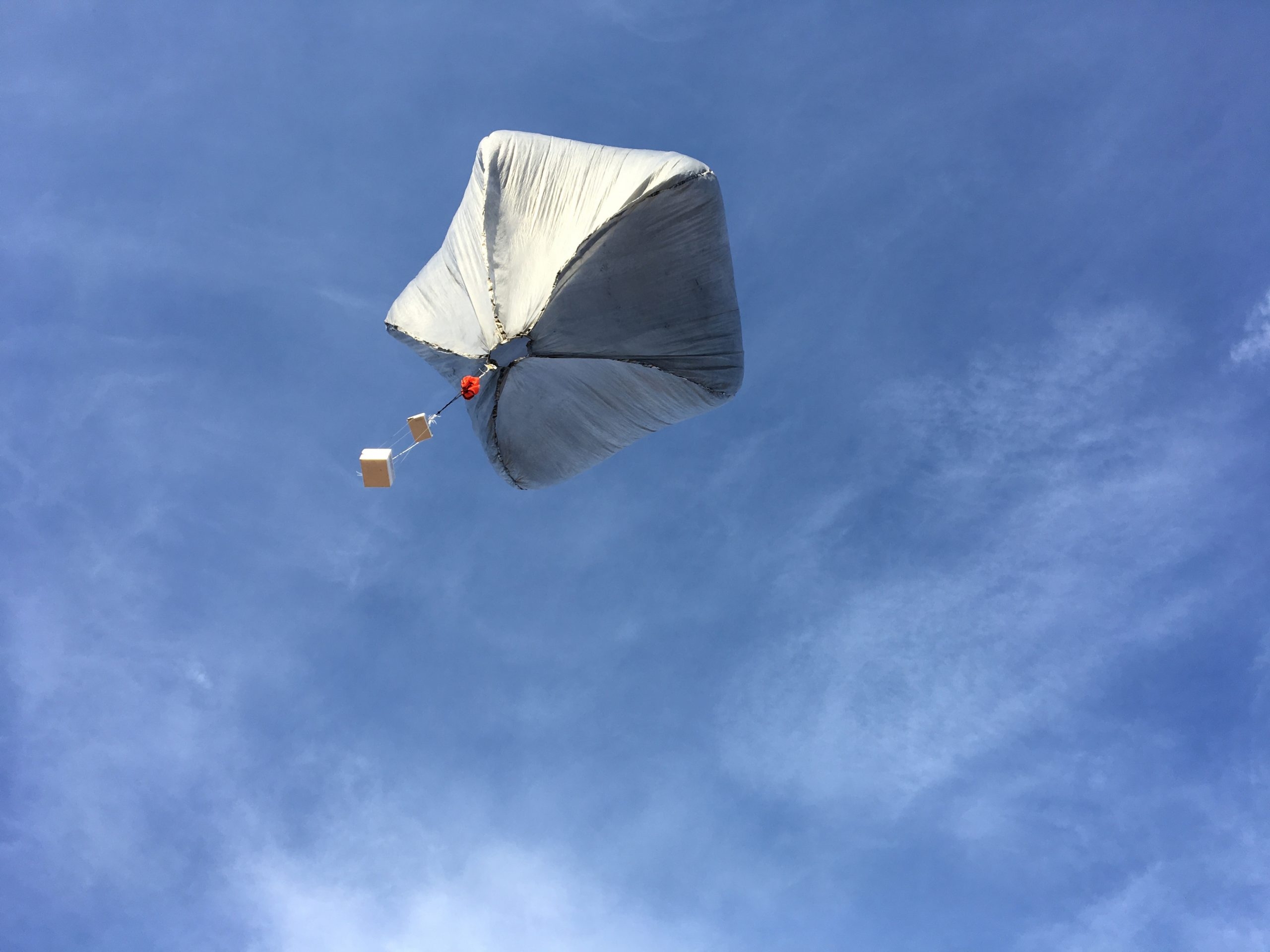
A Sandia National Laboratories balloon taking flight bears sensors including a GPS tracker and reusable infrasound sensor. This type of flight hardware was used to support data-gathering during the re-entry of the OSIRIS-REx capsule into Utah.
Image credit: Sandia National Laboratories

Part of the network of sensors used to record the in-coming OSIRIS-REx capsule re-entry.
Image credit: Sandia National Laboratories/Elizabeth Silber

Sensor equipment was placed right under the point of peak heating by the OSIRIS-REx capsule as it made its way to a Utah landing.
Image credit: Johns Hopkins University/Benjamin Fernando
 Posted in Space News


Thank you for providing this link. I’ll limit my comments to your link, although there is more information about this Subject, but it is behind a paywall.
I’m surprised that there haven’t been more comments sooner on the well-documented, well-tracked recovery, and more to the point: the fact that they had visual on this “artificial meteor” all the way from “peak heating” (most luminous) all the way down to the ground – all the way from hypersonic, thru supersonic, thru transonic, down to subsonic. What this means is that they had visual on this thing thru dark-flight… DARK FLIGHT!
It goes without saying that this is a game-changer. It’s a proof-of-concept that shows this technology could be applied to Earth-crossing meteoroids (of this size and larger) – if we can detect the meteoroid soon enough, if we can predict the fall zone soon enough, and if we can install and test the portable sensor array before the fall event occurs. We’ve proven it can be done.
So, the more pertinent news to me is not that “Artificial Meteor Science Data [is] Gained”, but that “Realtime Meteoroid/Meteorite-Recovery is Now Possible”!
My question is this: How long do we have to wait until an official “Meteorite-Recovery Team” is formed?
Has there even been funding allocated for this capability?
Or is impossible to get funding for an event that may only happen once a decade, if ever?
Or do we have to wait until it becomes political – like when another country beats us to the punch?