 By
By  May 6th, 2023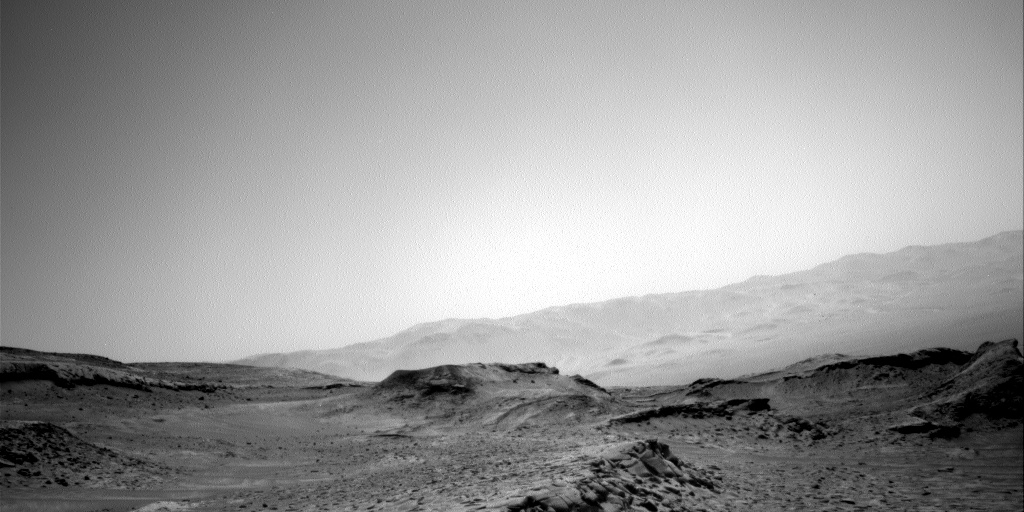
Curiosity Right B Navigation Camera photo taken on Sol 3820, May 6, 2023.
Image credit: NASA/JPL-Caltech
NASA’s Curiosity Mars rover at Gale Crater is now wrapping up Sol 3820 duties.
Catherine O’Connell-Cooper, a planetary geologist at University of New Brunswick; Fredericton, New Brunswick, Canada reports that inspection of “Ubajara” as a potential drill site is underway.

Curiosity Mars Hand Lens Imager (MAHLI) photo produced on Sol 3819, May 5, 2023.
Image credit: NASA/JPL-Caltech/MSSS
“In the last plan, we brushed the surface and did some further investigation of Ubajara’s chemistry and structure,” O’Connell-Cooper adds, and that information gathered by the rover indicated that the target “appears to be representative of what we have been seeing recently, as we climbed up the Canyon from the Marker Band.”
Preload test
As recently scripted, the plan calls for rover planners scoping out a “preload” test, to get an idea of how the rock will behave when drilled. “This involves putting the target under some pressure to make sure the rock is stable and safe to drill,” O’Connell-Cooper notes.
The Mars Hand Lens Imager (MAHLI) on the robot was scheduled to take two documentation images to document any changes.
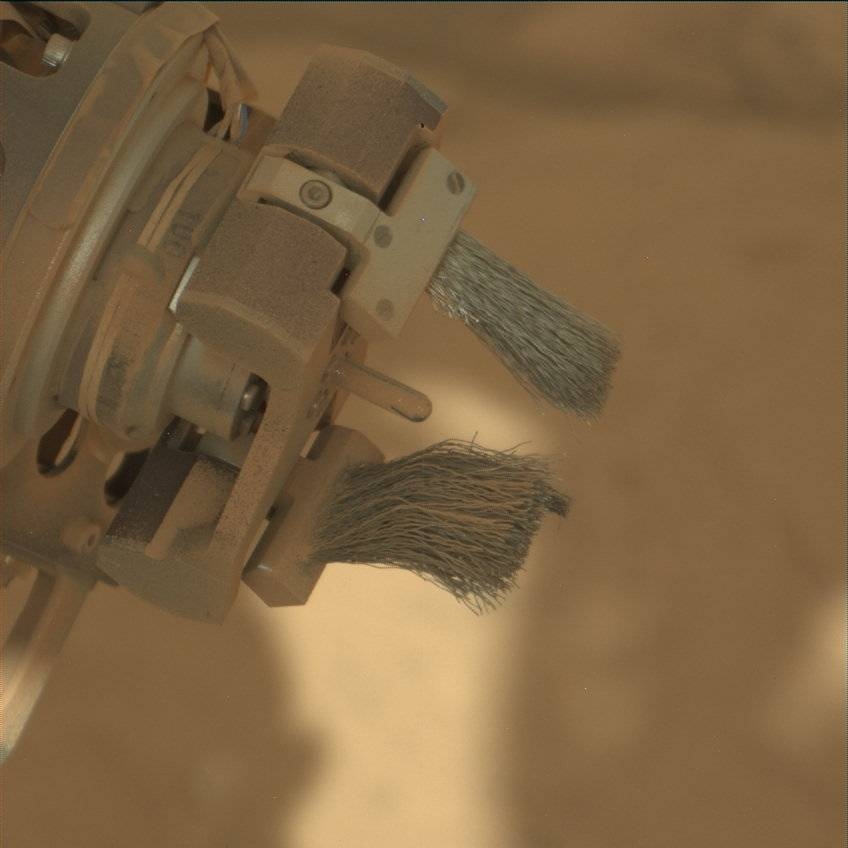
Dust busting dust removal tool! Curiosity Mast Camera Right image taken on Sol 3819, May 5, 2023.
Image credit: NASA/JPL-Caltech/MSSS
“Curiosity won’t be sitting idly for the rest of the weekend,” O’Connell-Cooper says. The rover’s Alpha Particle X-Ray Spectrometer (APXS) and Mars Hand Lens Imager (MAHLI) are investigating a patch of darker material at “Ilha Grande” and some adjacent bedrock at “Ilha Grande offset” for comparison.
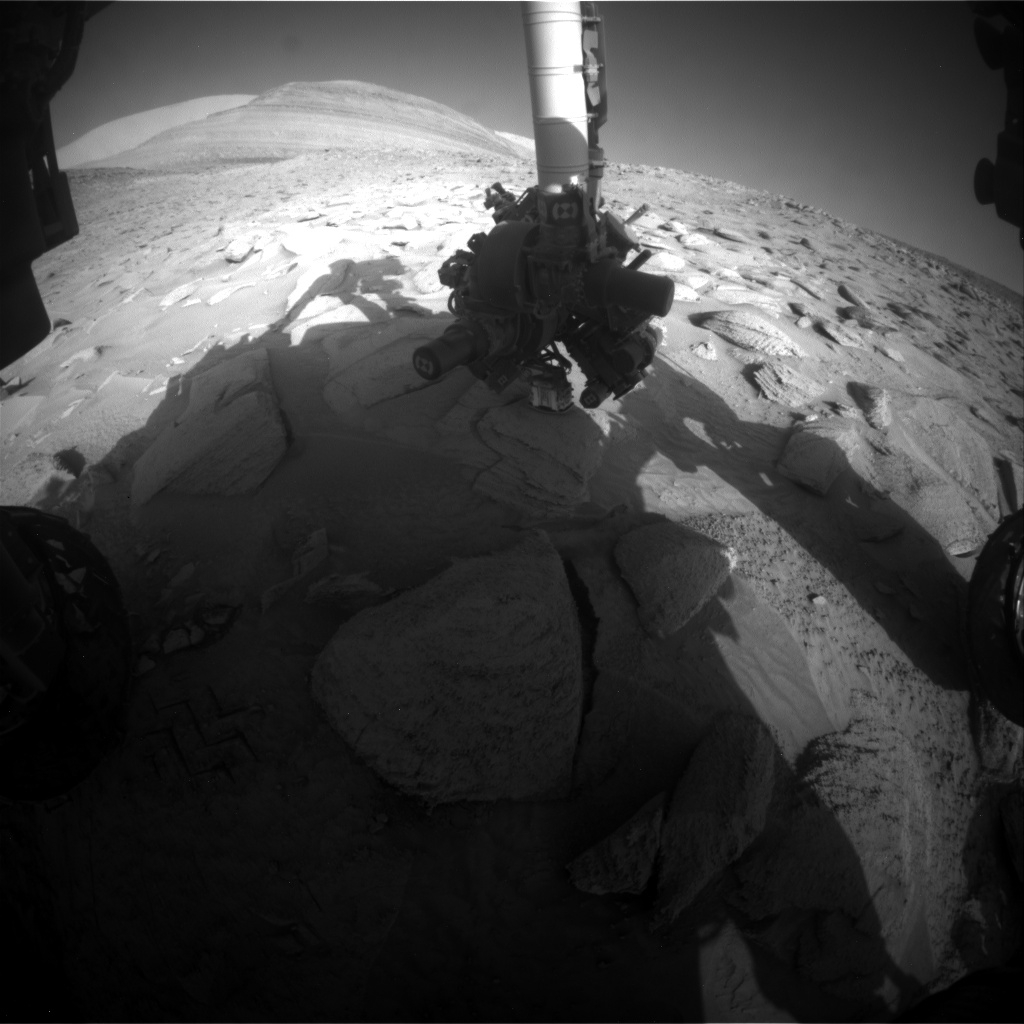
Curiosity Front Hazard Avoidance Camera Left B image acquired on Sol 3819, May 5, 2023.
Image credit: NASA/JPL-Caltech
Dream list
MAHLI is also imaging the target “Bwesse Kiiki” which was analyzed by Curiosity’s Chemistry and Camera’s Laser Induced Breakdown Spectroscopy (LIBS) instrument on sol 3818 (Tuesday of this past week).

Curiosity Chemistry & Camera (ChemCam) Remote Micro-Imager (RMI) photo taken on Sol 3820, May 6, 2023.
Image credit: NASA/JPL-Caltech/LANL
Meanwhile ChemCam will analyze some nodular bedrock just beyond the Ubajara bedrock block at ‘Carajas’ and will take a long distance image (‘LD RMI’), looking ahead to Gediz Vallis, a large ridge feature which has been high on our ‘dream list’ of places to go in Gale since before landing,” O’Connell-Cooper reports.
This ChemCam Remote Micro-Imager (RMI) will focus on an area of large stones and boulders which were identified in previous images.

Curiosity Right B Navigation Camera photo taken on Sol 3820, May 6, 2023.
Image credit: NASA/JPL-Caltech
Future drive direction
“We have been talking about the science we would do here for so many years, it’s hard to believe we are close enough to identify individual stones and boulders! Mastcam is acquiring a “9×3 mosaic” (3 rows of 9 images) of fractured light toned rocks ahead of us in our future drive direction,” O’Connell-Cooper adds. “These are close to some small impact craters, so we are interested to look at the fractures and see if they are related in any way to the craters.”
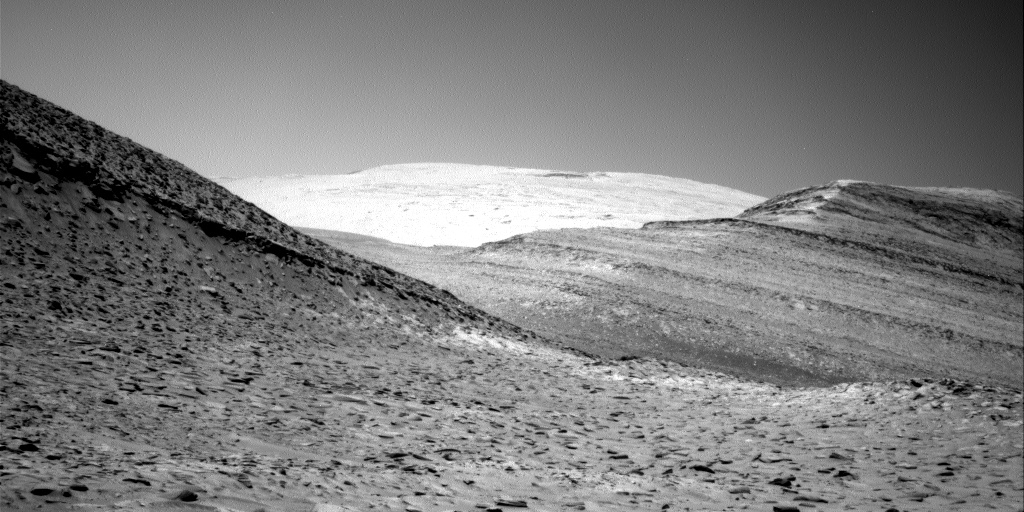
Curiosity Right B Navigation Camera photo taken on Sol 3820, May 6, 2023.
Image credit: NASA/JPL-Caltech
Also on tap is use of Mastcam to monitor dust with a “crater rim image” and two tau measurements. These help to quantify the abundance of dust in the atmosphere.
Several images are slated to be taken to characterize active environmental conditions in Gale, looking at clouds and searching for dust devils.
The Dynamic Albedo of Neutrons (DAN) investigation and the Rover Environmental Monitoring Station (REMS) round out the environmental monitoring, O’Connell-Cooper concludes, measuring hydrogen concentrations (DAN) and temperatures (REMS).
 Posted in Space News

