 By
By  March 13th, 2023
Image credit: Roscosmos
NASA’s budget request this year includes seeking $180 million in fiscal year 2024 to safely de-orbit the massive International Space Station.
Completion of ISS operations is slated for 2030, with the huge structure undergoing a controlled re-entry dumping into ocean waters.
The new budget request includes $180 million in FY 2024, building on the $10 million provided in FY 2023 appropriations to initiate development of this capability.
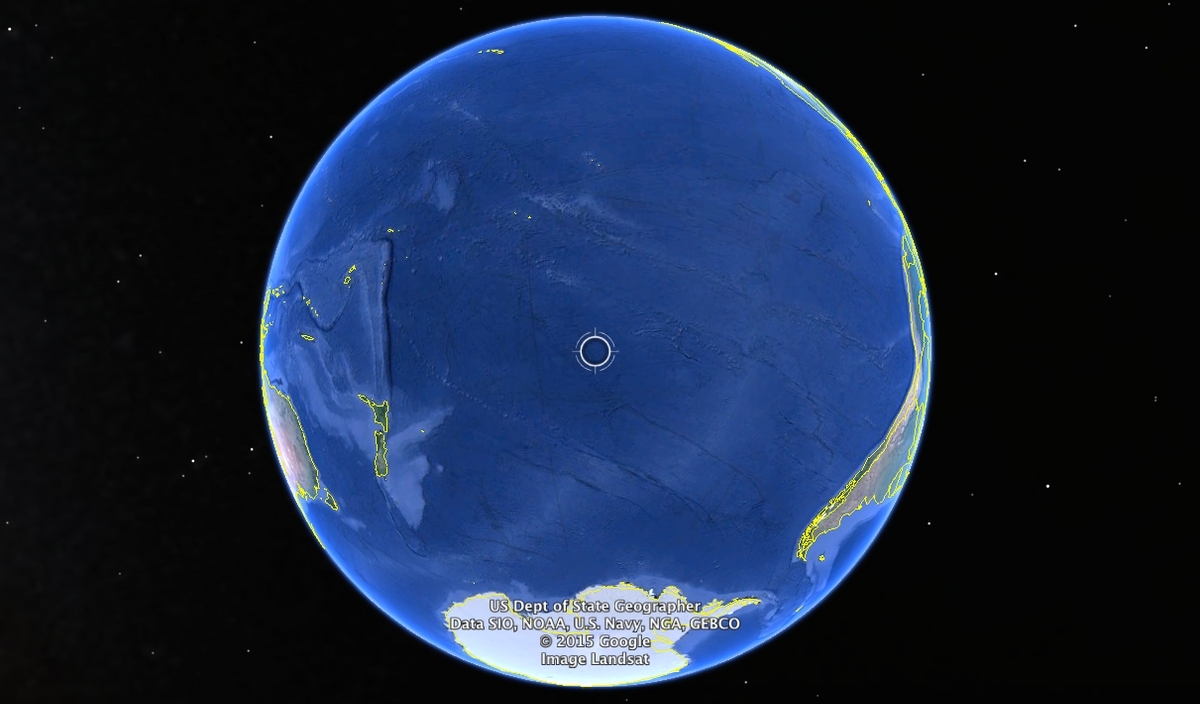
Possible splash down zone for the International Space Station, an area around Point Nemo, formally dubbed “the oceanic pole of inaccessibility.”
Credit: Google/Public Domain
Deorbit vehicle
“NASA and its partners have studied deorbit requirements and determined that additional capabilities are needed to reduce risk and provide for a more robust deorbit capability,” a NASA budget document explains, calling for an ISS de-orbit vehicle.
In 2023, NASA plans to release a Request for Proposal to provide the capability to design, develop, manufacture, launch, and provide the on-orbit operation to enable a controlled re-entry and the safe deorbit of the ISS. A contract award is planned for fall 2023.
“The deorbit vehicle will attach (via docking or berthing) to the ISS at least one year prior to the planned ISS reentry date to enable adequate time for on-orbit tests and checkouts,” the budget document adds. “Although nominal ISS end of life is late 2030, the Government requires that this deorbit capability be available as soon as possible to protect for contingencies that could drive early re-entry.”
For more information on this prospect, go to my Space.com story — “Watery graves: Should we be ditching big spacecraft over Earth’s oceans? It’s a form of pollution, after all” — at:
https://www.space.com/spacecraft-deorbiting-over-earth-oceans-ethical-concerns
 Posted in Space News


Is there no option to simply push it out into space?
Not really. It’s heavy and would require a very large supply of fuel to get it a long distance out. Plus there are problems with having it deteriorate and possibly have components leak or break off.
It would take a LOT of energy (fuel) to push the ISS out of orbit, or even into a higher orbit. Dropping it into the atmosphere would require very little (it would fall on its own, given time), but dropping it in the right place, without hitting anything else, requires a bit of finesse.
I wonder if anybody has considered selling it in place, though. Some billionaire would likely be willing to pay to use it as a high-end vacation destination for other billionaires. But the various governments involved would probably rather spend money deorbiting it instead of making a profit.
Even with a billionaire, I’d want to see a bond securing proper maintenance and ultimate disposition, but a billionaire should be able to afford that.
Even so, you’re probably right. For a while I was involved in a local government’s efforts to sell surplus real estate. It generally went cheap to some politically favored group. When I suggested we had a duty to maximize value for the taxpayers,I got an odd look.
The issue is age. The original ISS modules are nearing 25 years-old, are showing signs of stress-related wear, and replacing them isn’t practical. Hate to say it but NASA and/or private companies will be better off building newer, more robust structures, perhaps using 3-D printing technology. https://youtu.be/bfsidvoSIGA