 By
By  February 8th, 2023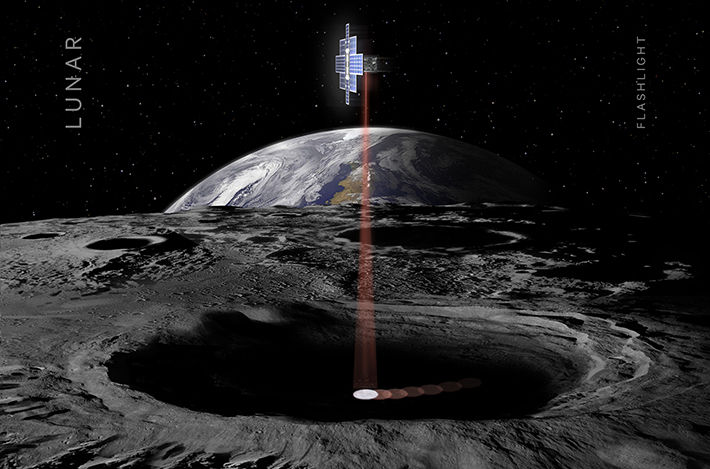
Moon orbiting Lunar Flashlight.
Credit: NASA/JPL
That troubled NASA Lunar Flashlight mission is facing an uphill battle in achieving its primary goals.
The Lunar Flashlight team decided to attempt lunar flybys using any remaining thrust that the probe’s out of kilter propulsion system can deliver.
This new attempt is designed to get the CubeSat into high Earth orbit, which includes periodic flybys of the lunar south pole once a month to collect data. The team plans to begin maneuvers on Thursday, and, if successful, the expected first science pass will now be in June.

Image credit: NASA GSFC Arizona State University
Stretch science goal
The CubeSat launched on Dec. 11, 2022, to demonstrate several new technologies with what NASA is now characterizing as “a stretch science goal” of detecting surface ice at the Moon’s south pole.
Shortly into Lunar Flashlight’s journey, the mission operations team discovered three of its four thrusters were underperforming.
“The rest of the CubeSat’s onboard systems are fully functional, and the mission recently successfully tested its four-laser reflectometer,” a NASA posting explains. “This mini-instrument is the first of its kind and is designed and calibrated to seek out surface ice inside the permanently shadowed craters at the Moon’s south pole.”
 Posted in Space News

