 By
By  January 9th, 2023
Once again, the Philippine Space Agency (PhilSA) advised the country’s public to take precautions related to launch of China’s Long March 7A from the Wenchang Space Launch Center in Hainan Island.
That booster hurled three satellites, Shijian-23, Shiyan-22A and Shiyan-22B, into orbit from Wenchang on January 8, 2023, at 22:00 UTC (9 January, at 06:00 local time).
PhilSA noted that unburned debris from the rocket were projected to fall in two drop zones.
- Drop zone area 1 is 79.877 kilometers from Burgos, Ilocos Norte, and 121.306 kilometers from Dalupiri Island in the Babuyan Islands.
- Drop zone area 2 is 41.686 kilometers from Sta. Ana, Cagayan, 41.37 kilometers from Camiguin Island in the Babuyan Islands, and 47.844 kilometers from Babuyan Island.
Danger and potential risk
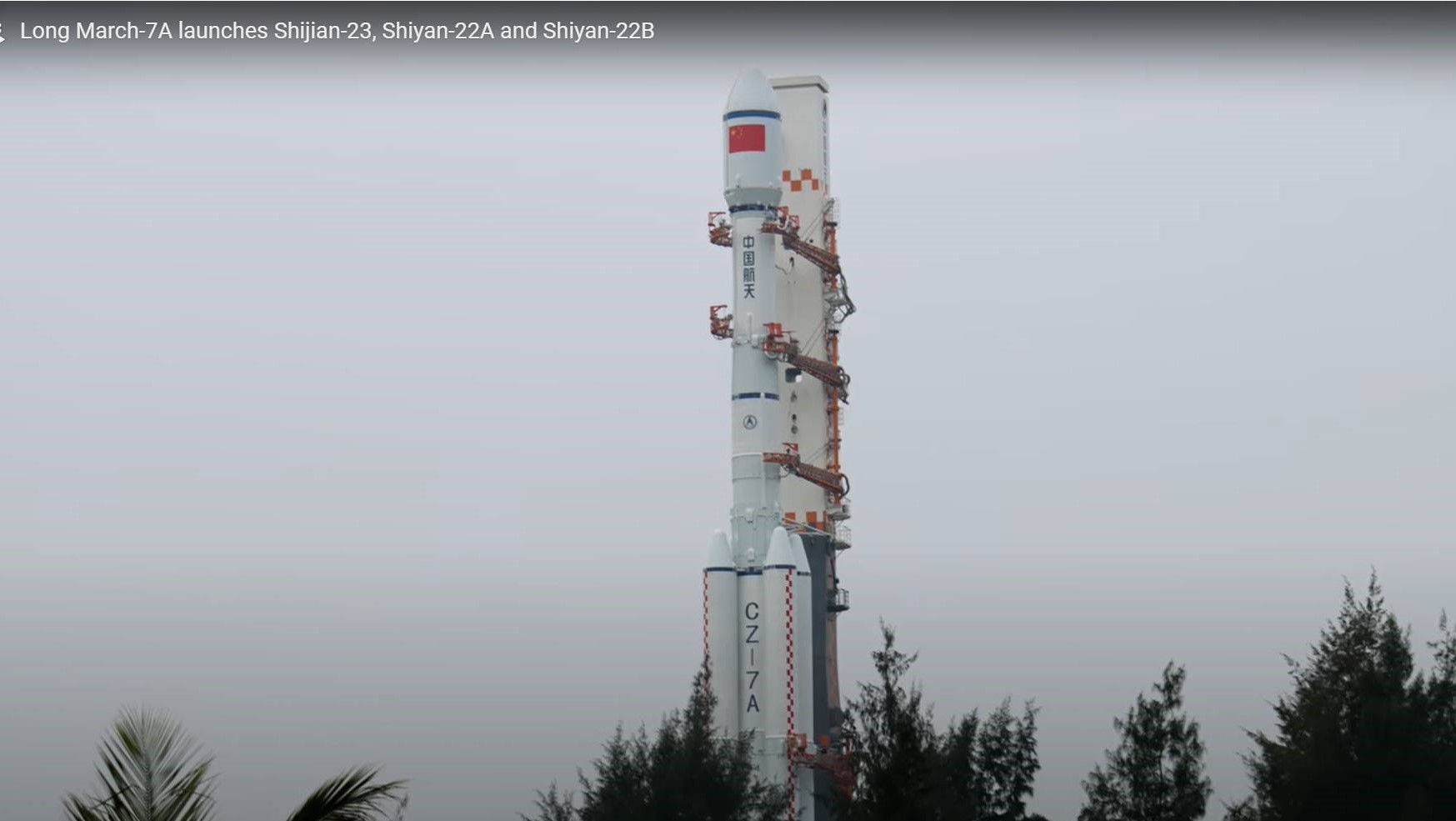
Image credit: China Central Television (CCTV)/China Aerospace Science and Technology Corporation (CASC)
“While not projected to fall on land features or inhabited areas,” the PhilSA advisory explains, “falling debris poses danger and potential risk to ships, aircraft, fishing boats, and other vessels that will pass through the drop zone. There is also a possibility for the debris to float around the area and wash toward nearby coasts. Additionally, the possibility of an uncontrolled re-entry to the atmosphere of the rocket’s upper stages returning from outer space cannot be ruled out at this time.”
PhilSA repeated earlier advice for the public to inform local authorities if suspected debris is sighted.
“PhilSA also cautions against retrieving or coming in close contact with these materials that may contain remnants of toxic substances such as rocket fuel,” the advisory adds.
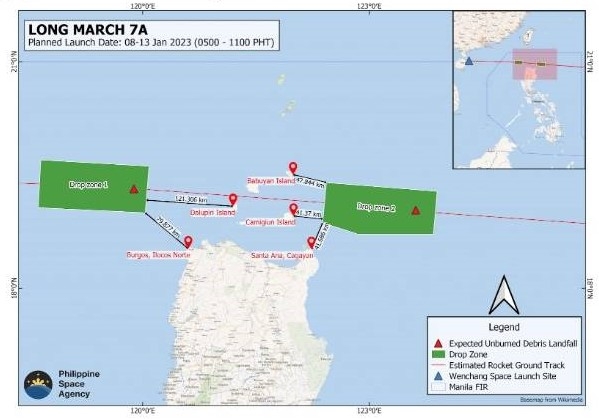
Image credit: PhilSA
Advance notice
Prior to the launch, the Civil Aviation Administration of China issued Notice to Airmen (NOTAM) warnings “due to an aerospace flight activity.”
Upon coordination with the Civil Aviation Authority of the Philippines, the coordinates of the areas where expected unburned debris from the rocket fallout were identified.
“PhilSA immediately issued advance notice to relevant government agencies and authorities as soon as the launch dates have been confirmed, and has recommended the issuance of appropriate air and marine warnings,” the advisory explains.
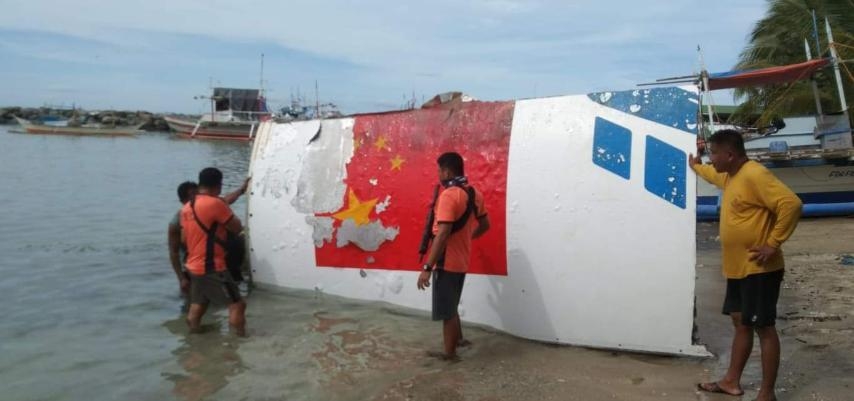
China Long March-5B Y3 rocket remains from July 24, 2022.
Image credit: Philippine Coast Guard/Mamburao
Beijing and Manila spat
In a recent agreement signed between Beijing and Manila, the countries made a joint statement that a notification system for rocket launches is to be established. That cooperation reportedly flowed from a recent diplomatic spat about turning over Chinese debris found in Philippine waters.
Both sides have noted their willingness to establish an information notification system on rocket launches, as well as hammer out procedures for the retrieval and return of space debris.
 Posted in Space News

