 By
By  December 17th, 2022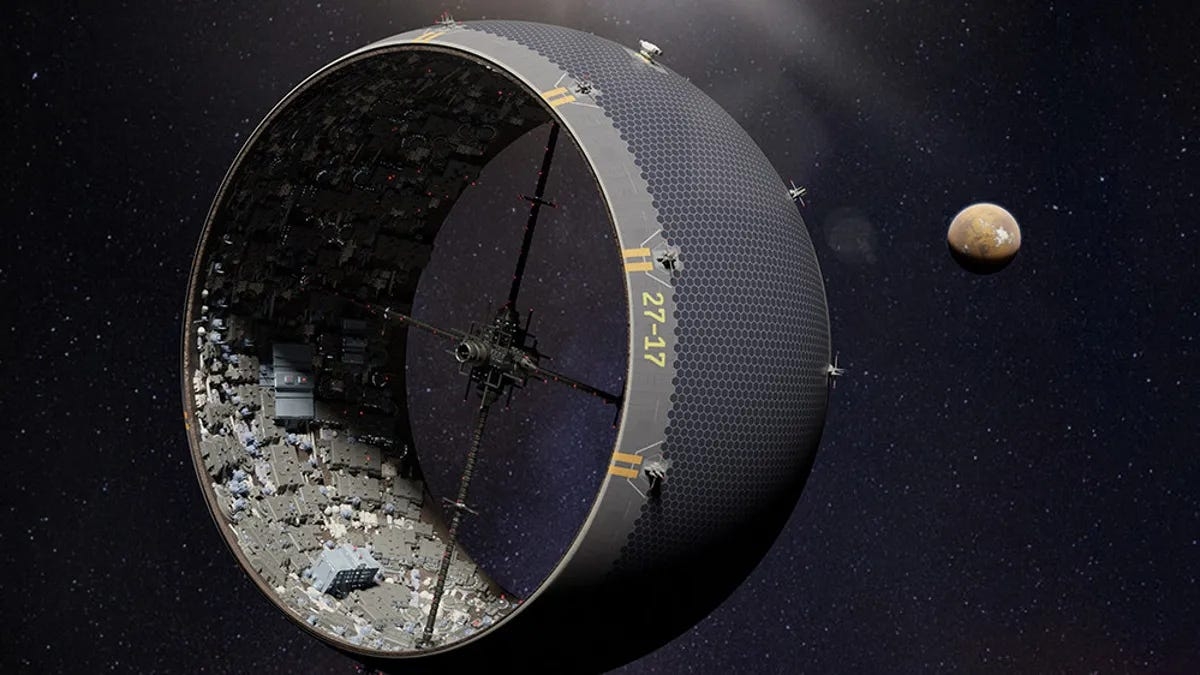
Rochester researchers imagine covering an asteroid in a flexible, mesh bag made of ultralight and high-strength carbon nanofibers as the key to creating human cities in space.
Image credit: University of Rochester illustration/Michael Osadciw)
Researchers have proposed using near-Earth asteroids (NEAs) as a platform for humanity’s expansion into space.
Due to NEA trajectories, a habitat built on an asteroid has implications for interplanetary transport. Manipulating an asteroid’s extensive mass could create shielding from the hazards of space, such as solar radiation.
In recent research paper, what’s being suggested is carefully spinning such a NEA habitat so artificial gravity can be generated for human occupants, ideal for long-term space travel.
For detailed information, go to “Habitat Bennu: Design Concepts for Spinning Habitats Constructed From Rubble Pile Near-Earth Asteroids” at:
https://www.frontiersin.org/articles/10.3389/fspas.2021.645363/full
 Posted in Space News


THIS IS A VERY CLEAN C0NCEPT, IS IT AN EASY BUILD IN SPACE LIKE THE gATEWAYS MODULES?