 By
By  December 5th, 2022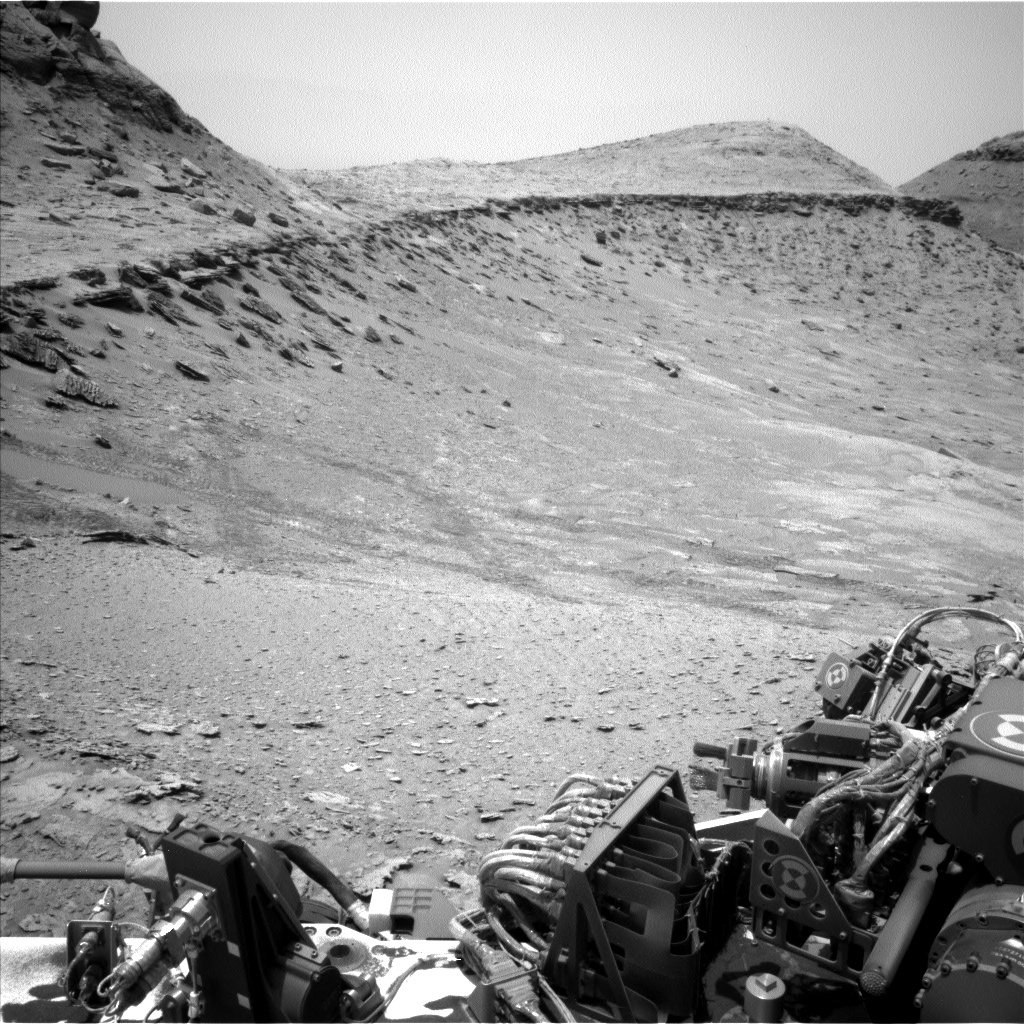
Curiosity Left B Navigation Camera image taken on Sol 3672, December 5, 2022.
Image credit: NASA/JPL-Caltech
NASA’s Curiosity Mars rover at Gale Crater is now performing Sol 3673 duties.
Elena Amador-French, a science operations coordinator at NASA’s Jet Propulsion Laboratory reports that, as happens occasionally, a previous plan did not execute quite as expected.
There was an issue with the rover’s avionics in last Wednesday’s plan just before the Mars Hand Lens Imager (MAHLI) was to take images of our contact science target “Roxinho.”
“This precluded that imaging, the subsequent drive and observations taken from our remote sensing mast. Thankfully our engineering team here at JPL assessed the fault and felt comfortable clearing us for nominally planning this morning,” Amador-French notes.

Curiosity Left B Navigation Camera image taken on Sol 3672, December 5, 2022.
Image credit: NASA/JPL-Caltech
Previous plan recovery
The science observations job on a morning like this, Amador-French says, “is to take stock of what activities we need to recover from the previous plan with the fault, make sure they make it into today’s plan and then consider what additional activities we have the resources to bring in.”
As is typical for a 3-sol Friday plan (Sols 3671-3673), Mars researchers were able to bring in contact science as well as a drive.
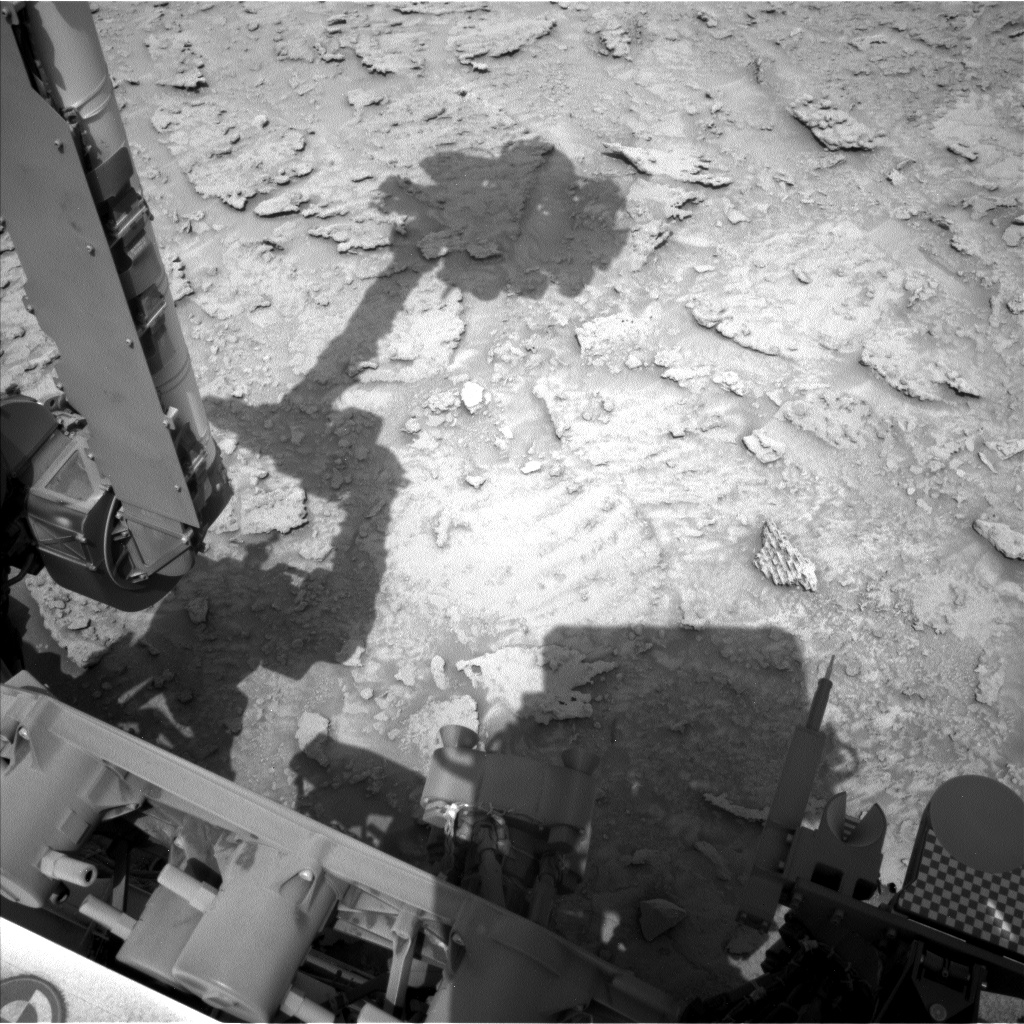
Curiosity Left B Navigation Camera image taken on Sol 3672, December 5, 2022.
Image credit: NASA/JPL-Caltech
“We worked to recover the “Roxinho” MAHLI target, but also brought in a new target “Shabono” which we will brush to remove any pesky dust and will inspect,” Amador-French adds, with both MAHLI and the Alpha Particle X-Ray Spectrometer (APXS).

Curiosity Left B Navigation Camera image taken on Sol 3672, December 5, 2022.
Image credit: NASA/JPL-Caltech
Rhythmically layered bedrock
“Shabono is another example of the lovely rhythmically layered bedrock,” Amador-French explains. Robot operators are also using the MAHLI camera to image the Chemistry & Mineralogy X-Ray Diffraction/X-Ray Fluorescence Instrument (CheMin) inlet funnel for any remaining debris after the rover’s “Canaima” drill campaign back in October – a requirement before any new sample is delivered to CheMin.

Curiosity Left B Navigation Camera image taken on Sol 3672, December 5, 2022.
Image credit: NASA/JPL-Caltech
Curiosity controllers will recover the same drive previously planned on last Wednesday. This drive will be about 50 feet (15 meters) and will set the robot up to perform contact science on an interesting slab of bedrock that the science team is considering for its next sampling campaign.
Untargeted observations
The third sol of the plan (Sol 3673) includes typical untargeted observations – using the Chemistry and Camera (ChemCam) Autonomous Exploration for Gathering Increased Science – a software suite that permits the rover to autonomously detect and prioritize targets.
As for the AEGIS capabilities to autonomously select a Laser Induced Breakdown Spectroscopy (LIBS) target: “It’s so nice” Amador-French concludes “when the rover does the thinking for us, as well as our regular environmental monitoring observations.”

Curiosity Left B Navigation Camera image taken on Sol 3672, December 5, 2022.
Image credit: NASA/JPL-Caltech
 Posted in Space News

