 By
By  October 25th, 2022
Credit: NASA
As robots wheel across the Red Planet and future human footprints are implanted there, ancient bacteria may well lurk beneath Mars’ surface.
A new study finds the chances of uncovering life on Mars are better than previously expected.
Michael Daly from the Bethesda, Maryland-based School of Medicine, Uniformed Services University of the Health Sciences, and colleagues, sought to better understand the impact of the martian surface, inundated with ionizing radiation — on microbial dormancy and survivability.
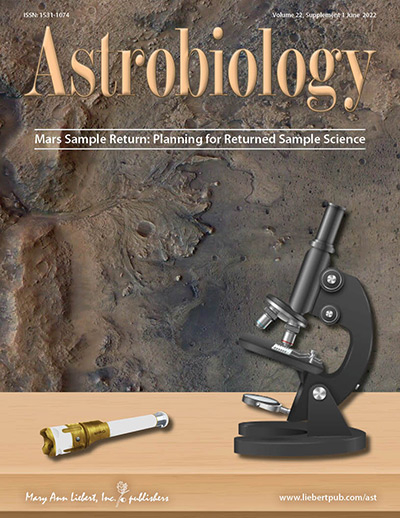
Credit: Astrobiology
The study results are published today in the peer-reviewed journal Astrobiology.
Conan the bacterium
Researchers mimicked the conditions on Mars and tested the influence of desiccation and freezing on the ionizing radiation survival of six model microorganisms: vegetative cells of two bacteria, a strain of yeast, and vegetative cells and endospores of three Bacillus bacteria.
They found that the hearty bacterium — D. radiodurans — could survive 280 million years if buried. Indeed, if life ever evolved on Mars, then its living remains could still be dormant in the deep subsurface.
D. radiodurans is affectionately known as “Conan the Bacterium.”
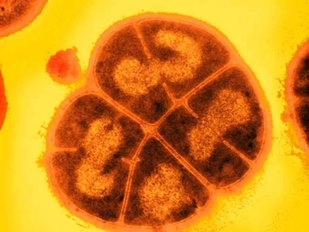
D. radiodurans (affectionately known as “Conan the Bacterium”) is particularly well-suited to surviving Mars’ harsh environment.
Credit: Michael Daly, et al.
Surviving radiation
“We report that desiccated and frozen cells of the bacterium D. radiodurans can survive astonishing ionizing radiation,” stated the investigators, “exposures equivalent to hundreds of millions of years of background radiation on Mars.”
The new findings, “Effects of desiccation and freezing on microbial ionizing radiation survivability: Considerations for Mars sample-return,” was supported by the Defense Threat Reduction Agency and the National Institutes of Health.
This new work comes at a time when NASA’s Mars return sample to Earth project is jelling. It becomes important to protect Earth from potential extraterrestrial sources of contamination. Likewise, it is critical to avoid mistaking Earth life for indigenous life hauled back from Mars.

Newly revised Mars Sample Return campaign makes use of a set of machines, including use of helicopters, to collect Martian soil, rock and atmospheric specimens for return to Earth.
Image Credit: NASA/JPL-Caltech
Comprehensive look
John Rummel, an Astrobiology Editorial Board Member, noted that “the work put forward by Michael Daly and his colleagues represents a comprehensive look at the interactions between desiccation, freezing, and radiation survivability in one of our most tenacious microbes, Deinococcus radiodurans,” he said in an Astrobiology statement.
Even if viable lifeforms are not now present on Mars, given that whole viable D. radiodurans cells can survive the equivalent of 280 million years in the frozen martian subsurface, then their macromolecules would survive much, much longer.
“This strengthens the probability that, if life ever evolved on Mars, this will be revealed in future missions,” the investigators concluded.
Rummel added that the potential for D. radiodurans or other Earth microbes to survive present-day conditions on Mars “draws attention to the need for a complex analysis regarding the very real possibility of Earth microbes contaminating specific landing sites on Mars, and even some of them—as qualified martian survivors—showing up in our studies after a ride home to Earth in a sample returned from Mars.”

Mars Life Explorer – a general engineering model for MLE with solar panels, drill, and science payload on lander deck.
Courtesy: Amy Williams
Deep drilling
The research team, including Northwestern University’s Brian Hoffman and Ajay Sharma, reported that ancient bacteria could survive close to the surface on Mars much longer than previously assumed. And — when the bacteria are buried and, thus, shielded from galactic cosmic radiation and solar protons — they can survive much longer.
Any biological remains of life could be revealed in future missions, such as the European Space Agency’s ExoMars (Rosalind Franklin rover) and the projected Mars Life Explorer, which will carry drills to extract materials from 6.5 feet (2 meters) below the surface.
“Importantly, these findings have biodefense implications, too, because the threat of biological agents, such as Anthrax, remains a concern to military and homeland defense,” said study leader, Daly, in the university statement.
Back contamination
According to Hoffman, senior co-author of the first-of-its-kind study: “We concluded that terrestrial contamination on Mars would essentially be permanent…over time frames of thousands of years.” This may well complicate scientific efforts to search for Mars life, he said.

Signs of ancient life on Mars could be preserved in layered rocks like those shown in this illustration of NASA’s Perseverance rover in Jezero crater.
Credit: NASA/JPL-Caltech
“Likewise, if microbes evolved on Mars, they could be capable of surviving until present day. That means returning Mars samples could contaminate Earth,” said Hoffman.
Although Conan the Bacterium could only survive for a few hours at the surface while bathed in ultraviolet light, its lifetime improves dramatically when it is shaded or located directly below Mars’ surface.
According to the university statement, buried just 10 centimeters below the Martian surface, “Conan the Bacterium’s survival period increases to 1.5 million years. And, when buried 10 meters down, the pumpkin-colored bacterium could survive a whopping 280 million years.”
To view the paper — “Effects of Desiccation and Freezing on Microbial Ionizing Radiation Survivability: Considerations for Mars Sample Return” — go to:
https://www.liebertpub.com/doi/10.1089/ast.2022.0065
To access a collection of informative works in Astrobiology — Mars Sample Return: Planning for Returned Sample Science – go to:
 Posted in Space News

