 By
By  October 23rd, 2022
Chang’e-5: Returned lunar samples are offering new insight into the evolution of Earth’s Moon.
Credit: CNSA
China’s lunar exploration program has revealed how volcanism takes place on Earth’s Moon.
Bits and pieces of the Moon were rocketed back to Earth in December 2020 via the country’s Chang’e-5 lunar mission. Detailed looks at those returned samples continue to offer new perspectives on the Moon’s volcanic history.
One new finding: young volcanoes surprisingly took shape on the cooling Moon two billion years ago.
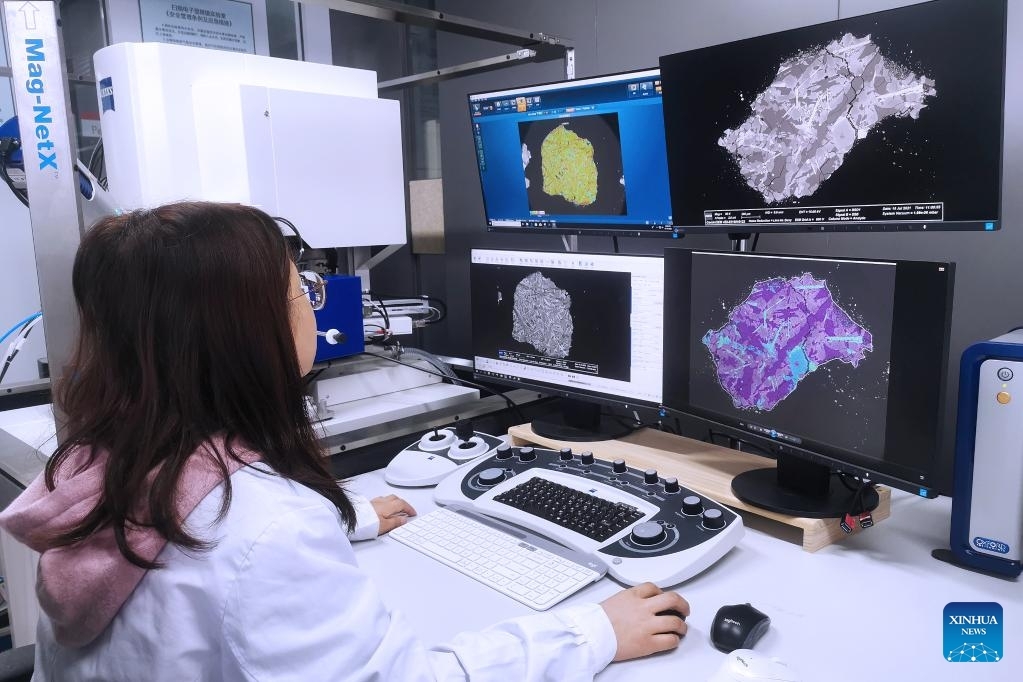
Under scientific scrutiny, specimens from the Moon returned to Earth for detailed study.
Credit: IGGCAS
Young lunar volcanism
A new study has been published on in the journal Science Advances showing that the mantle melting-point depression due to the presence of fusible, easily-melted components could generate young lunar volcanism.

Credit: IGGCAS
The new work was carried out by the Institute of Geology and Geophysics of the Chinese Academy of Sciences (IGGCAS). A team of researchers scrutinized 27 Chang’e-5 basalt clasts to calculate the original ingredients of those samples. A clast is defined as a fragment of an older rock, now broken up and embedded in a younger one.
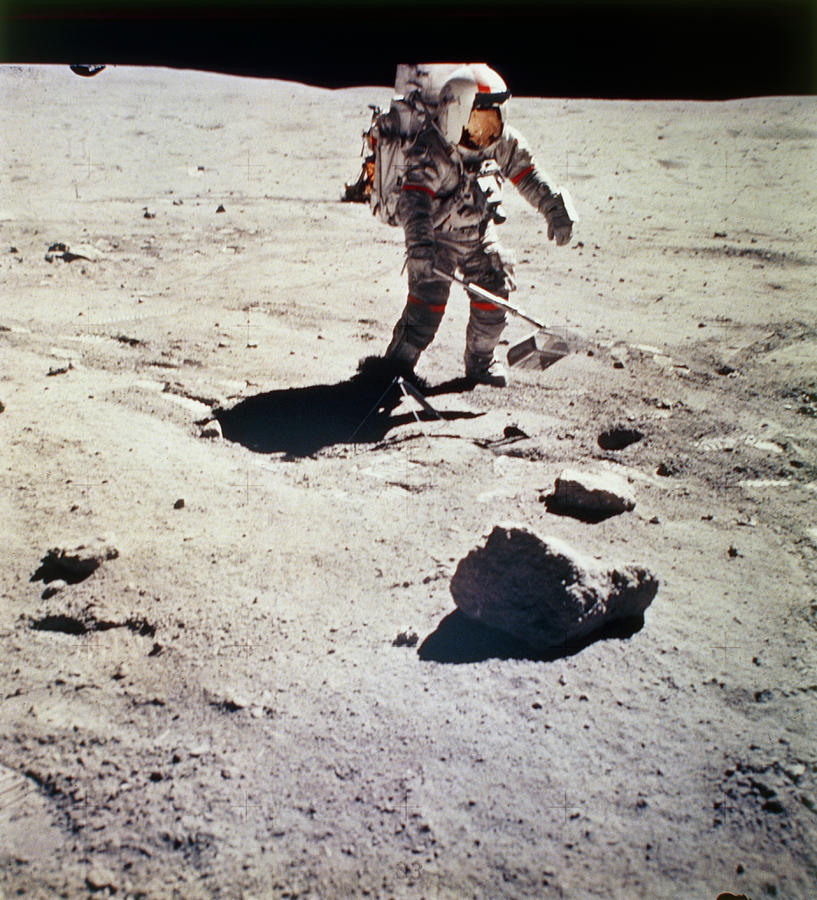
Apollo 16 photo shows on-site gathering of lunar specimens.
Credit: NASA
According to the just-released paper, the Chang’E-5 mission “has demonstrated that lunar volcanism was still active until two billion years ago, much younger than the previous isotopically dated lunar basalts.”
Ruling out a theory
How the small Moon retained enough heat to drive such late volcanism is unknown.
The study team found that the young Chang’e-5-source magma might have higher calcium oxide and titanium dioxide contents than magmas in older samples returned by the Apollo lunar landing missions decades ago.

Chinese President Xi Jinping inspects Chang’e-5 lunar sample return capsule.
Credit: CCTV/Inside Outer Space screengrab
The Chang’e-5 lunar samples rule out the theory that the Moon has been geologically dead after the formation of Apollo returned-to-Earth samples from at least 3 billion years ago.
To view the entire paper – “Fusible mantle cumulates trigger young mare volcanism on the cooling Moon” – go to:
 Posted in Space News

