 By
By  October 21st, 2022
The Red Planet as seen by Europe’s Mars Express.
Credit: ESA/D. O’Donnell – CC BY-SA IGO
Getting hardware and science gear down and dirty on Mars is an expensive proposition – be it via airbags, retrorockets or a “rover on a rope” technique called the Sky Crane.
Put aside for a moment the multi-billion dollar campaign to extract rock, soil, and atmospheric samples from the Red Planet, hauling those collectibles back to Earth for detailed study. That Mars Sample Return project promises to be a financially “big ticket,” money-hungry endeavor.

Newly revised Mars Sample Return campaign makes use of a set of machines, including use of helicopters, to collect Martian soil, rock and atmospheric specimens for return to Earth.
Image Credit: NASA/JPL-Caltech
Lander/shock absorber in one
Enter the SHIELD, for Simplified High Impact Energy Landing Device.
It’s a collapsible Mars lander designed to intentionally crash land on the Red Planet, absorbing the impact and protecting onboard science devices.

Part lander, part shock absorber in one is the once called Small High Impact Energy Landing Device (SHIELD) concept.
Credit: NASA/JPL/Caltech
“SHIELD is basically both a lander and a shock absorber in one,” said Louis Giersch, the primary investigator for SHIELD. Still being evaluated is what kinds of science instruments make sense, be they weather sensors, cameras, mass spectrometers, or other micro-devices.
SHIELD’s goal is to make doable a broad suite of potential missions. For example, the technology could potentially allow NASA to put down dozens of individual robots over a relatively short timespan, dotting the distant planet with landers.
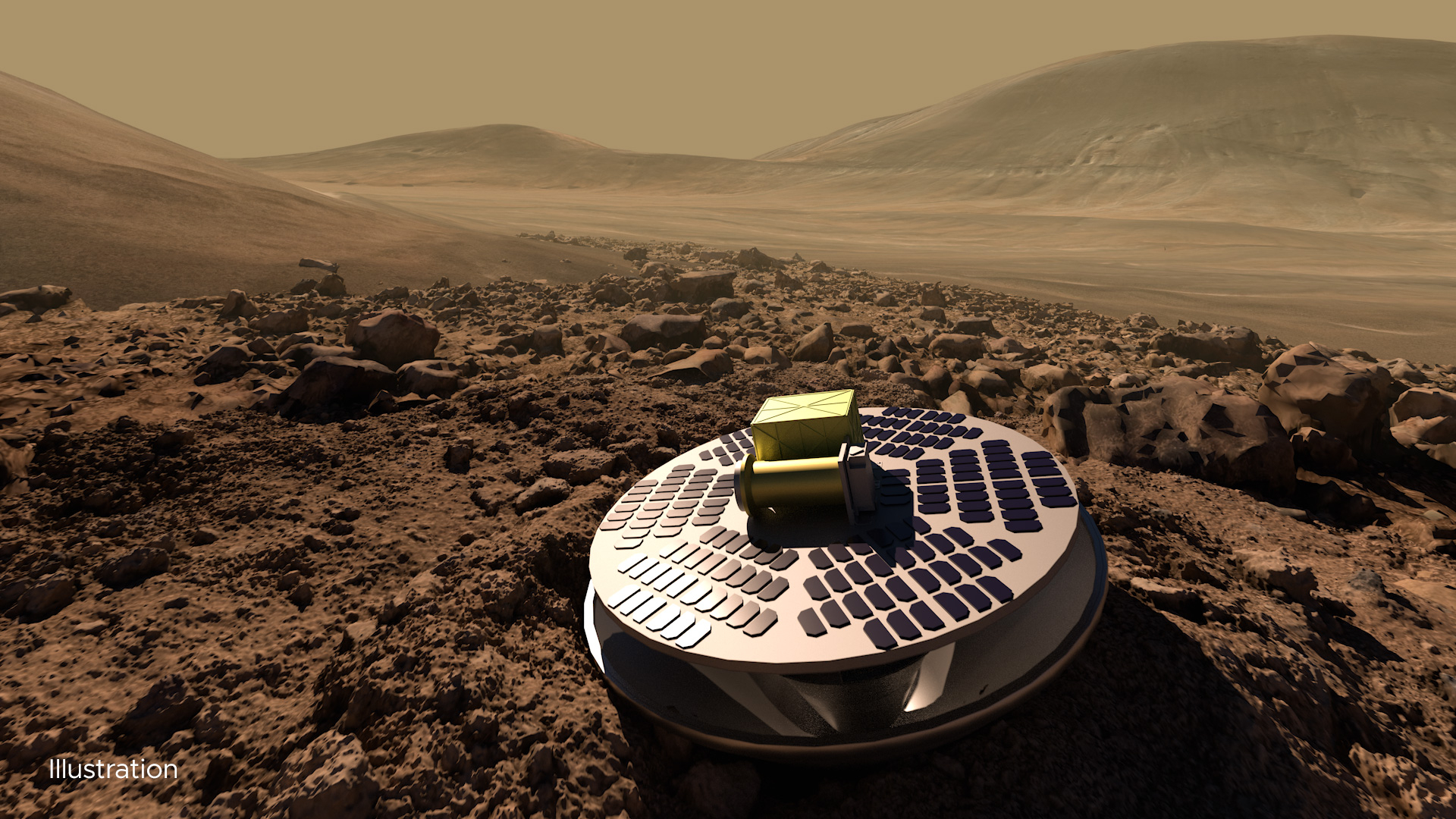
A current illustration of SHIELD that would allow lower-cost missions to reach the Red Planet’s surface by safely crash landing, using a collapsible base to absorb the impact. Credit: California Academy of Sciences
Giant sling
To help confirm SHIELD can guard sensitive electronics during a head-on crash landing, a drop tower at the Jet Propulsion Laboratory (JPL) is being used. It features a giant sling – called a bow launch system – that can hurl an object into the surface at the same speeds reached during a Mars landing.
The bow launcher has slammed SHIELD into the ground at roughly 110 miles per hour (177 kilometers per hour) – the velocity that a Mars lander reaches near the surface after being slowed by atmospheric drag.
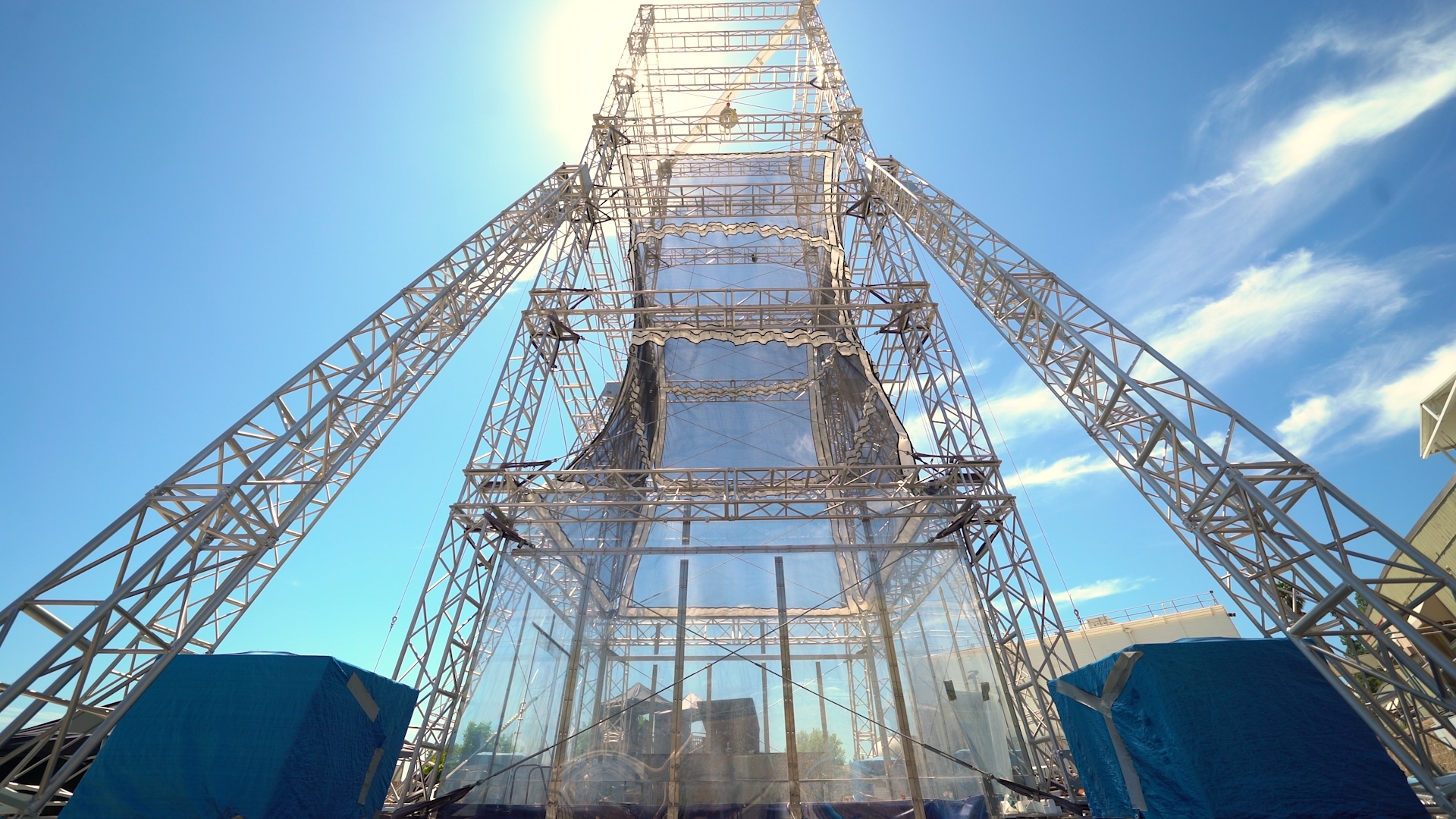
This drop tower at JPL includes a bow launch system, which can hurl test articles 110 mph into the ground, re-creating the forces they would experience during a Mars landing.
Credit: NASA/JPL-Caltech
As follow-on, the next step is designing the rest of a lander in 2023 and seeing just how far the SHIELD idea can go forward…straight into Mars!

This prototype base for SHIELD – a collapsible Mars lander that would enable a spacecraft to intentionally crash land on the Red Planet, absorbing the impact – was tested in a drop tower at JPL on Aug. 12 to replicate the impact it would encounter during a Mars landing.
Credit: NASA/JPL-Caltech
For a video depicting the SHIELD testing, go to:
Also, go to these stories I’ve written that spotlight the emerging role of low-cost missions to open up Mars to a new era of exploration.
Go to:
- “NASA rethinks its Mars strategy” at:
https://aerospaceamerica.aiaa.org/features/nasa-rethinks-its-mars-strategy/
- “Mars on the cheap: Scientists working to revolutionize access to the Red Planet – The concepts include souped-up Mars helicopters and inexpensive orbiters and landers” at:
 Posted in Space News

