 By
By  October 7th, 2022
Earth’s Moon, a dusty denizen of deep space. How as it formed?
Credit: NASA/Jeff Williams
The Moon is usually thought to have coalesced from the debris ejected by a giant impact onto the early Earth, hit by a Mars-sized impactor dubbed “Theia.”
But new research suggests giant impacts can immediately place a satellite with similar mass and iron content to the Moon into orbit far outside Earth’s “Roche limit.”
That limit is the distance from a celestial body within which a second celestial body — held together only by its own force of gravity — will disintegrate because the first body’s tidal forces exceed the second body’s gravitational self-attraction.
However, high-resolution simulations have revealed how giant impacts can immediately place a satellite into a wide orbit with a Moon-like mass and iron content.
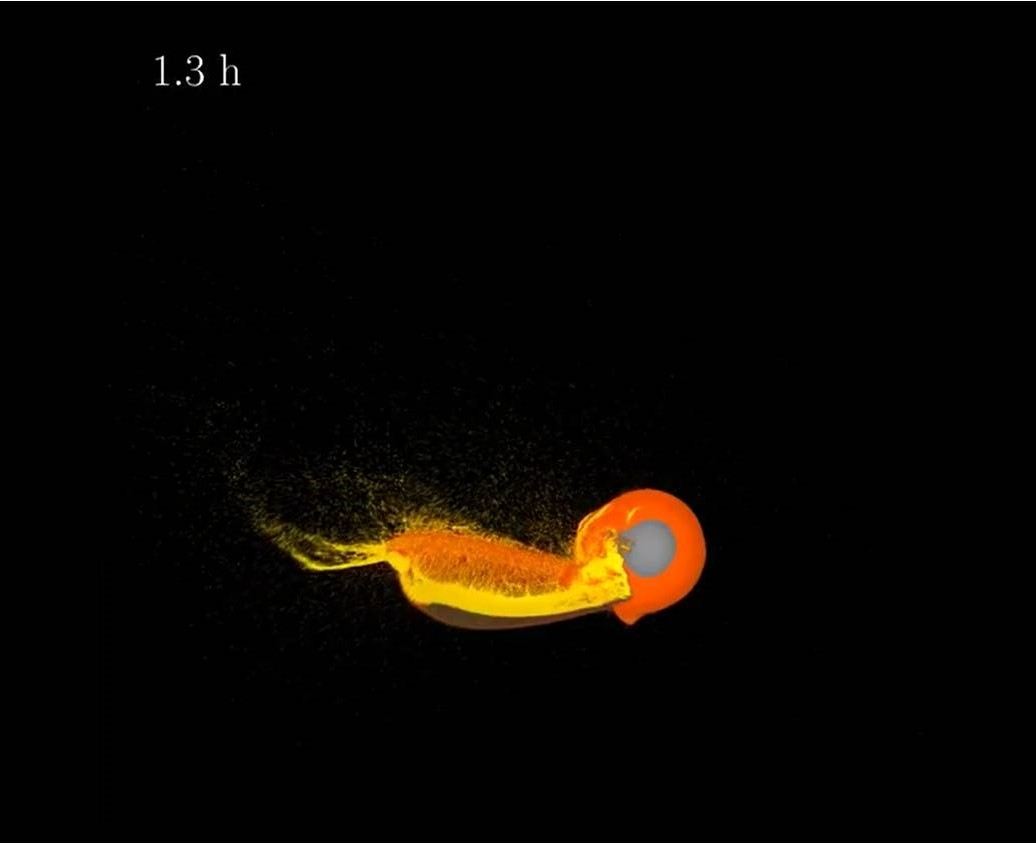
Credit: Jacob Kegerreis, et al.
“The resulting outer layers rich in proto-Earth material and the new options opened up for the initial lunar orbit and internal structure could help to explain the isotopic composition of the Moon and other unsolved or debated lunar mysteries,” explains the research paper – “Immediate Origin of the Moon as a Post-impact Satellite” – appearing in The Astrophysical Journal Letters
The research is led by Jacob Kegerreis in the physics department at the Institute for Computational Cosmology, Durham University in the UK.
Impact scenarios – hotly debated
Past models struggle to explain the similar isotopic compositions of Earth and lunar rocks at the same time as the system’s angular momentum, and the details of potential impact scenarios are hotly debated, Kegerreis and colleagues report.
“Above a high resolution threshold for simulations, we find that giant impacts can immediately place a satellite with similar mass and iron content to the Moon into orbit far outside Earth’s Roche limit. Even satellites that initially pass within the Roche limit can reliably and predictably survive, by being partially stripped and then torqued onto wider, stable orbits,” the research team explains.

Credit: Jacob Kegerreis, et al.
The concept of immediate formation opens up new options for the Moon’s early orbit and evolution, the researchers add, including the possibility of a highly tilted orbit to explain the lunar inclination, and offers a simpler, single-stage scenario for the origin of the Moon.
This new data could help explain the isotopic composition of the Moon and other unsolved or debated lunar mysteries, Kegerreis and colleagues report.
To read the full paper – “Immediate Origin of the Moon as a Post-impact Satellite” – go to:
https://iopscience.iop.org/article/10.3847/2041-8213/ac8d96/pdf
Also, go to these striking videos at:
http://icc.dur.ac.uk/giant_impacts/moon_wide_orbit_slice.mp4
http://icc.dur.ac.uk/giant_impacts/moon_wide_orbit_houdini.mp4
 Posted in Space News

