 By
By  April 3rd, 2014
Europe’s ExoMars 2018: Landing sites under review
Credit: ESA-Roscosmos/LSSWG/D. Loizeau
Europe is pressing ahead on blueprinting its Red Planet exploration via the ExoMars program.
Some 60 scientists and engineers came together late last month for the first ExoMars 2018 Landing Site Selection Workshop, held at the European Space Agency’s (ESA) European Space Astronomy Centre near Madrid.
Their task was to begin the process of drawing up a shortlist of the most suitable landing locations for ESA’s first Mars rover.
The rover can cover a limited driving range in the course of its seven-month nominal surface exploration mission.

ESA’s ExoMars Rover.
Credit: ESA
And the landing site votes are in!
Four sites
The workshop attendees favored four candidate sites. All of the landing spots are located relatively near the equator.
They are: Mawrth Vallis, Oxia Planum, Hypanis Vallis and Oxia Palus.
The area around Mawrth Vallis and nearby Oxia Planum contains one of the largest exposures of ancient, clay-rich rocks on the planet.
The other two sites represent former fluvial environments.
A final shortlist of up to four candidate sites is expected in June 2014, prior to a more detailed analysis. According to the ExoMars project, some attention will be given to three other sites: Coogoon Valles, Simud Vallis and Southern Isidis.
The aim is to complete the certification of at least one landing site for the ExoMars rover by the second half of 2016. The final decision on the landing site will be taken sometime in 2017.
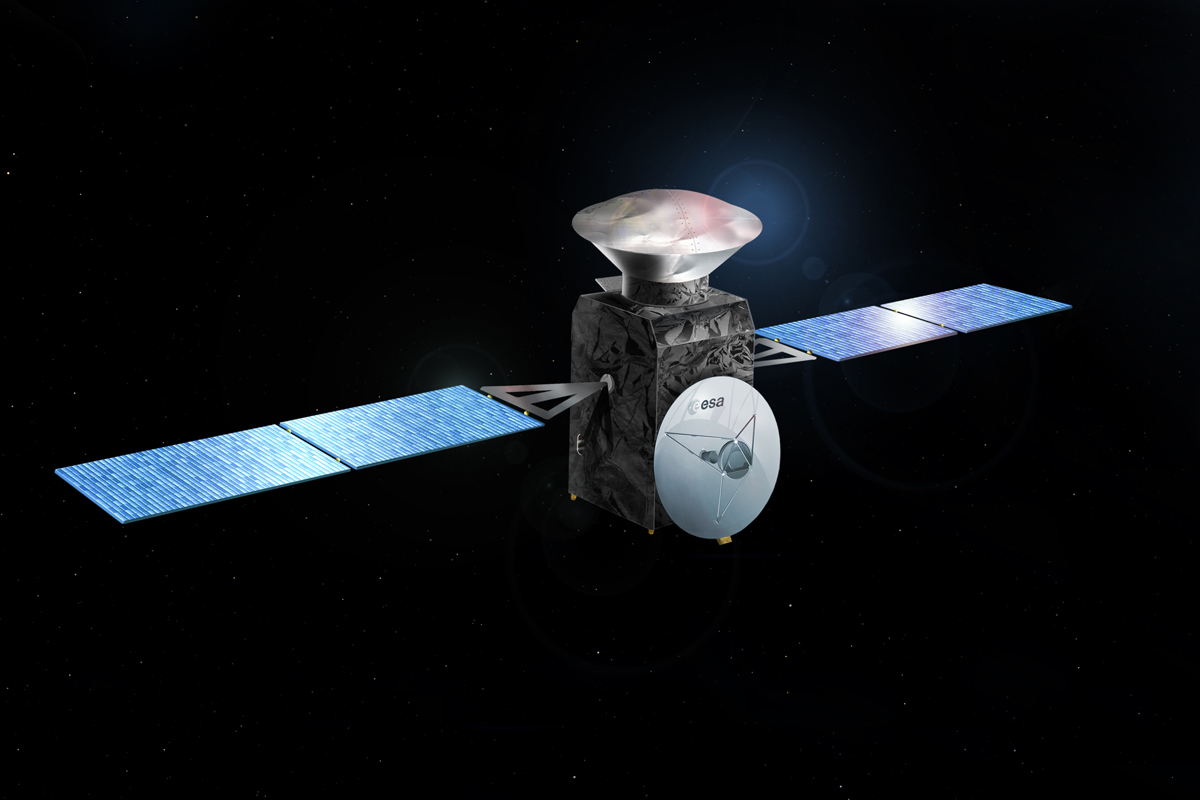
ExoMars Trace Gas Orbiter and Entry, Descent and Landing Demonstrator Module
Credit: ESA
Two missions are foreseen within the ExoMars program: one consisting of an Orbiter plus an Entry, Descent and Landing Demonstrator Module, to be launched in 2016.
The other mission, featuring a rover, has a launch date of 2018.
Both missions will be carried out in cooperation with Russia’s Roscosmos. Roscosmos will provide a Proton launcher for both missions.
The 2016 mission includes a Trace Gas Orbiter (TGO) and an Entry, Descent and Landing Demonstrator Module (EDM).
The Orbiter will carry scientific instruments to detect and study atmospheric trace gases, such as methane.
The EDM will contain sensors to evaluate the lander’s performance as it descends, and additional sensors to study the environment at the landing site.
The 2018 mission includes a rover that will carry a drill and a suite of instruments dedicated to exobiology and geochemistry research.
 Posted in Space News

