 By
By  September 12th, 2022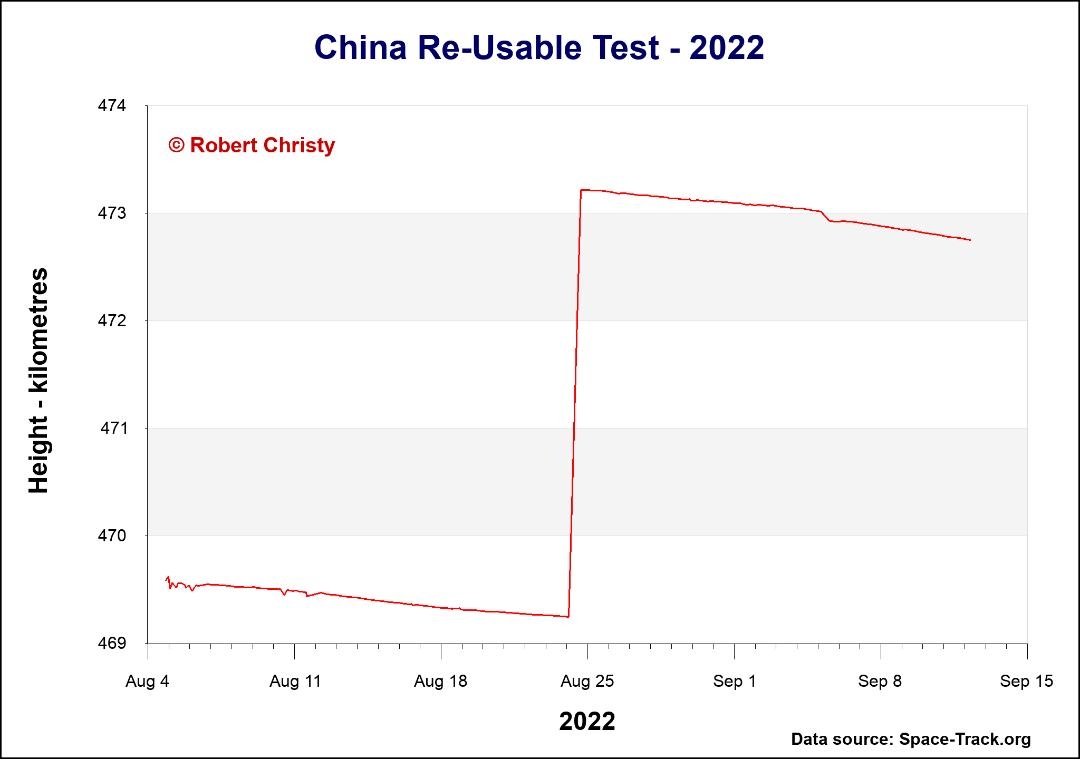
China’s mysterious reusable space plane remains in orbit, a mission that got underway on August 4th. This “reusable experiment spacecraft” was hurled into orbit from Jiuquan in the Gobi Desert atop of a Long March 2F rocket.
This type craft flew back in September 2020, but performed a much shorter shake-out mission of two days.
As for the currently flying space plane, Inside Outer Space reached out to Bob Christy and his informative website: http://orbitalfocus.uk/ and hisTwitter: @OrbitalFocus for an update.

Possible design of China’s space plane.
Source: Homem do Espaco/Twitter
Long-duration flight
“I suspect this is a long-duration test or operational flight after the 2020 ‘shakedown,’” Christy said.
“The vehicle itself hasn’t performed any startling maneuvers so far,” Christy said. There was a small adjustment, he added, when a 1.9 mile (3 kilometers) orbit raise on August 24 took it from 215 miles x 368 miles (346 km x 593 km) to 218 miles x 370 (351 km x 595 km) altitude.
“An almost-imperceptible change September 5 lowered it by a few hundred meters. There is no obvious reason for the changes but possibilities are thruster tests and/or debris avoidance maneuvers,” Christy explained. “The orbit is decaying very slowly, probably indicating that it is flying nose or tail first, presenting a high mass/cross-section ratio to the air,” he said.
Unidentified object
“Early days, radio trackers detected transmissions similar to those from a small satellite left in orbit after the 2020 flight. It then fell silent,” Christy said.
He went on to explain: “A possibility is a detachable camera package on an arm and used to inspect the re-entry insulation. We may get a further clue if it too is left behind after the space plane lands back on Earth. As yet, it is still attached to the main craft.”
Landing opportunities
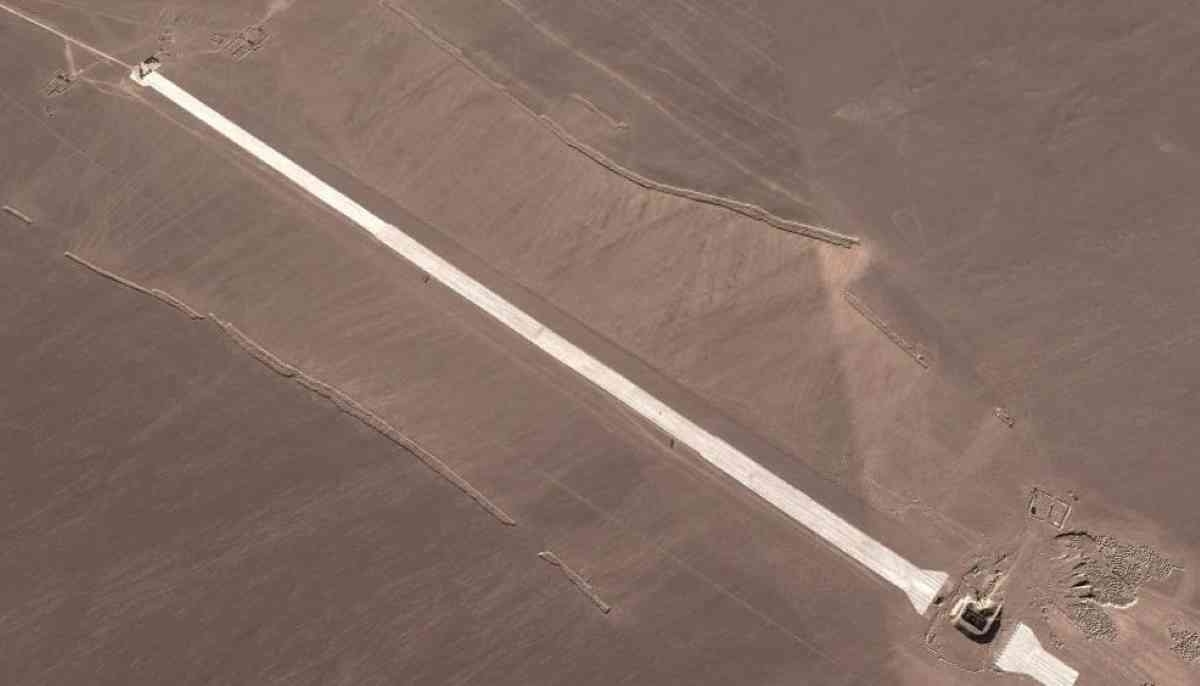
There was an early landing opportunity at a Lop Nor landing strip on August 27, Christy noted, under similar on-orbit and ground lighting conditions — and from a similar ground track — to the 2020 flight.
“Ideal” ground tracks for the space plane’s landing now occur every 12 days and similar lighting conditions recur every 60 days, Christy added.
“They probably shouldn’t be taken as strict rules because there’ll be leeway in the lighting constraints and it will have a degree of cross-track maneuverability,” said Christy.

Encapsulated X-37B Orbital Test Vehicle for United States Space Force-7 mission.
Credit: Boeing
U.S. space plane
Often characterized as akin to the U.S. Space Force X-37B space plane, China’s now orbiting long-duration winged vehicle has a lot of catching up to do.
The X-37B Orbital Test Vehicle (OTV-6) was launched on May 17, 2020. OTV-6 is also called USSF-7 for the U.S. Space Force.
OTV-6 is nearing 850 days of flight.
The still orbiting X-37B space drone broke the program’s on-orbit record for long duration flight on July 6 at 5:49:08 ZULU, according to a Pentagon statement provided to Inside Outer Space.

X-37B Air Force space plane.
Credit: Boeing/Inside Outer Space Screengrab
Flight roster
Here’s a listing of previous flights of the X-37B Space Force space plane:
OTV-1: launched on April 22, 2010 and landed on December 3, 2010, spending over 224 days on orbit.
OTV-2: launched on March 5, 2011 and landed on June 16, 2012, spending over 468 days on orbit.
OTV-3: launched on December 11, 2012 and landed on October 17, 2014, spending over 674 days on orbit.
OTV-4: launched on May 20, 2015 and landed on May 7, 2015, spending nearly 718 days on-orbit.
OTV-5: launched on September 7, 2017 and landed on October 27, 2019, spending nearly 780 days on-orbit.

X-37B (OTV-5) on the runway after landing at the Kennedy Space Center.
Credit: U.S. Air Force
Progressive records: time on orbit
As to when and where OTV-6 will return to a wheels-stopped landing is anybody’s guess.
OTV-1, OTV-2, and OTV-3 missions landed at Vandenberg Air Force Base, California, while the OTV-4 and OTV-5 missions landed at Kennedy Space Center, Florida.
According to the builder of the space plane, Boeing, a fact sheet explains that “the X-37B is one of the world’s newest and most advanced re-entry spacecraft, designed to operate in low-earth orbit, 150 to 500 miles above the Earth. The vehicle is the first since the Space Shuttle with the ability to return experiments to Earth for further inspection and analysis. This United States Air Force unmanned space vehicle explores reusable vehicle technologies that support long-term space objectives.”
At first designed to fly 270 days per mission, Boeing adds that “the X-37B has set progressive records for time on orbit during each of its five previous missions.”
 Posted in Space News

