 By
By  July 16th, 2022
Credit: NASA
“New and unexpected” findings from the Alpha Magnetic Spectrometer (AMS) on the International Space Station, says Samuel Ting of MIT at the Committee on Space Research (COSPAR) being held July 16-24, 2022 in Athens, Greece.
The Alpha Magnetic Spectrometer is a precision particle physics magnetic spectrometer, normally used in accelerators, installed on the International Space Station.
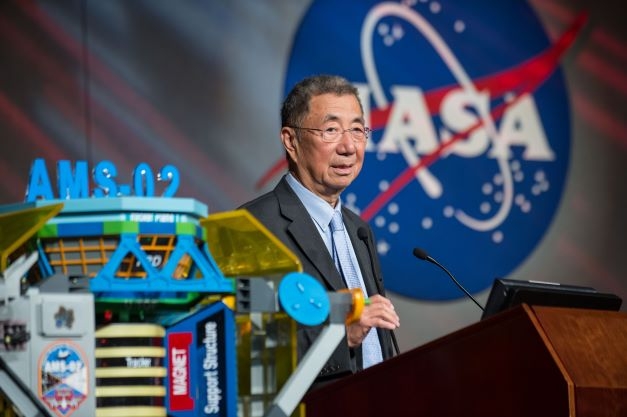
Nobel Laureate Samuel Ting, principal investigator for the Alpha Magnetic Spectrometer, speaks about the first published results of AMS-02 during a 2013 press conference at NASA’s Johnson Space Center in Houston.
Credit: NASA/James Blair
Nobel Laureate Samuel Ting, principal investigator for the AMS, reports that in ten years the space-based equipment has collected more than 200 billion cosmic rays of elementary particles and nuclei with a large acceptance and per cent level accuracy.

Credit: NASA
New physics
“The results on positrons, electrons, and antiprotons show the existence of new physics,” Ting explains.
“The results on nuclei, from hydrogen to iron, show that the current understanding of cosmic rays cannot explain the data,” Ting notes in a COSPAR abstract. “The ten-year AMS results require the development of a new and comprehensive theory of the cosmos.”
AMS was launched on Space Shuttle Endeavour on May 16, 2011, then attached to the International Space Station’s Starboard Truss-3 structure.
 Posted in Space News

