 By
By  June 9th, 2015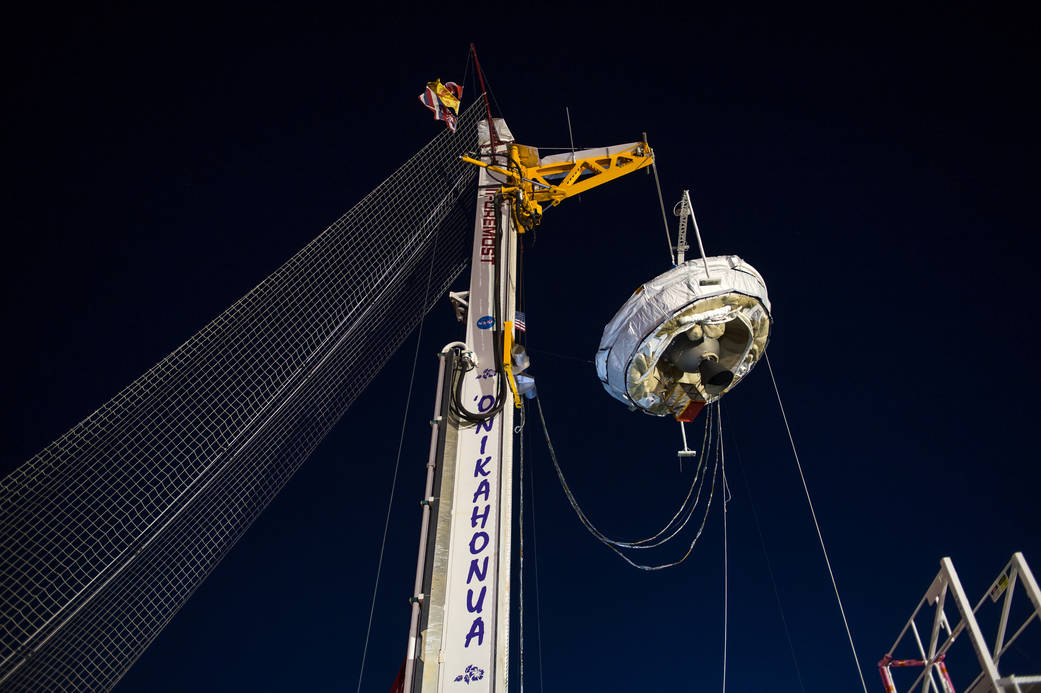
Pre-launch view of the Low-Density Supersonic Decelerator (LDSD) at the U.S. Navy Pacific Missile Range Facility in Kauai, HI. The LDSD crosscutting technology demonstration mission will test entry, descent and landing technologies that will enable large payloads to be landed safely on the surface of Mars.
Credit: NASA/JPL
On June 8, NASA’s Low-Density Supersonic Decelerator (LDSD) project tested two decelerator technologies – hardware that could enable larger payloads to land safely on the surface of Mars, and allow access to more of the planet’s surface by assisting landings at higher-altitude sites.
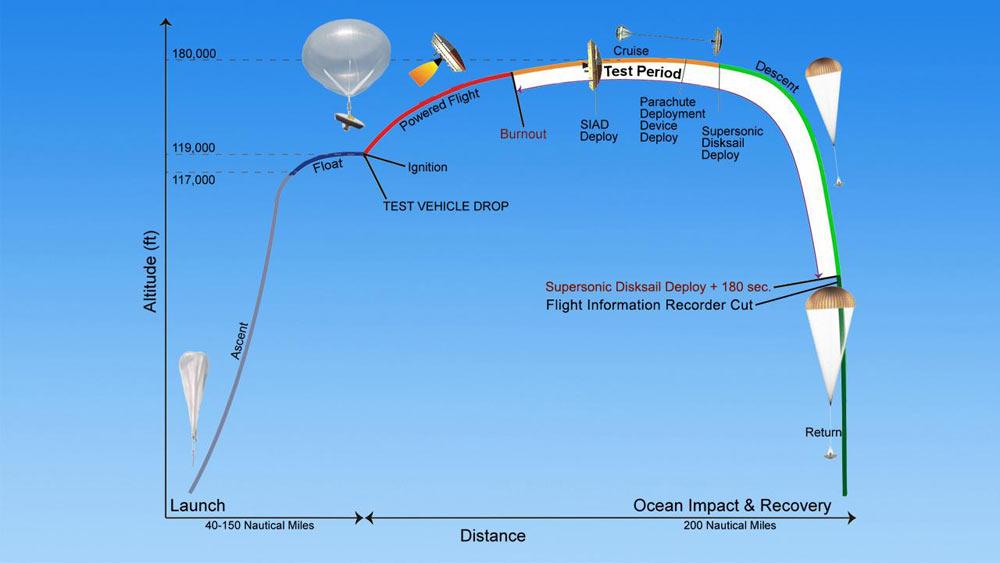
Liftoff of the LDSD took place at the U.S. Navy’s Pacific Missile Range Facility on Kauai. After its balloon ride high above Earth, the saucer-shaped LDSD craft was released, later splashing down in the Pacific Ocean off the west coast of the Hawaiian island of Kauai.
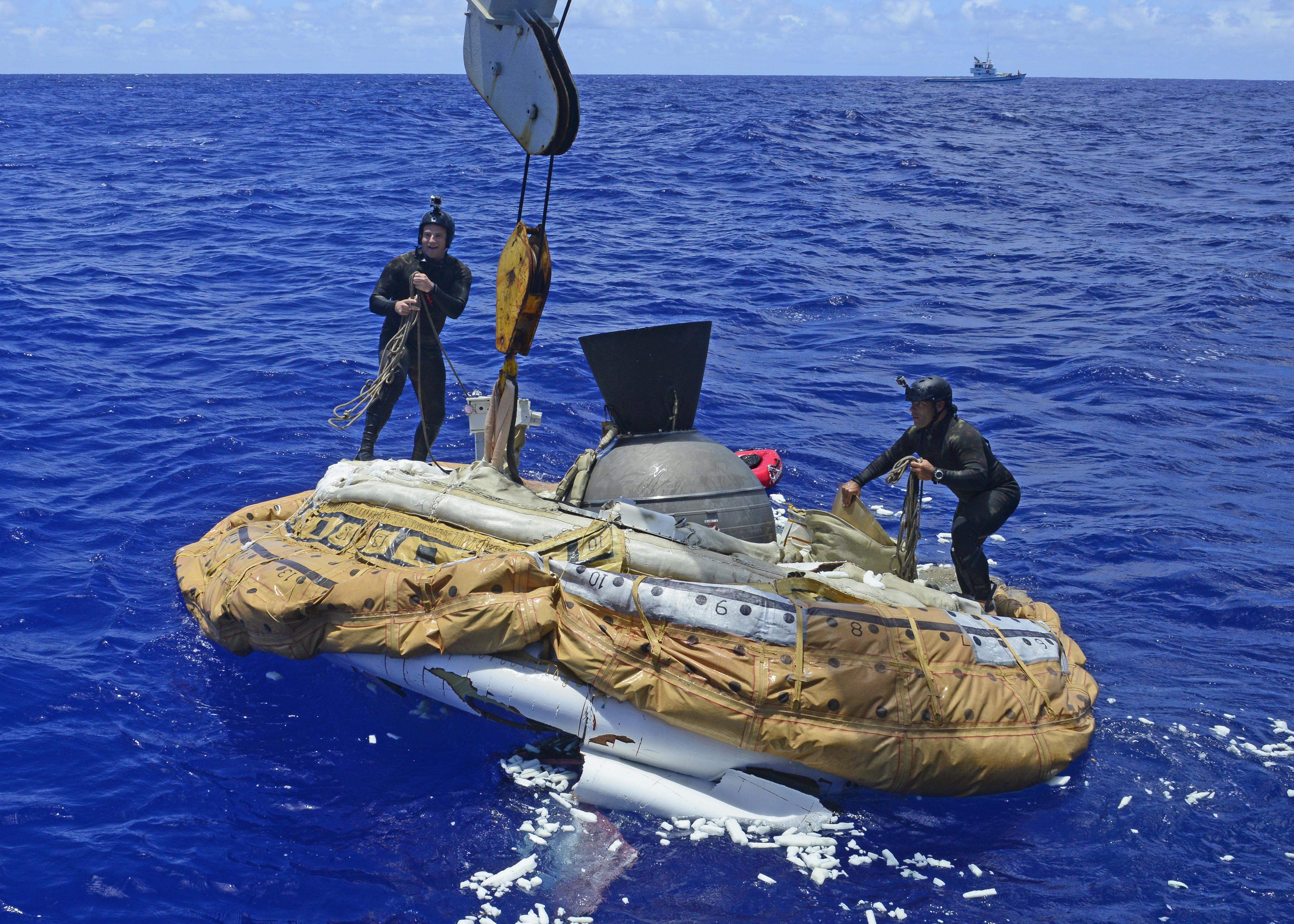
Sailors assigned to the Explosive Ordnance Detachment of Mobile Diving and Salvage Unit 1 recover the test vehicle for NASA’s Low-Density Supersonic Decelerator (LDSD) off the coast of the U.S. Navy’s Pacific Missile Range Facility in Kauai, Hawaii. NASA’s LDSD project is designed to investigate and test breakthrough technologies for landing future robotic and human Mars missions, and safely returning large payloads to Earth.
Credit: U.S. Navy photo by Chief Mass Communication Specialist John M. Hageman
Braking technology
The vehicle separated from the balloon at about 120,000 feet above the ocean. An onboard rocket motor then took the vehicle to 180,000 feet, where the first braking technology, the Supersonic Inflatable Aerodynamic Decelerator (SIAD), was successfully deployed at about Mach 3.
There was also successful deployment and inflation of a supersonic ballute – an inflatable drag device that extracts the large supersonic parachute.
Fourteen seconds after SIAD inflation, the test vehicle’s parachute was released into the supersonic slipstream.
“Tear…ifying”
Preliminary analysis of imagery and other data received during the test indicates the Supersonic Ringsail parachute also deployed. This 100-foot-wide parachute is the largest supersonic parachute ever flown.
Credit: NASA/JPL
However, a tear appeared in the canopy at about the time it was fully inflated. The supersonic parachute did not inflate as designed.
“Early indications are that we got what we came for, new and actionable data on our parachute design,” said Mark Adler, project manager for LDSD at NASA’s Jet Propulsion Laboratory (JPL) in Pasadena, California.
Ian Clark, principal investigator for LDSD at JPL said in a NASA press statement: “Going into this year’s flight, I wanted to see that the parachute opened further than it did last year before it began to rupture. The limited data set we have at present indicates we may not only have gone well down the road to full inflation, but we may have achieved it.”
High-speed imagery
For now, the data from the test is limited, but this will soon change.
With the test vehicle recovered, LDSD team members can inspect ultra-high resolution, high-speed imagery and other comprehensive information carried in the memory cards on board the LDSD test vehicle.
The flight test was the second for the project, mimicking the first LDSD flight on June 28, 2014.
NASA’s Space Technology Mission Directorate funds the LDSD mission, a cooperative effort led by JPL.
 Posted in Space News


Excellent post. I was checking constantly this blog and I am impressed! Very helpful information particularly the last part 🙂 I care for such info a lot. I was seeking this certain info for a very long time. Thank you and good luck.