 By
By  July 11th, 2022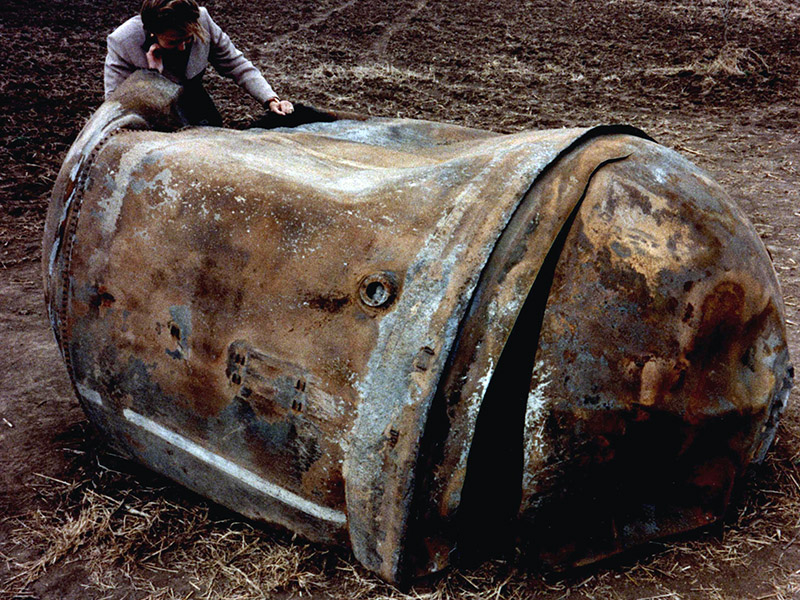
Main propellant tank of the second stage of a Delta 2 launch vehicle which landed near Georgetown, TX, on January 22, 1997. This approximately 250 kg tank is primarily a stainless steel structure and survived reentry relatively intact. Credit: NASA ODPO.
The number of rocket bodies abandoned in orbit is growing. The distribution of rocket body launches and reentries leads to what’s termed as the “casualty expectation,” in other words, risk to human life. That incoming space risk to humans is being disproportionately borne by populations in the Global South, with major launching states exporting risk to the rest of the world.”
A new research paper has focused on space launches resulting in uncontrolled rocket body reentries, creating casualty risks for people on the ground, at sea and in airplanes.
Populations put at risk
Using publicly available reports of rocket launches and data on abandoned rocket bodies in orbit, researchers calculate approximate casualty expectations due to rocket body reentries as a function of latitude.
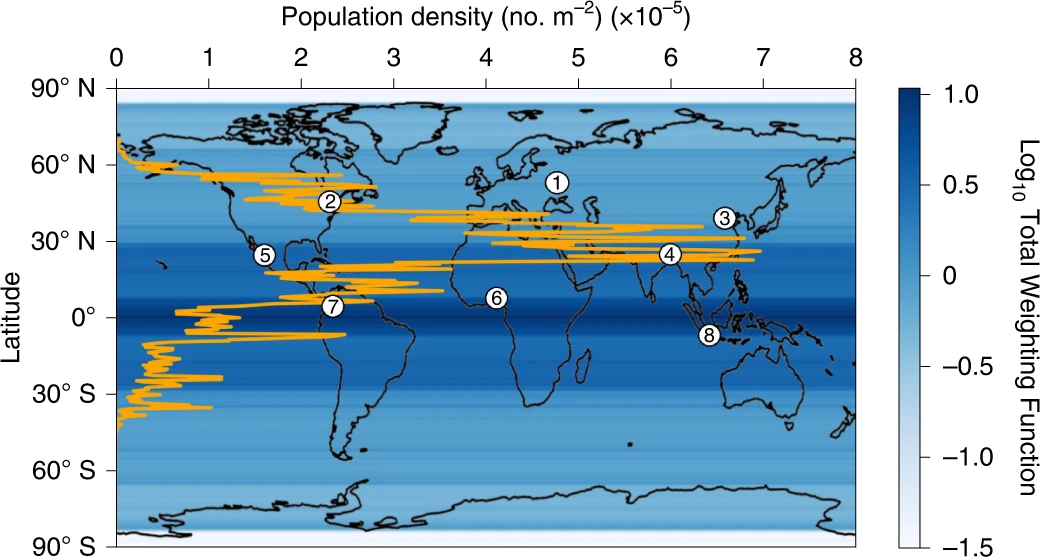
Some major and high-risk cities are labelled: 1, Moscow; 2, Washington, DC; 3, Beijing; 4, Dhaka; 5, Mexico City; 6, Lagos; 7, Bogotá; 8, Jakarta. The chosen weighting function is for all rocket bodies currently in orbit with perigees less than 600 km in altitude. The outline of the continents is an equirectangular projection, taken from the Python package Cartopy.
Credit: Michael Byers, et al.
They argue that recent improvements in technology and mission design “make most of these uncontrolled reentries unnecessary, but that launching states and companies are reluctant to take on the increased costs involved.”
Furthermore, those national governments whose populations are being put at risk “should demand that major spacefaring states act, together, to mandate controlled rocket reentries, create meaningful consequences for non-compliance and thus eliminate the risks for everyone.”
Shortage of international rules
The research paper – “Unnecessary risks created by uncontrolled rocket reentries” – appears in Nature Astronomy.
Led by Michael Byers of the Department of Political Science, University of British Columbia, Vancouver, British Columbia, Canada, the paper notes that “the added technological complexity and cost involved in achieving controlled reentries helps to explain the shortage of international rules on this matter.”
Among examples in the paper:
— In 2016, the second stage of a SpaceX rocket was abandoned in orbit; it reentered one month later over Indonesia, with two refrigerator-sized fuel tanks reaching the ground intact.
— In May 2020, an 18-ton core stage of China’s Long March 5B rocket reentered the atmosphere from orbit in an uncontrolled manner. Debris from the rocket body, including a 12-meter-long pipe, struck two villages in the Ivory Coast, causing damage to several buildings.
— In 2021, another 18-ton core stage of a Long March 5B rocket made an uncontrolled reentry crashing into the Indian Ocean.
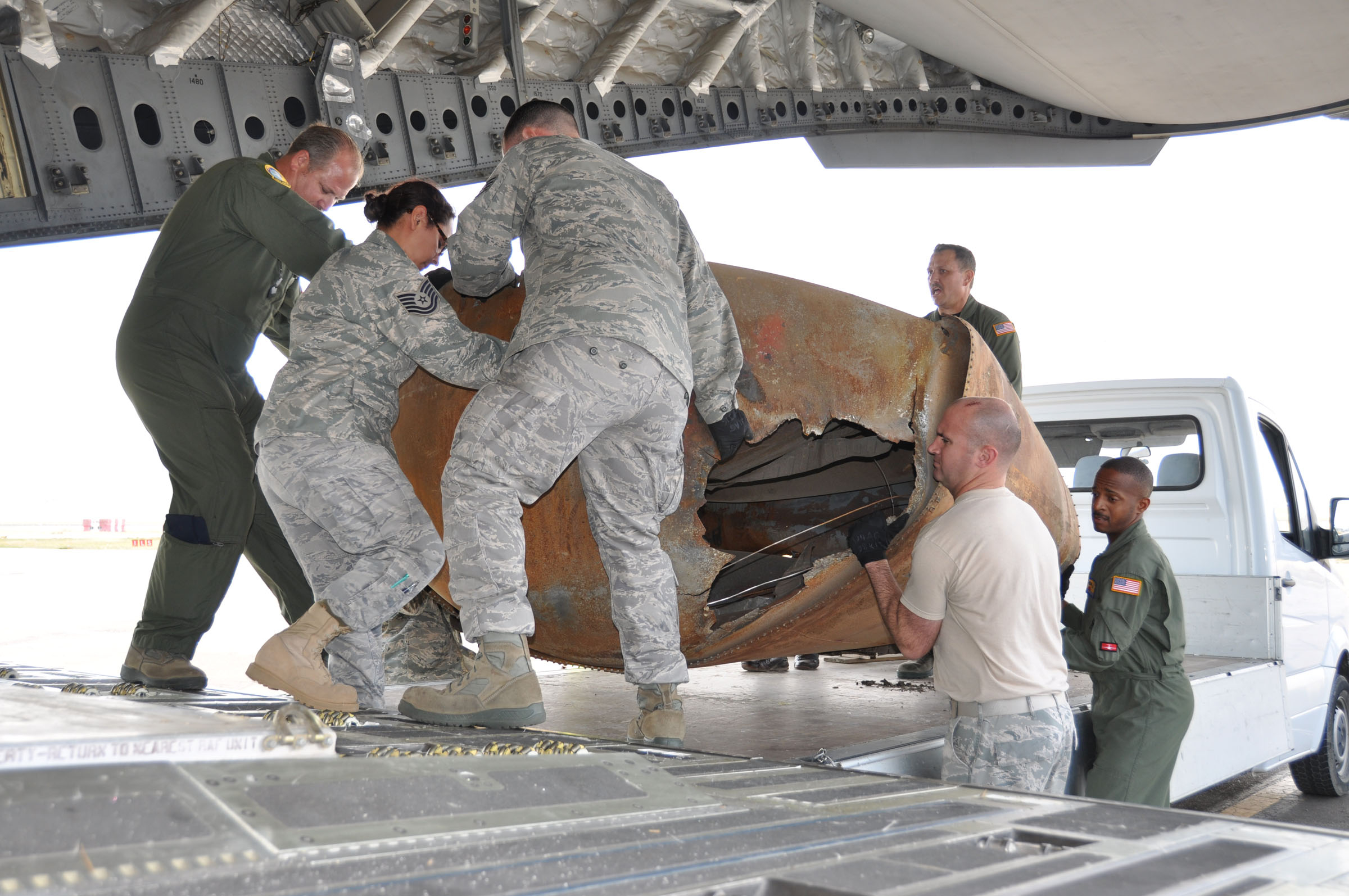
Air Force reservists hoist a 480-pound rocket part into a C-17 Globemaster III, Aug. 26, 2011. The aircraft was in Mongolia from the 729th Airlift Squadron at March Air Reserve Base, Calif., to retrieve fallen space debris. (U.S. Air Force photo/Master Sgt. Linda Welz)
Potentially lethal
When intact stages return to Earth, the paper says, “a substantial fraction of their mass survives the heat of atmospheric reentry as debris. Many of the surviving pieces are potentially lethal, posing serious risks on land, at sea and to people in airplanes,” adding that “even a small piece could cause hundreds of casualties.”
In their work, the trend of rocket body reentries from the past 30 years was assessed, then applied to the next 10 years. The number of rocket launches is increasing quickly and assuming that each reentry spreads lethal debris over a 10m2 area, “we conclude that current practices have on order a 10% chance of one or more casualties over a decade.”
In a concluding statement, the paper states: “On the issue of uncontrolled rocket body reentries, the states of the Global South hold the moral high ground: their citizens are bearing most of the risks, and unnecessarily so, since the technologies and mission designs needed to prevent casualties exist already.”
To take a read of the full paper — “Unnecessary risks created by uncontrolled rocket reentries” – go to:
 Posted in Space News

