 By
By  July 6th, 2022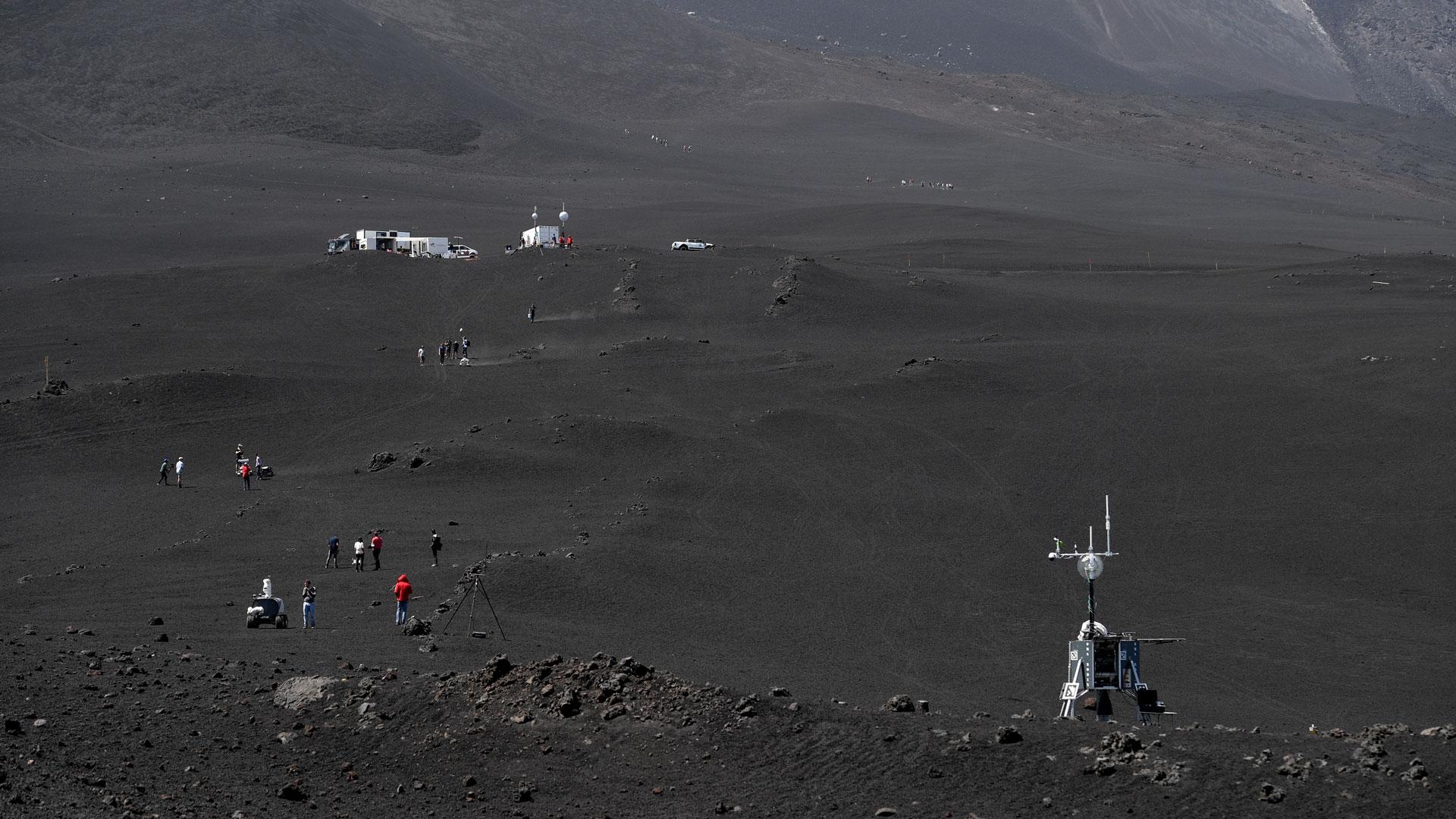
Simulated lunar exploration on Mount Etna, a volcano in Italy.
Credit: DLR (CC BY-NC-ND 3.0)
The Helmholtz Future Project Autonomous Robotic Networks to Help Modern Societies (ARCHES) has wrapped up simulated lunar exploration on Mount Etna, a volcano in Italy.
The German Aerospace Center (Deutsches Zentrum fuer Luft- und Raumfahrt; DLR) organized the venture that also involved the European Space Agency’s “Analog-1” project.
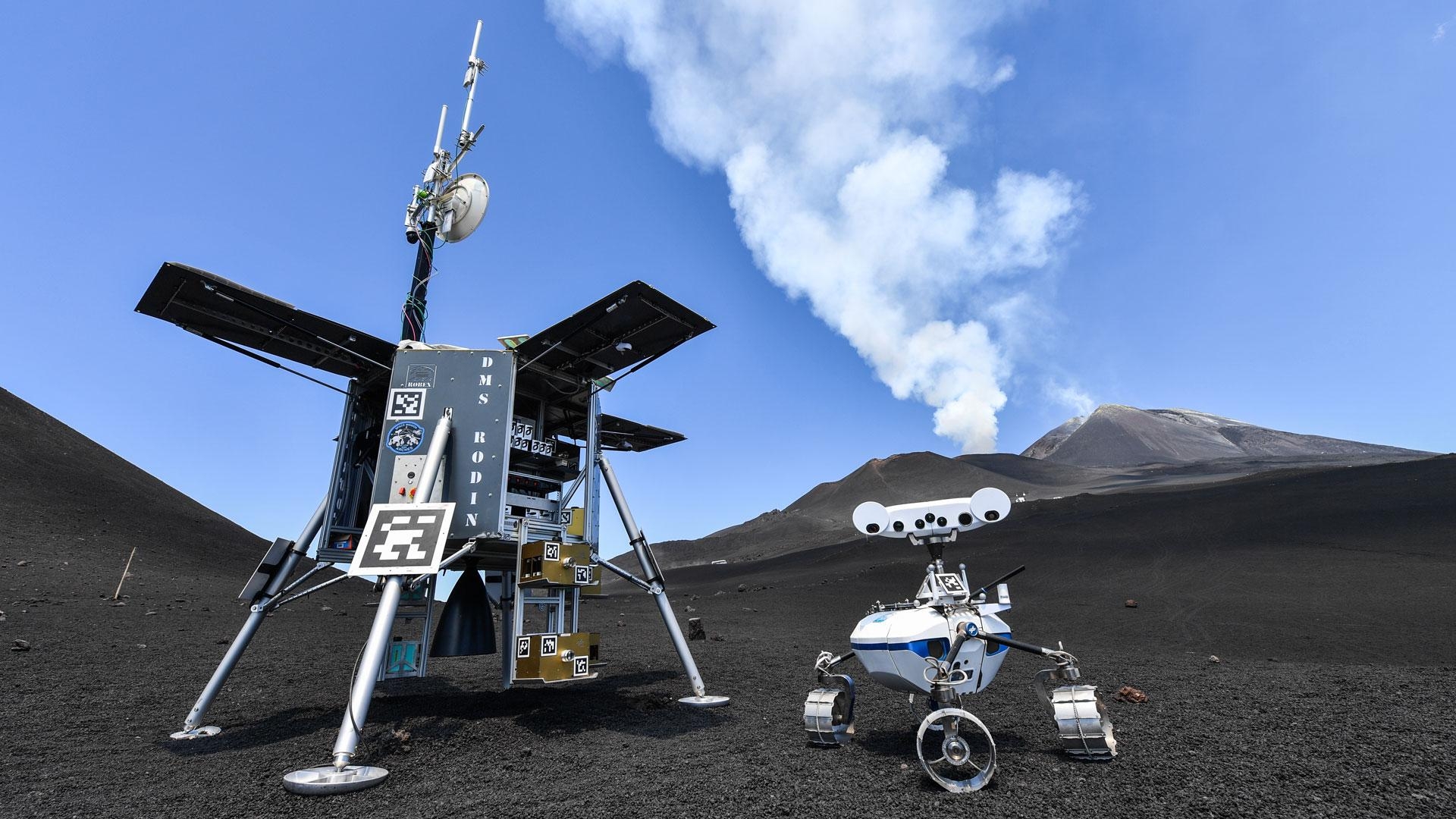
DLR lander and rover working together.
Credit: DLR (CC BY-NC-ND 3.0)
The Mount Etna site resembles the lava landscape on the Moon. In addition to the loose, coarse-grained surface composition, the solidified lava layers also present realistic challenges for exploration missions.
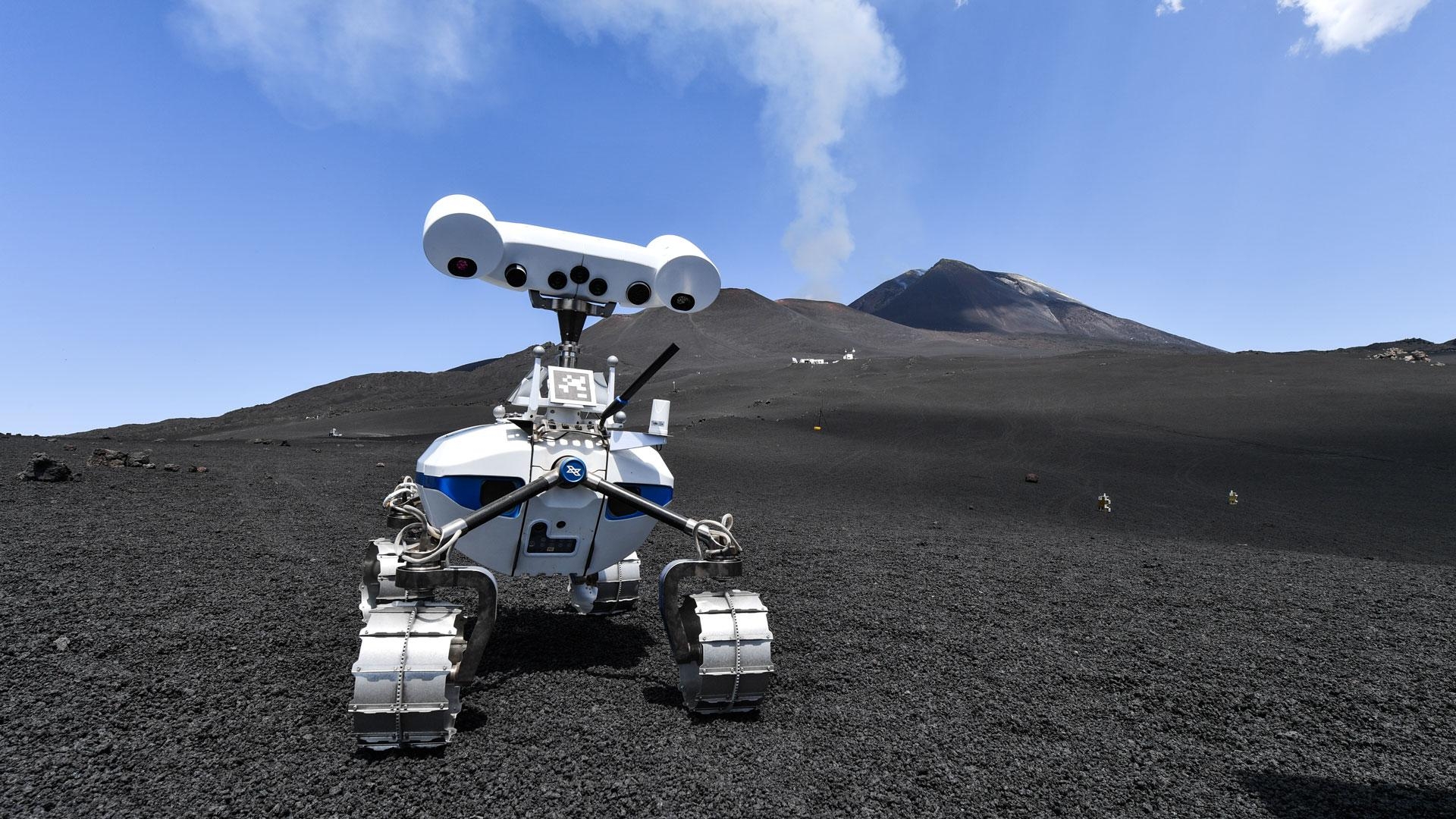
DLR Lightweight Rover Unit 1 (LRU1).
Credit: DLR (CC BY-NC-ND 3.0)
Robot menagerie
According to the DLR, two robots moved around together autonomously. They were joined by a drone. Also practiced was control of the robots from a simulated station in orbit. For maximum realism a second of signal delay was added to the rover control system, equivalent to the time it would take commands to travel between the Gateway station and the lunar surface. The force feedback control method has been designed to operate with such delays.
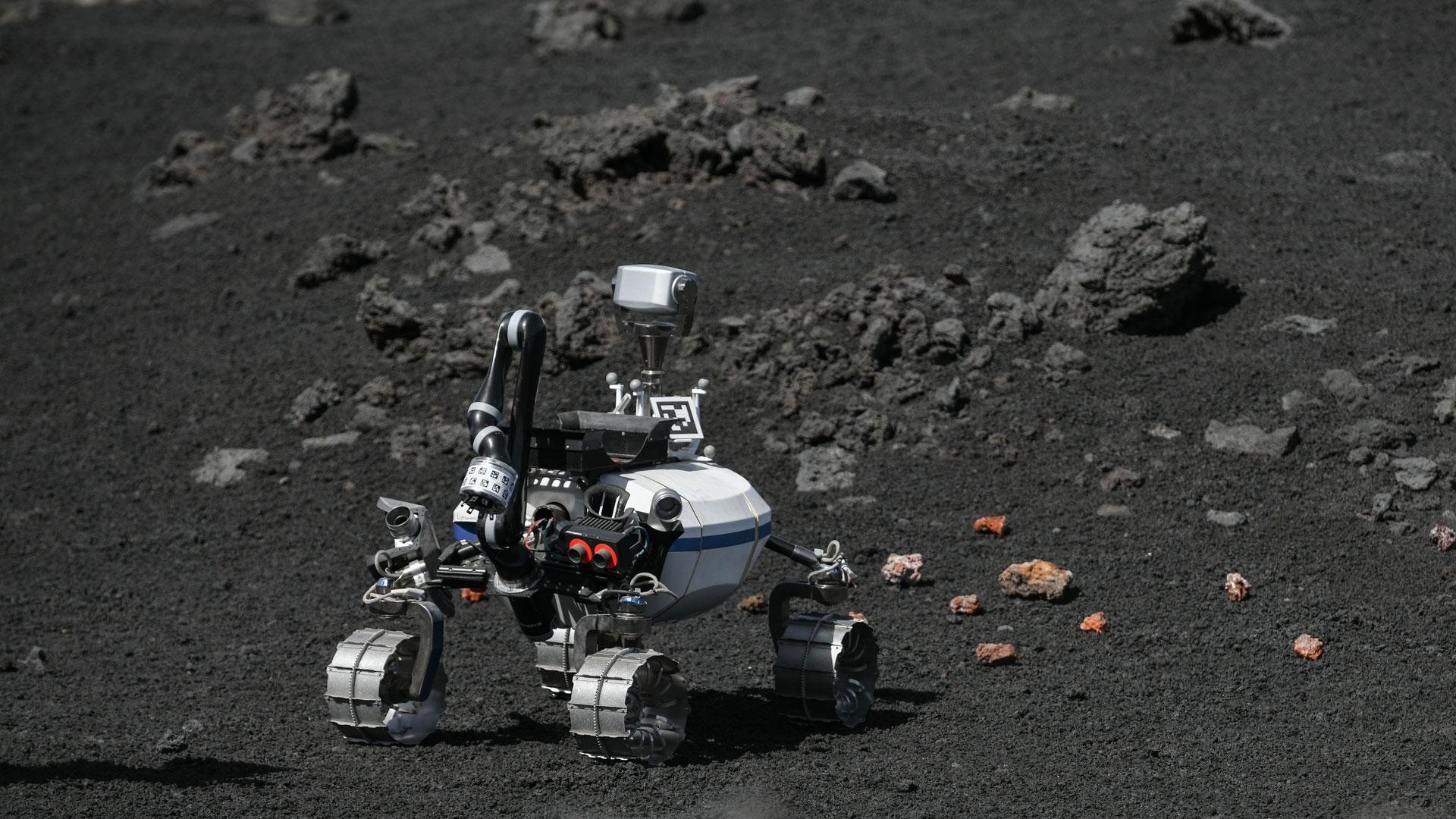
LRU2 robot took on the role of “assistant.”
Credit: DLR (CC BY-NC-ND 3.0)
During this demonstration activity, German astronaut Thomas Reiter carried out this task from a special control room, in fact a hotel room, in Catania, Sicily about 14 miles (23 kilometers) away.
- The Lightweight Rover Unit 1 (LRU1) robot evaluated soil samples using its cameras and is considered the “scientist” of the team.
- LRU2 took on the role of “assistant,” collecting surface samples, then analyzed them using Laser-Induced Breakdown Spectroscopy (LIBS).
- ESA’s four-wheeled Interact rover collected rock samples and brought them to a lander. The Interact Rover has a camera arm and a gripper arm that also provide haptic feedback. This means that the remote scientists can obtain a tactile “feel” for the rock samples. ESA’s Interact rover was built by the Agency’s Human Robot Interaction Lab and modified for the rugged slopes of the volcano. Interact Rover operations were coordinated from the European Space Operations Centre (ESOC) in Germany.
- The ARDEA drone is considered the “scout” for the team and mapped the area.

Scout rover in the lava landscape.
Credit: DLR (CC BY-NC-ND 3.0)
Far side simulation
Various scenarios were played out, including the “LOFAR Experiment.” It involved simulating the installation and maintenance of a low-frequency radio antenna array. The LRU rover and the ARDEA drone demonstrated the installation of an antenna system on the far side of the Moon. A similar antenna could be directed from the lunar surface into deep space.
Heterogeneous, autonomous, networked robotic systems have been in development since 2018 as part of the ARCHES initiative. This involves a number of different robots and fields of application.

ESA’s Interact Rover chose rock samples and brought them to DLR’s RODIN lunar lander.
Credit: ESA
Extension of human arms and eyes
Thomas Reiter commented: “We’ve learned a lot about collaboration between ground control on Earth and the crew aboard a space station orbiting the Moon, both operating a rover on the surface – this ‘shared’ operation can be extremely efficient –much more efficient than if either side does it alone.”
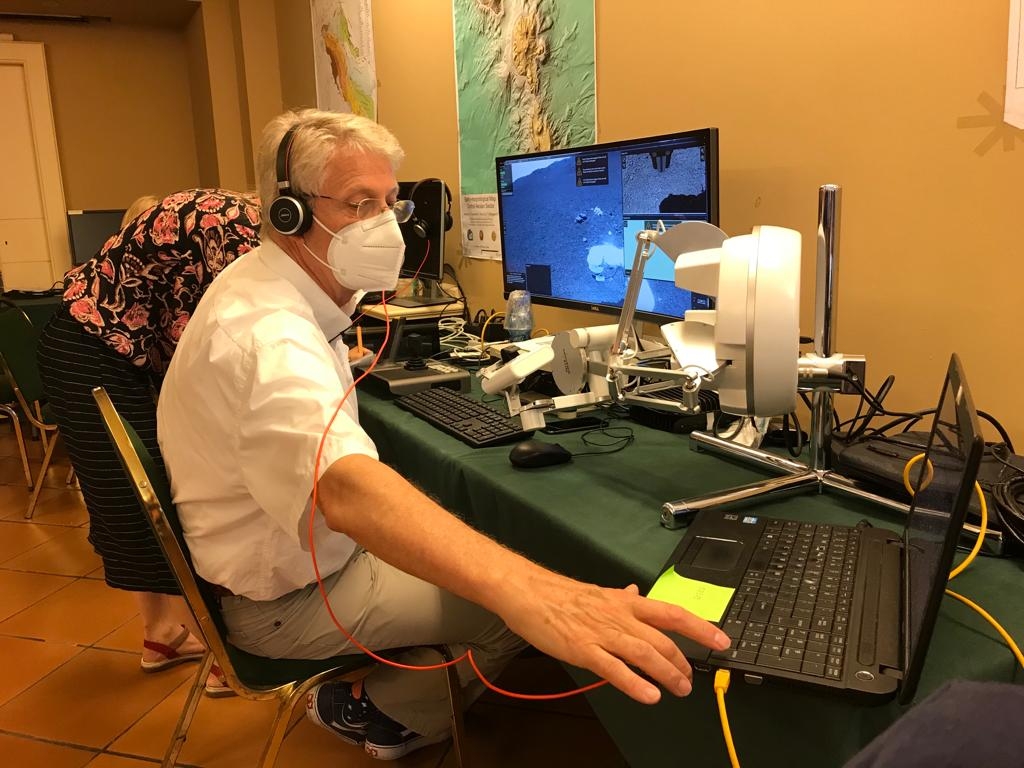
ESA astronaut Thomas Reiter at the controls.
Credit: ESA
“Teams of mobile robots have an important role to play in future space missions. Operating in heterogeneous teams, the robots complement and support each other with their different capabilities. They serve as an extension of human arms and eyes,” explains Armin Wedler, Project Manager at the DLR Institute of Robotics and Mechatronics in a DLR statement.
In addition to opening up the exploration of the Solar System, ARCHES also opens the way for environmental monitoring of the oceans and can provide assistance during crises on Earth.
 Posted in Space News

