 By
By  June 4th, 2022
Credit: CCTV/Inside Outer Space screengrab
The upcoming Shenzhou-14 crewed space mission will loft Chen Dong, Liu Yang and Cai Xuzhe.
The Long March-2F carrier rocket for the Shenzhou-14 piloted launch is being fueled Saturday, making the final preparations for the launch at 10:44 on Sunday (local time).
Shenzhou-14 will fly a fast automated rendezvous and docking with the radial port of the space station core module Tianhe, forming a complex with Tianhe as well as the cargo spacecraft Tianzhou-3 and Tianzhou-4.

Credit: CMG/CCTV/CASC/Inside Outer Space screengrab
The Shenzhou-14 mission will complete the construction of the Tiangong space station, with a basic three-module structure consisting of the core module Tianhe and the lab modules Wentian and Mengtian.
National space laboratories
The two lab modules are scheduled to be launched in July and October, respectively, and will host many large-scale and multidisciplinary scientific research experiments for astronauts in orbit following the completion of the space station construction, according to the China Manned Space Agency (CMSA).

Credit: CCTV/Inside Outer Space screengrab
“As national space laboratories, the modules on China’s space station will be equipped with 25 experiment cabinets, with each cabinet serving as a small-scale space lab for single-disciplinary or interdisciplinary scientific experiments. Overall, they have reached international advanced levels,” said Lin Xiqiang, deputy director of the CMSA.
“The Wentian lab module will be mainly used for space life science research as it is be equipped with experiment cabinets for research on life ecology, biotechnology and variable gravity science. It can support research on the growth, development, heredity and senescence of plants, animals and microorganisms under space conditions, as well as experimental research on an enclosed ecosystem. Through visible light, fluorescent light, microscopic imaging and other online monitoring means, it can support multi-level biological experimental research like on the levels of molecule, cell, tissue and organ. It can also provide variable gravity simulation with a range from 0.01 g to 2 g to support comparative research on the growth mechanisms of organisms under different gravity conditions,” said Lin.

Credit: GLOBALink/Inside Outer Space screengrab
“The Mengtian lab module will be mainly used for microgravity science research as it is equipped with multidisciplinary experiment cabinets for research on fluid physics, materials science, combustion science, fundamental physics and aerospace technology experiments. It can support cutting-edge experimental research like research on the essential laws of materials such as multiphase flow, phase change heat exchange, basic combustion process, and material solidification mechanism in microgravity, as well as research on ultra-cold atomic physics,” Lin said.

Credit: GLOBALink/Inside Outer Space screengrab
Cold atomic clock system
Mengtian will also carry the world’s first space-based cold atomic clock system consisting of a hydrogen clock, a rubidium clock and an optical clock, which will become humanity’s most accurate timekeeping device.
“In the meantime, built on the cold atomic clock system in the Tiangong-2 lab, we will establish the world’s first space-based cold atomic clock system [in the Mengtian lab module] which will consist of a hydrogen clock, a rubidium clock and an optical clock, forming the most stable and accurate time and frequency system in space to support frontier scientific research on gravitational redshift, measurement of fine-structure constant and others,” Lin said.

Credit: GLOBALink/Inside Outer Space screengrab
The world’s first-ever cold atomic clock that operates in space was developed by Chinese scientists. It was launched with the Tiangong-2 space lab in 2016 and has a margin of error of less than one second in 30 million years.
Shenzhou-14 crew
China’s Shenzhou-14 spaceflight commander is Chen Dong. This is Chen’s second time to work in space. He served as a crew member of Shenzhou-11 in October 2016.
Liu Yang, the first Chinese woman in space, flew aboard Shenzhou-9 in 2012 – a 13-day mission.
The new Chinese astronaut, Cai Xuzhe, was selected as a member of China’s second batch of astronauts in May 2010.
China has so far completed eight piloted space missions, sending 13 astronauts into Earth orbit and it is now prepping for its 9th crewed launch.
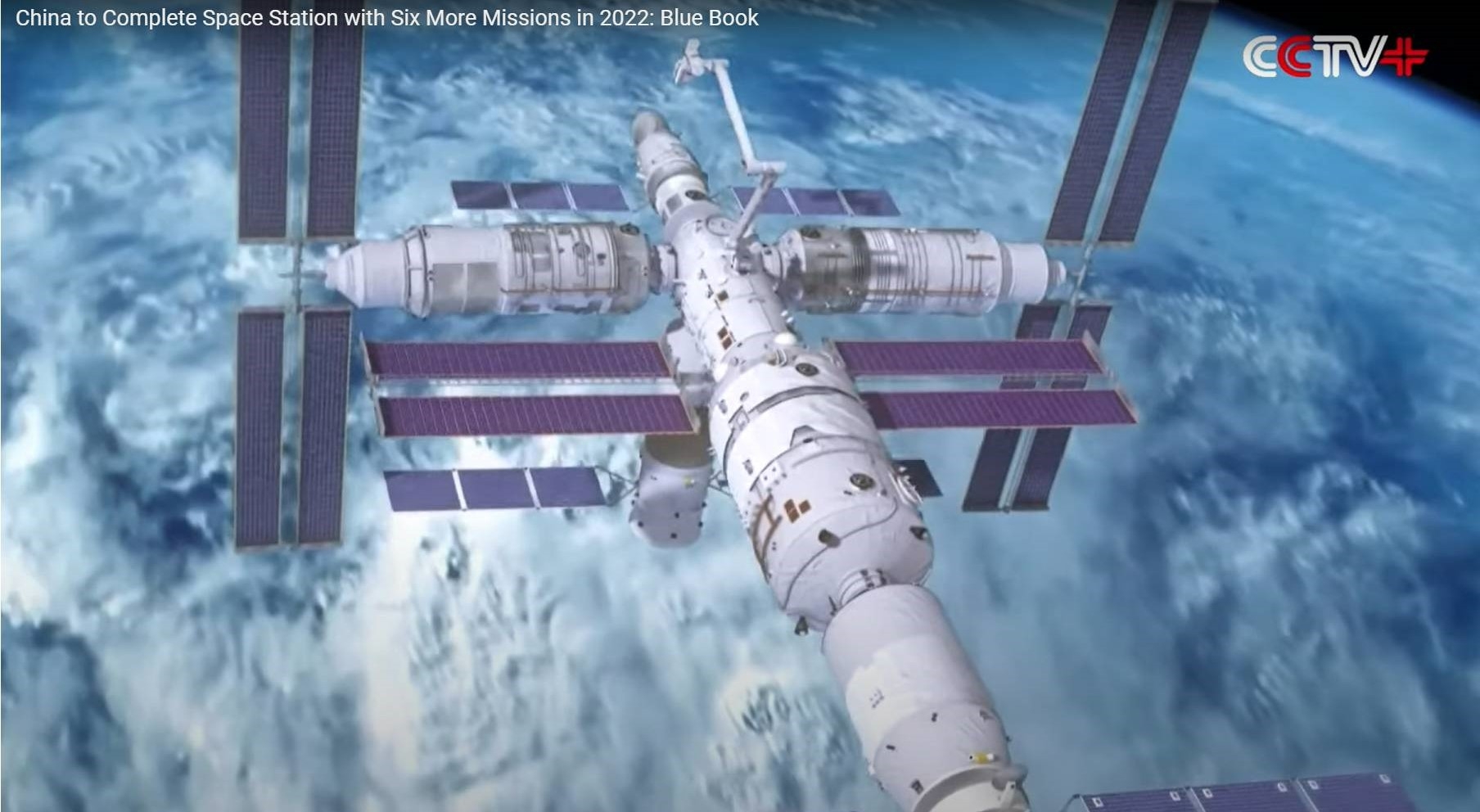
China’s space station to be completed by end of 2022.
Credit: CCTV/Inside Outer Space screengrab
Mission overview
“The Shenzhou-14 crew will work with the ground team to complete the rendezvous, docking and transposition of the two lab modules with the core module, enter the Wentian and Mengtian lab modules for the first time and help make the environment suitable for their stay,” Lin said.
“They will also cooperate with the ground team to carry out tests on the two-module space station complex, the three-module space station complex, large and small mechanical arms, and the exit function of the airlock cabin. The crew will, for the first time, use the airlock cabin in the Wentian lab module to carry out extravehicular activities for two to three times, and unlock and install a dozen of scientific experiment cabinets in the Wentian and Mengtian lab modules,” Lin said.
There is a small mechanical arm installed on the Wentian lab module and the larger robotic arm on the Tianhe core module. They can work independently or together.
According to Lin, the two mechanical arms can be connected to form a combination that can transfer a heavier load for a larger area range.
“The small arm can be grasped by the bigger one to form a combination, so that they can cover a wider range in extravehicular activities (EVAs), transfer for a larger area range and reach different positions for detailed operations,” Lin said.
For more information on the upcoming Shenzhou-14 mission, go to these videos at:
 Posted in Space News

