 By
By  September 9th, 2021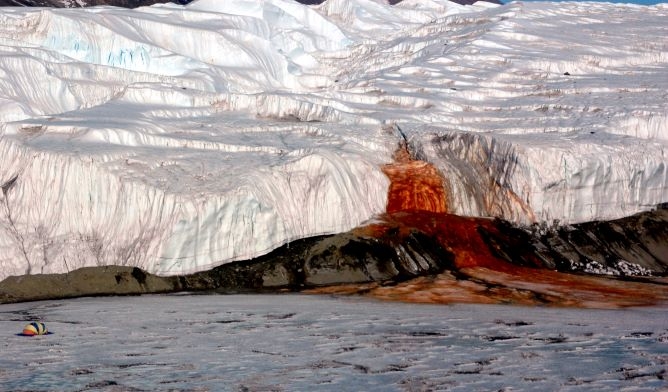
Blood Falls seeps from the end of the Taylor Glacier into Lake Bonney. The tent at left provides a sense of scale for just how big the phenomenon is. Scientists believe a buried saltwater reservoir is partly responsible for the discoloration, which is a form of reduced iron.
Photograph by Peter Rejcek/United States Antarctic Program
Taylor Glacier in Antarctica’s McMurdo Dry Valleys features Blood Falls.
Researchers first thought the red color came from algae. Later work unveiled that the glacier is a natural time capsule, containing an ancient community of microbes.
The existence of the Blood Falls ecosystem shows that life can exist in the highly extreme conditions here on Earth – but perhaps elsewhere in the form of extraterrestrial life.
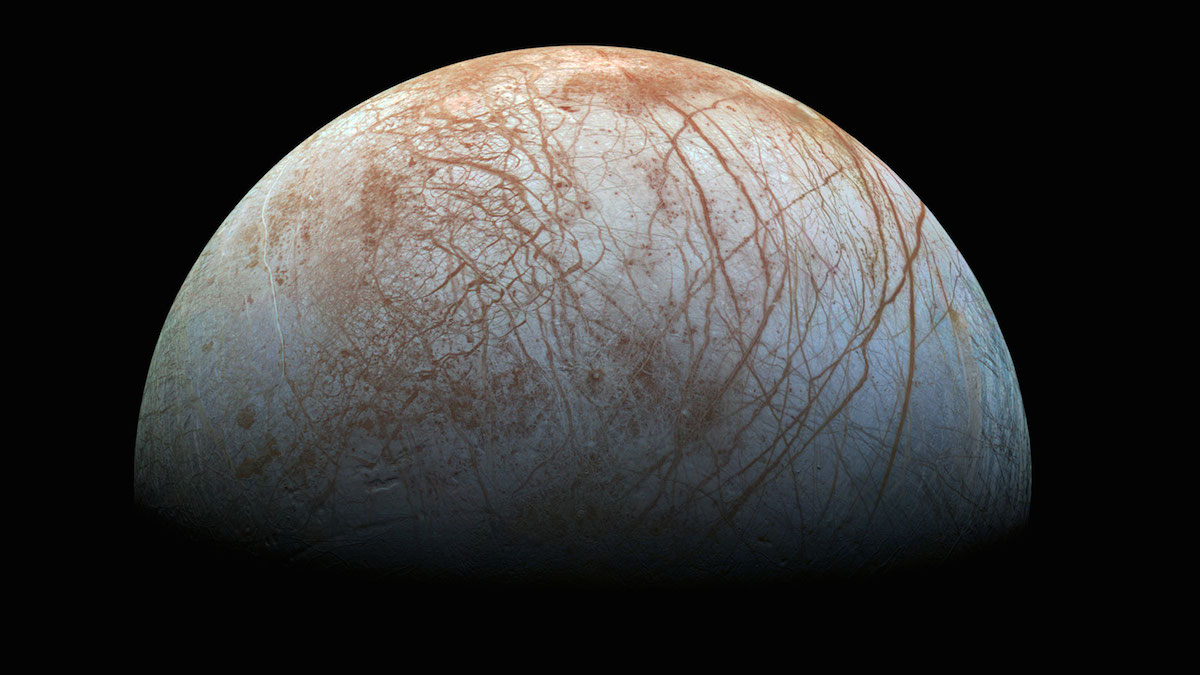
Moon of Jupiter, Europa, is about 90 percent the size of Earth’s Moon. Perhaps Europa is a promising place in our solar system to find present-day environments suitable for some form of life beyond Earth.
Go to this intriguing story in Atlas Obscrua: “Blood Falls Antarctica -Natural time capsule containing an alien ecosystem” at:
https://www.atlasobscura.com/places/blood-falls
Also, go to this paper “MICROBIAL LIFE IN BLOOD FALLS: AN ANCIENT ANTARCTIC ECOSYSTEM” at:
https://www.lpi.usra.edu/meetings/earlymars2004/pdf/8023.pdf
As well as this Arizona State University press release “Unlikely life thriving at Antarctica’s Blood Falls” at:
https://news.asu.edu/content/unlikely-life-thriving-antarctica%E2%80%99s-blood-falls
 Posted in Space News

