 By
By  August 24th, 2021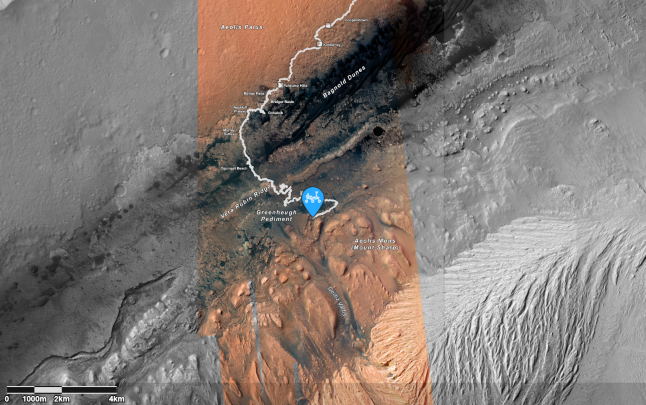
Curiosity’s Location as of Sol 3216. Distance Driven 16.32 miles/26.27 kilometers.
Credit: NASA/JPL-Caltech/Univ. of Arizona
NASA’s Curiosity Mars rover at Gale Crater is now performing Sol 3217 tasks.
Ken Herkenhoff, a planetary geologist at USGS Astrogeology Science Center in Flagstaff Arizona, reports that the robot’s Sol 3216 drive went well, placing the rover in an area of bright bedrock partly covered by dark sand.
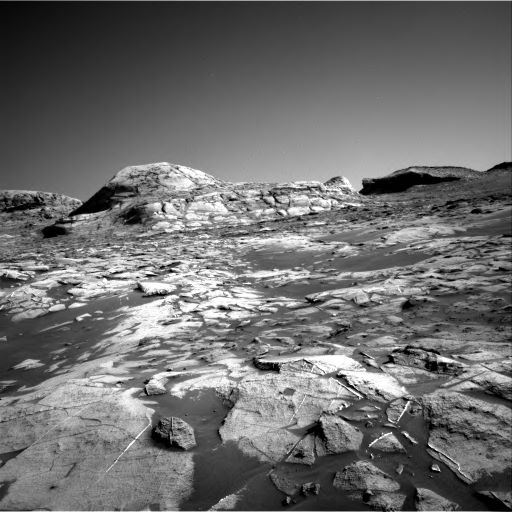
Curiosity Right B Navigation Camera image taken on Sol 3216, August 23, 2021.
Credit: NASA/JPL-Caltech
The top priority for the recently scripted plan is to continue making good progress toward the next potential drill target, “so we worked to optimize the drive distance.” The required drive duration didn’t leave much time for other activities.
“We had to make some difficult choices between various scientific observations,” Herkenhoff adds, “but ultimately were able to plan both contact science and some important remote sensing activities.”
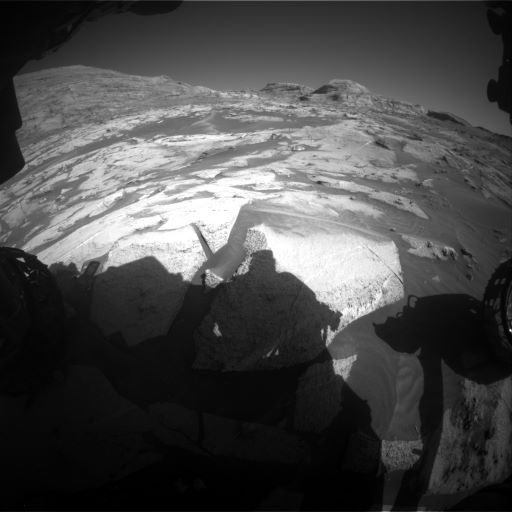
Curiosity Front Hazard Avoidance Camera Left B photo acquired on Sol 3216, August 23, 2021.
Credit: NASA/JPL-Caltech
Bedrock target
On the first sol of a 2-sol plan (3217-3218) the rover’s Alpha Particle X-Ray Spectrometer (APXS) was to be placed on a bedrock target named “Spiggie” for a short integration.
Then the Mars Hand Lens Imager (MAHLI) was to take images of Spiggie from 25 and 5 centimeters above the target before the arm is stowed.
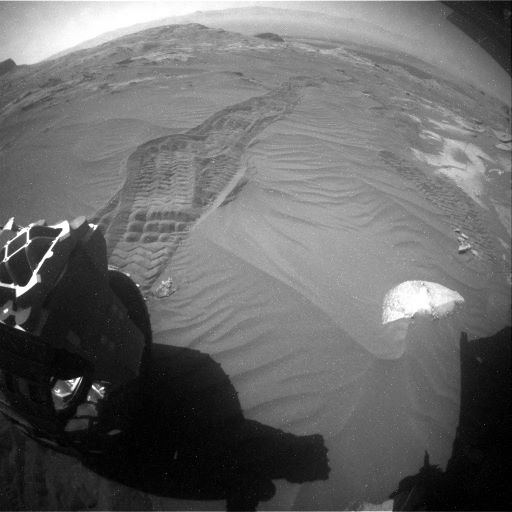
Curiosity Rear Hazard Avoidance Camera Left B image taken on Sol 3216, August 23, 2021.
Credit: NASA/JPL-Caltech
Squeezed into the plan was a Chemistry and Camera ChemCam) Laser-Induced Breakdown Spectrometer (LIBS) observation of another bedrock target called “Dagon Stone” and a Right Mastcam image of the same target, plus an 18×4 Mastcam stereo mosaic of Rafael Navarro Mountain toward the southeast.
“This Mastcam mosaic had to be planned today because we expect to drive away from the mountain,” Herkenhoff notes.
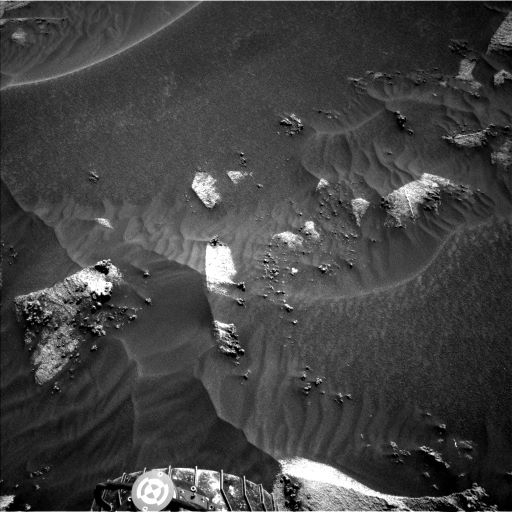
Curiosity Left B Navigation Camera image taken on Sol 3216, August 23, 2021.
Credit: NASA/JPL-Caltech
Twilight image
After a drive of roughly 187-feet (57-meters) and the standard post-drive imaging, the Mars Descent Imager (MARDI) will acquire another twilight image of the ground behind the left front wheel.
Overnight, Curiosity’s Chemistry & Mineralogy X-Ray Diffraction/X-Ray Fluorescence Instrument (CheMin) is slated to vibrate its inlet funnel in an attempt to remove a speck of debris left on the inlet screen after the last drill sample was delivered to CheMin, Herkenhoff points out.
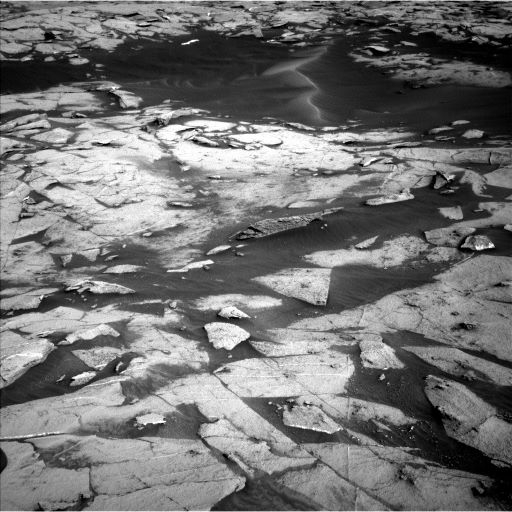
Curiosity Left B Navigation Camera image taken on Sol 3216, August 23, 2021.
Credit: NASA/JPL-Caltech
Shoot the laser
“Planning the second sol was much less constrained, and it was easy to schedule Navcam dust devil survey and line-of-sight extinction observations, along with ChemCam untargeted activities,” Herkenhoff adds.
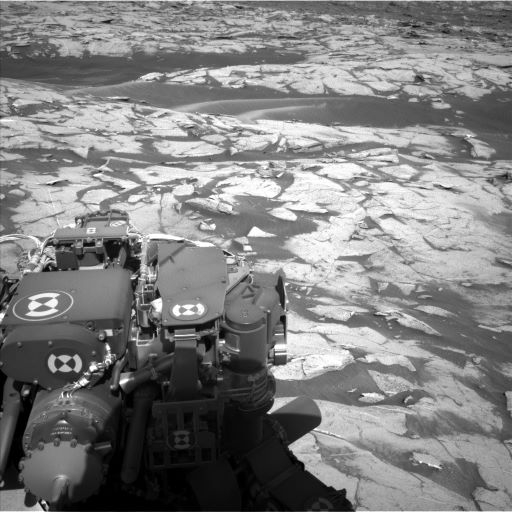
Curiosity Left B Navigation Camera image taken on Sol 3216, August 23, 2021.
Credit: NASA/JPL-Caltech
The Autonomous Exploration for Gathering Increased Science) autonomous targeting system (AEGIS)software will be used to autonomously select a ChemCam LIBS target and shoot the laser at 5 points across that target.
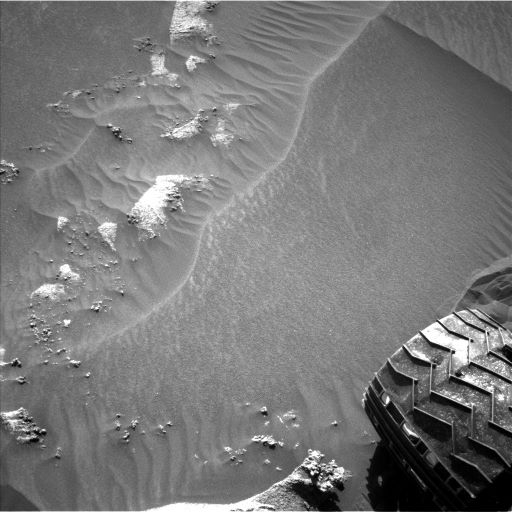
Curiosity Left B Navigation Camera image taken on Sol 3216, August 23, 2021.
Credit: NASA/JPL-Caltech
ChemCam will also measure the spectral reflectance of several calibration targets to improve the calibration of ChemCam passive (no laser) observations.
“While we couldn’t fit everything into this plan that we desired,” Herkenhoff concludes, “it’s still a good plan and I look forward to seeing the results!”
 Posted in Space News

