 By
By  August 14th, 2021
Credit: Wageningen University
Growing crops on the Red Planet is a Mars underground necessity.
New research has shown that the effect of cosmic radiation on plants demand they be protected.
Netherlands-based Wageningen University and Research and the Reactor Institute Delft (RID) have investigated the effect of gamma radiation as was recorded by the Mars rover Curiosity on garden cress and rye.
Because the radiation on Mars is about 17 times higher than on Earth, the experiment was carried out under strict safety precautions.

Credit: Wageningen University/RID
Led castle
“We conducted the experiment in a special ‘led castle’ and in a fume hood,” says Nyncke Tack. There were multiple effects of the radiation visible, including brown leaves and dwarfed growth. Besides that, the researcher adds, the harvest was disappointing and lower than a non-radiated control group of plants.
Principal investigator at Wageningen University, Wieger Wamelink, said he had always expected that the radiation would have a negative effect on plant growth, “but it was never very well investigated so we needed to confirm if this expectation was correct.”
According to a university statement, the radiation was emitted by five cobalt 60 sources, especially ‘made’ by the RID. The sources were placed above the plants to create a plane radiation field comparable to Mars. The growing plants were radiated constantly for 28 days and harvested afterwards.
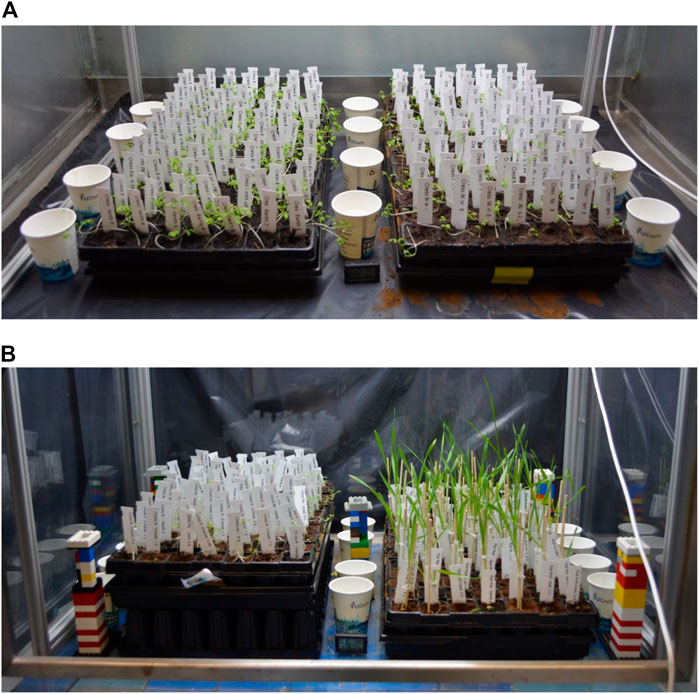
(A) sowing the cress control Earth (CE, left) and control Mars (CM, right). Shown are the pots with trays, the water cups and the temperature and humidity meter located in between the two trays. (B) is showing the radiation treatments in the radiation fume hood surrounded by lead walls. Treatments of cress (left) and rye (right) are indicated with white labels. Lego towers hold thermoluminescent dosimetry (TLD) cups at the top. Pictures were taken on the morning of harvest.
Below ground
“Creating a plane radiation field is tricky and that is why 5 sources were used to prevent one plant to receive a higher dose than another plant, which would otherwise influence the outcome of the experiment,” the university statement adds. Only gamma radiation was used, whereas on Mars cosmic radiation consists of alpha, beta gamma and UV radiation, so there are still differences, but the dose was about the same as what Mars receives.
“Now that it is clear that we can expect negative effects on plant growth due to the radiation on Mars, we have to protect them. An option is to grow the plants below ground in a dome where most of the radiation cannot penetrate so that humans are protected as well,” Wamelink affirms.
“It is a bigger challenge than growing plants in a greenhouse on the surface, but it also makes life easier since we can grow plants under fully controlled circumstances, applying LED light,” Wamelink reports.
For detailed information on the work, go to “Influence of Martian Radiation-like Conditions on the Growth of Secale cereale and Lepidium sativum” at:
https://www.frontiersin.org/articles/10.3389/fspas.2021.665649/full
 Posted in Space News


Growing plants in Mars is going to be incredible! It will of course be hard at the start but i’m pretty sure it is doable. That would be awesome!
What were the observed effects of gamma radiation on garden cress and rye? Greeting : Sistem Informasi Akuntansi