 By
By  August 10th, 2021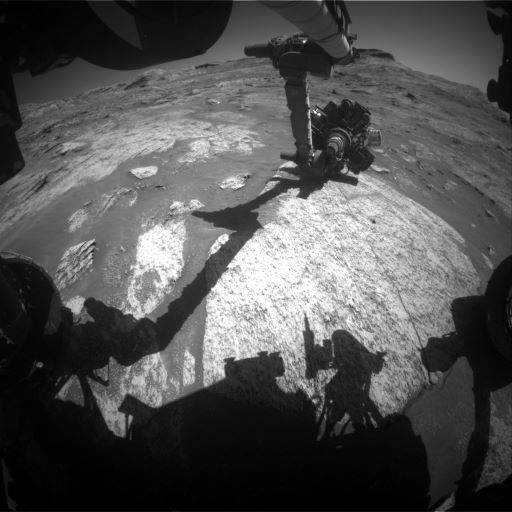
Curiosity Front Hazard Avoidance Camera Left B image taken on Sol 3203, August 10, 2021.
Credit: NASA/JPL-Caltech
NASA’s Curiosity Mars rover at Gale Crater is now performing Sol 3203 tasks.
“Curiosity is making good progress along the path to our next intended drill location, and making a lot of great observations along the way,” reports Lauren Edgar, a planetary geologist at the USGS Astrogeology Science Center in Flagstaff, Arizona.
All of this progress means the robot is about to leave the “Nontron” quadrangle and return to the “Torridon” quadrangle.
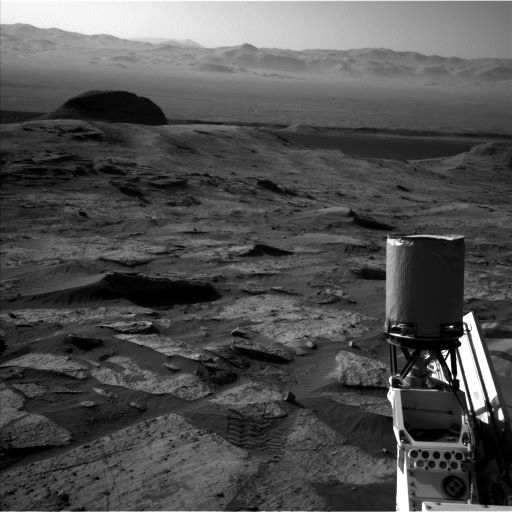
Curiosity Left B Navigation Camera image acquired on Sol 3203, August 20, 2021.
Credit: NASA/JPL-Caltech
Quad names
“These quad names are how we keep track of observations on Mars – prior to landing, the expected landing zone and nearby areas were divided into square quadrangles (1.5 km on a side) and each quadrangle was assigned a name of a town on Earth with a population of less than 100,000 people,” Edgar explains. “As we drive through the quads, we assign informal names to rock targets that correspond to geologic formations and features from that town on Earth.”
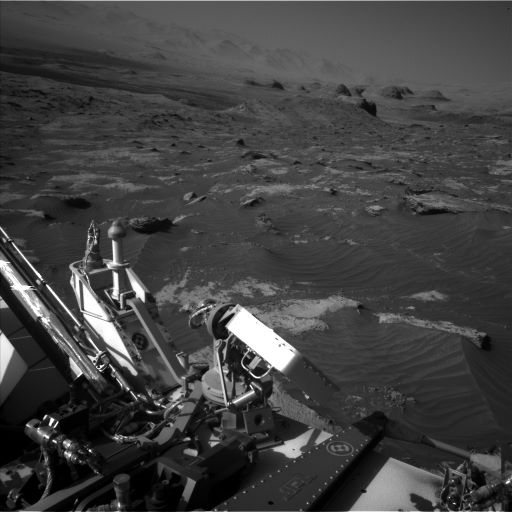
Curiosity Left B Navigation Camera image acquired on Sol 3203, August 20, 2021.
Credit: NASA/JPL-Caltech
What this means is that after the rover’s recent drive, Mars researchers will stop using French names from “Nontron” and return to using names from “Torridon” in Scotland.
“We were previously in this quad,” Edgar adds, “but now we’re much further to the south as we investigate the clay-sulfate transition.”
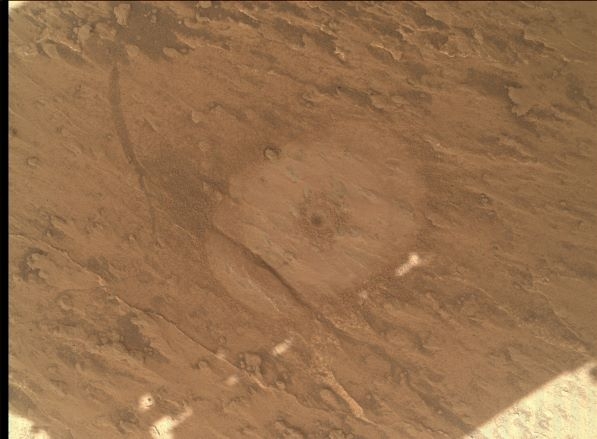
Curiosity Mars Hand Lens Imager photo produced on Sol 3203, August 10, 2021.
Credit: NASA/JPL-Caltech/MSSS
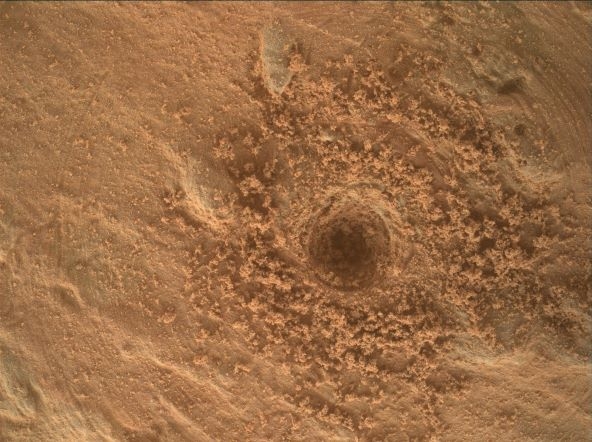
Curiosity Mars Hand Lens Imager photo produced on Sol 3203, August 10, 2021.
Credit: NASA/JPL-Caltech/MSSS
Remove dust
A recently scripted plan focused on contact science and continuing a rover drive.
The team was able to add in a Dust Removal Tool (DRT) to remove dust prior to Alpha Particle X-Ray Spectrometer (APXS) and Mars Hand Lens Imager (MAHLI) observations on the target “Blis et Born,” which will lead to better data about the bedrock in that locale.
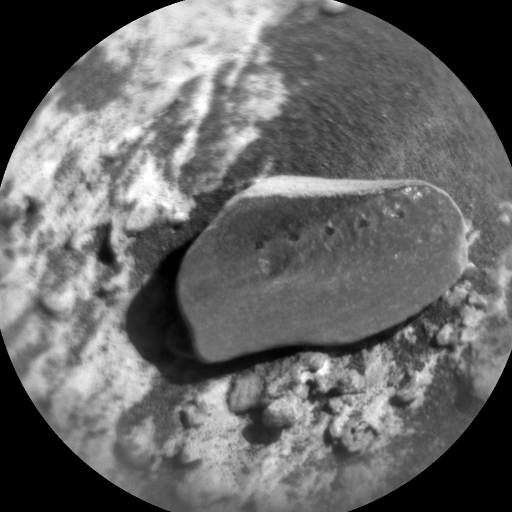
Laser strikes are seen in this Curiosity Chemistry & Camera Remote Micro-Imager (RMI) photo acquired on Sol 3203, August 10, 2021.
Credit: NASA/JPL-Caltech/LANL
The plan also includes two Mastcam mosaics to investigate vertical exposures of nearby stratification, as well as Chemistry and Camera (ChemCam) Laser Induced Breakdown Spectroscopy (LIBS) on an interesting blue-gray float rock and a ChemCam Remote Micro-Imager (RMI) to investigate nodular bedrock.
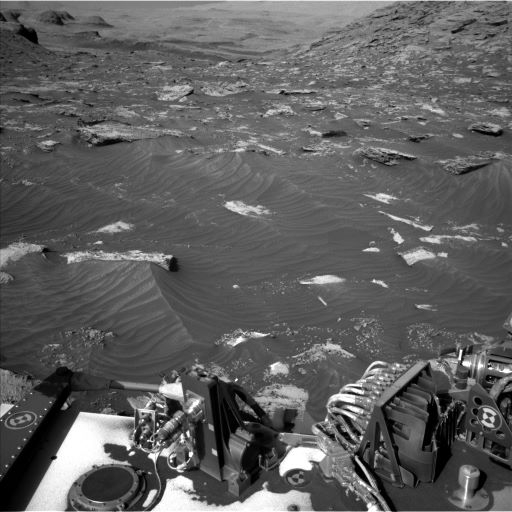
Curiosity Left B Navigation Camera image acquired on Sol 3203, August 20, 2021.
Credit: NASA/JPL-Caltech
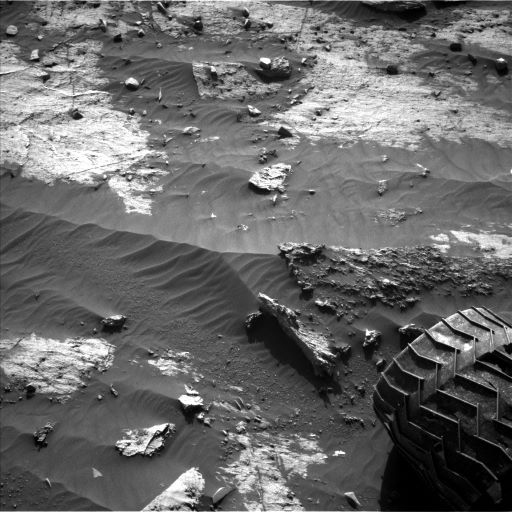
Curiosity Left B Navigation Camera image acquired on Sol 3203, August 20, 2021.
Credit: NASA/JPL-Caltech
“The team also planned some Navcam observations to assess the dust content of the atmosphere and search for dust devils,” Edgar concludes. “Onwards to Torridon!”
 Posted in Space News

