 By
By  August 7th, 2021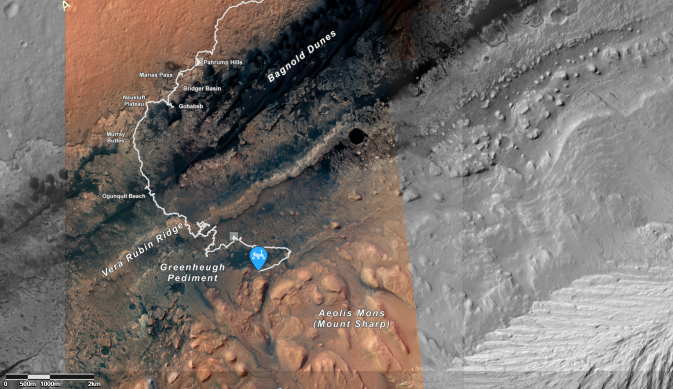
Credit: NASA/JPL-Caltech/Univ. of Arizona
NASA’s Curiosity Mars rover is now performing Sol 3200 tasks.
Curiosity’s team is saluting the rover’s 9 years of operating on the Red Planet, landing in Gale Crater on August 5, 2012. On the afternoon of Sol 3199, the robot began its 10th Earth year on Mars.
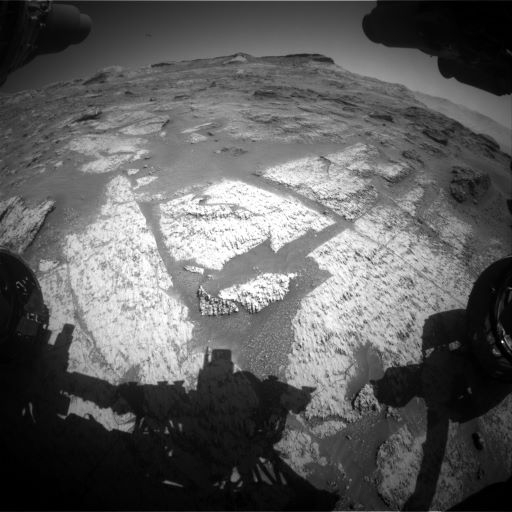
Curiosity Front Hazard Avoidance Camera Right B image acquired on Sol 3200, August 7, 2021.
Credit: NASA/JPL-Caltech
In the last nine years, the rover has traveled 16.3 miles (26.3 kilometers), climbed over 1,509 feet (460 meters) in elevation, and collected 32 drilled samples of rock.
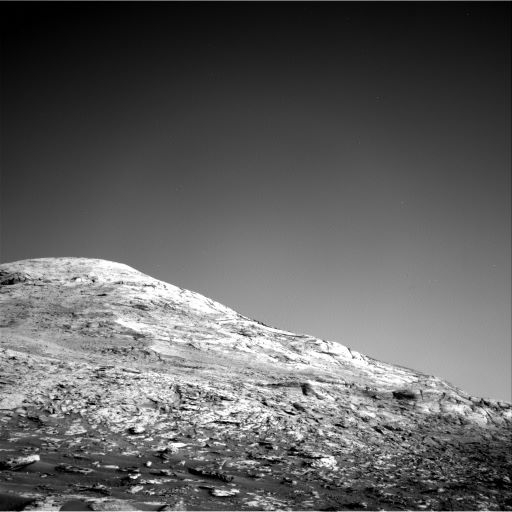
Curiosity Right B Navigation Camera photo taken on Sol 3200, August 7, 2021.
Credit: NASA/JPL-Caltech
Terrific journey
“It has been a terrific journey so far, and it is fun thinking back to those first images we saw on sol 0 of the mission,” notes Abigail Fraeman, a planetary geologist at NASA’s Jet Propulsion Laboratory. “The terrain in our landing area was quite different than the rocks we’re examining now, and it’s amazing to think we’ve climbed so high on the flanks of Mt. Sharp, which loomed in the distance in that first Hazcam image!”
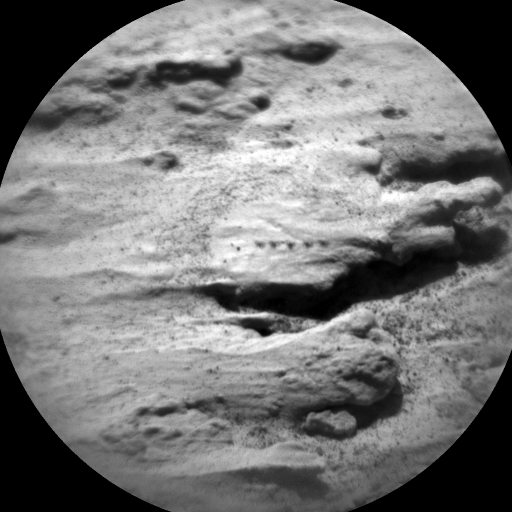
Laser shots across target. Curiosity Chemistry & Camera (ChemCam) Remote Micro-Imager (RMI) photo acquired on Sol 3200, August 7, 2021.
Credit: NASA/JPL-Caltech/LANL
Curiosity will spend its ninth landing anniversary continuing to study rocks in a transitional area. Alpha Particle X-Ray Spectrometer (APXS) and Mars Hand Lens Imager (MAHLI) data is being collected of a nodular target in front of the rover named “Gabillous,” and a Chemistry and Camera (ChemCam) Laser Induced Breakdown Spectroscopy (LIBS) observation of another nodule named “Champs Romain.”
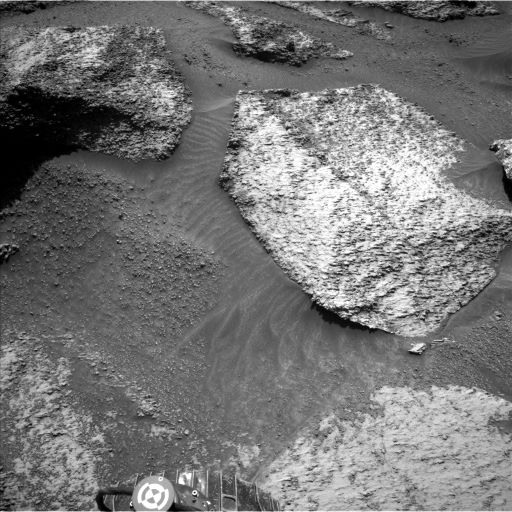
Curiosity Left B Navigation Camera image taken on Sol 3200, August 7, 2021.
Credit: NASA/JPL-Caltech
Strategically planned route
The rover’s Mastcam will peer off to the hills ahead, Fraeman reports, taking stereo mosaics to study their bedding geometry and a multispectral observation to document their spectral properties.
After a morning of science, Curiosity was slated to hit the road, driving roughly 46 feet (14 meters) along a strategically planned route.
“This is an usually short drive,” Fraeman points out, “and it’s because the terrain is so rocky that it’s hard to see too far beyond the rover’s current position. We don’t want to use too much autonomous driving in this rocky terrain and risk damaging the wheels. Despite the short drive, we should end up at a great looking outcrop and be prepared for more contact science this weekend.”
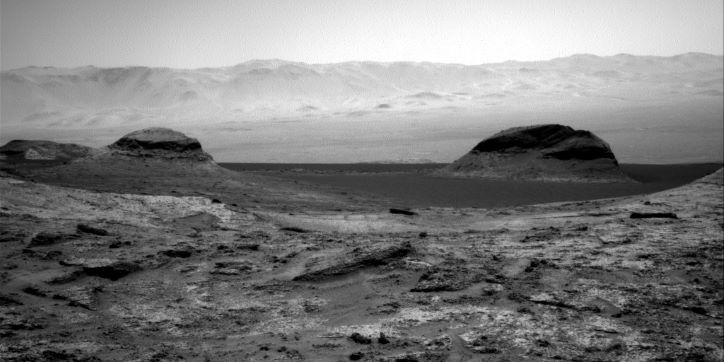
Curiosity Right B Navigation Camera photo taken on Sol 3200, August 7, 2021.
Credit: NASA/JPL-Caltech
Full weekend of work
Reports Susanne Schwenzer, a planetary geologist at The Open University; Milton Keynes, U.K., “Curiosity has a full weekend plan, but also gets one sol of soliday. This is to realign Mars and Earth timing, but I am sure it’s also going to be used for some celebrations.”
Observations in a recently scripted plan include many observations of the rocks around the rover, which again are a mixture of smooth sedimentary rocks with a lot of nodules.
APXS and MAHLI are set to look at target “Nadaillac,” which is one of the smooth sedimentary patches.
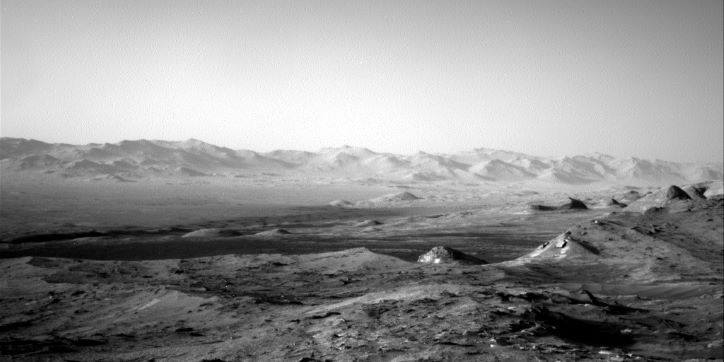
Curiosity Right B Navigation Camera photo taken on Sol 3200, August 7, 2021.
Credit: NASA/JPL-Caltech
Nodular features
ChemCam is also to look at this target with a passive observation and Mastcam is pointing at it with a multispectral observation. The nodular features are the target of two ChemCam LIBS observations on targets ‘Pageas’ and ‘Paugnac.’ Mastcam is documenting each of the ChemCam targets with a single image, and has one other single image on a very dark and blueish looking stone, Schwenzer adds.
“The terrain around us continues to give great vistas onto rock surfaces that allow us to understand the layering of the rocks and how different textures are stacked on top of each other,” Schwenzer says.
Curiosity’s Mastcam is documenting those with an 18×2 mosaic, “but because one of the outcrops is in shadow for most of the day, there is also a very early morning mosaic on that specific area. In addition, there is a dust devil survey in the plan,” Schwenzer concludes. “Lots to do on the first planning of the new year on Mars!”
Relive the nail-biting terror and joy as NASA’s Curiosity rover successfully landed on Mars the evening of Aug. 5 PDT (morning of Aug. 6 EDT) 2012.
 Posted in Space News

