 By
By  July 8th, 2021
Credit: Roscosmos
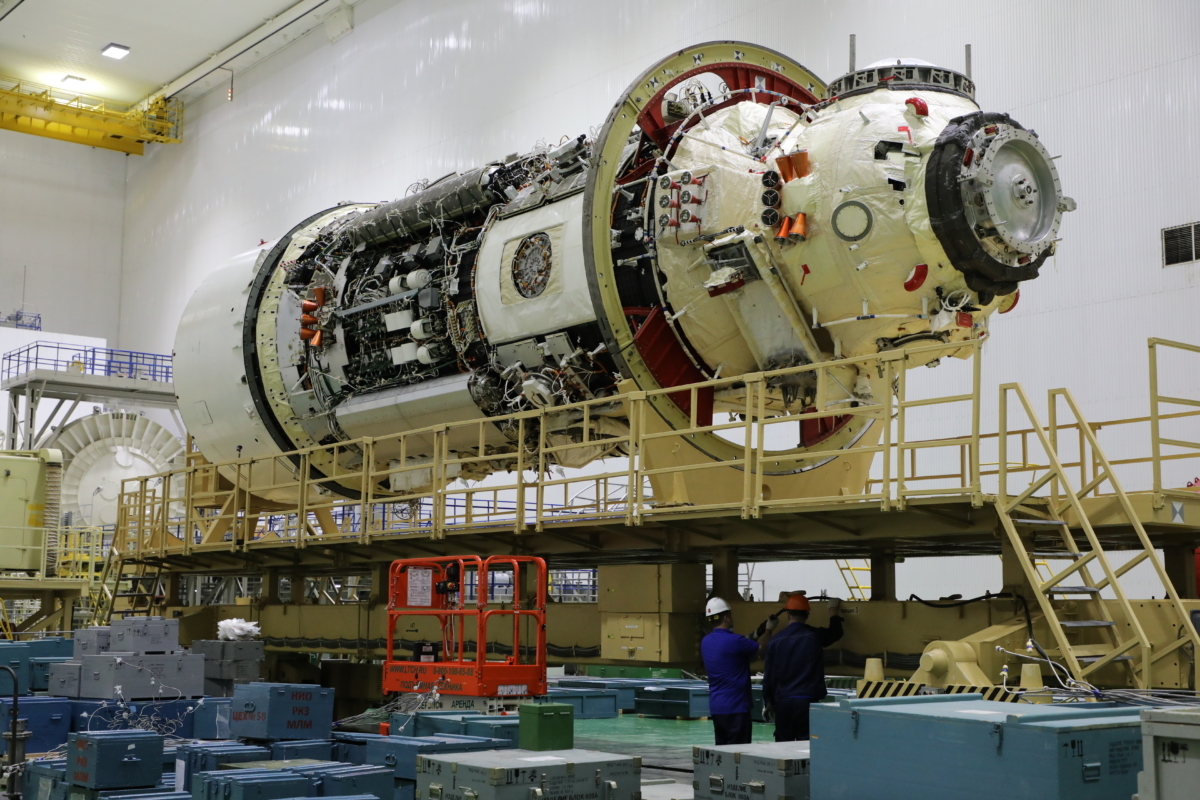
Russia’s Nauka laboratory module is now slated for launch on July 21.
A Roscosmos statement said the new module for the International Space Station will be launched from Site 200 of the Baikonur cosmodrome atop a Proton-M carrier rocket. Backup dates are July 22, and July 23.
The module’s flight to the ISS will take 8 days, docking at the nadir port of Russia’s Zvezda service module.
Undocking of the Progress MS-16 cargo vehicle with the Pirs docking module is scheduled for July 23 (subject to the Nauka launch on July 21).
Credit: Roscosmos
Prelaunch prep stage
At the Baikonur Cosmodrome, Roscosmos states, routine preparations of the Nauka module are underway for the upcoming launch. Currently, the ascent unit is at the fueling and neutralization station, the most important operation of the final prelaunch preparation stage.
The Nauka Laboratory Module is a research module of the Russian segment of the ISS, developed by RSC Energia together with Khrunichev Center (part of Roscosmos). This module is designed to expand the functionality of the Russian segment of the International Space Station.

Credit: Roscosmos
Added safety of ISS crew
“The Nauka module was created on the constructive and technological basis of the Zarya Functional Cargo Block employing the experience of designing a transport supply vehicle for the Salyut crewed scientific stations and modules for retrofitting the Mir orbital complex,” the Roscosmos statement adds.
“After the commissioning of the new module, the Russian segment will receive additional volumes for the workplaces and storage of cargo, places for water and oxygen regeneration equipment, improve the conditions of cosmonauts’ stay, as well as increase the safety of the entire ISS crew,” the statement concludes.
Credit: ESA
Cherry-picker crane
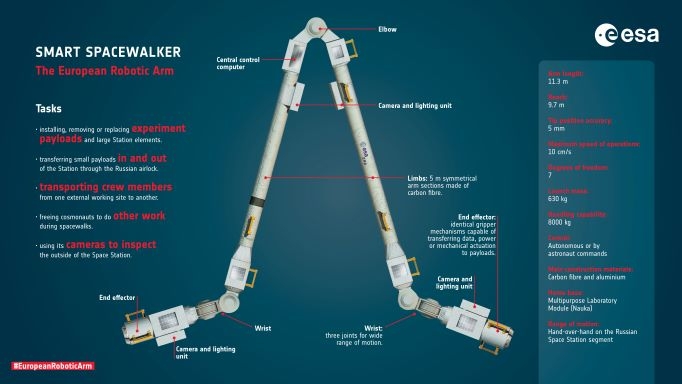
The European Robotic Arm (ERA) will be launched to the ISS together with the Nauka. ERA will work with the new Russian airlock, to transfer small payloads directly from inside to outside the ISS. This will reduce the set-up time for astronauts on a spacewalk and allow ERA to work alongside astronauts.
Another task for ERA is to transport astronauts like a cherry-picker crane to a position where they can work on the exterior of the ISS, or from one external location to another. This again saves time and effort during spacewalks.
ERA is 100% made-in-Europe. A consortium of European companies led by Airbus Defense and Space Netherlands designed and assembled it for the European Space Agency (ESA). The robotic arm is largely funded by the Dutch government.
Go to these informative videos about ERA at:
 Posted in Space News

