 By
By  May 15th, 2021
Credit: CGTN
The lander of China’s first Mars probe, the Tianwen-1, successfully touched down on the Red Planet Saturday morning, Beijing time, within a landing site region in Utopia Planitia.
The craft’s plummet through the Martian atmosphere lasted about nine minutes due to the specially designed aerodynamic shape of the entry capsule.
“Each step had only one chance, and the actions were closely linked. If there had been any flaw, the landing would have failed,” said Geng Yan, an official at the Lunar Exploration and Space Program Center of the China National Space Administration (CNSA).
Credit: CCTV/CNSA
Credit: CCTV/CNSA
When the velocity of the spacecraft was lowered from 4.8 km per second to about 460 meters per second, a huge parachute covering an area of about 200 square meters was unfurled to continue reducing the velocity to less than 100 meters per second.
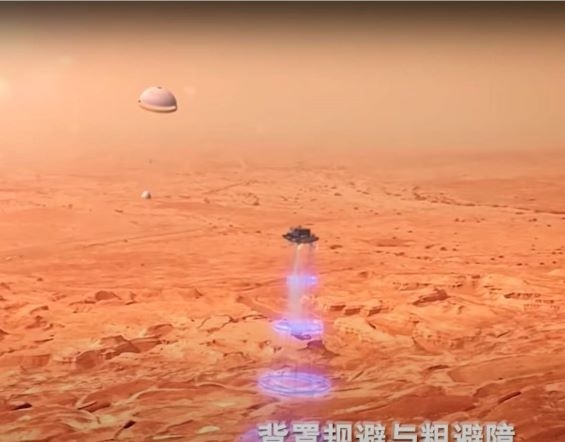
The parachute and the outer shield of the spacecraft were jettisoned, exposing the lander and rover. A retrorocket on the lander was fired to further slow the speed of the craft to nearly zero.
Buffer legs
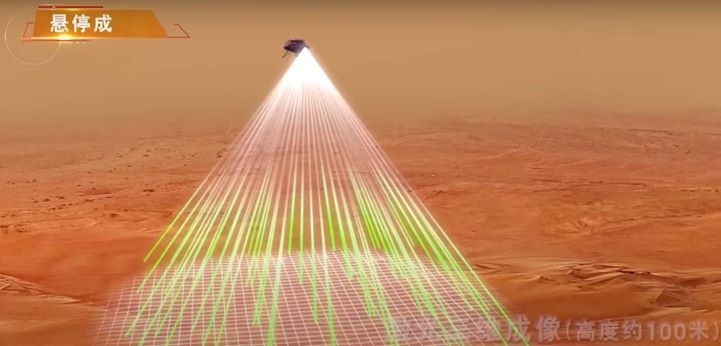
At about 100 meters above the Martian surface, the craft hovered to identify obstacles and measure the slopes of the surface. The craft then selected a relatively flat area and descended slowly, touching down safely on its four buffer legs.
It took ground controllers more than an hour to establish the success of the pre-programmed landing. Reportedly, the rover autonomously unfolded its solar panels and antenna to transmit signals after landing. There is a time delay of more than 17 minutes due to the distance between Earth and Mars.

Credit: CCTV/Inside Outer Space screengrab
“The Mars exploration mission has been a total success,” declared Zhang Kejian, head of the CNSA, announced at the Beijing Aerospace Control Center.
Roll off of the Zhurong rover from the lander onto Mars is not scheduled to occur for several days, according to reports.
Relay orbit
Tianwen-1 consists of an orbiter, a lander and a rover. Due to the huge distance between Mars and Earth, the Zhurong rover can’t transmit data back to Earth directly, but does so through the orbiter.
In order to transmit data accurately and timely, the Mars-circling orbiter will conduct a braking maneuver in a few days and enter a relay orbit to better complete the relay communication task.
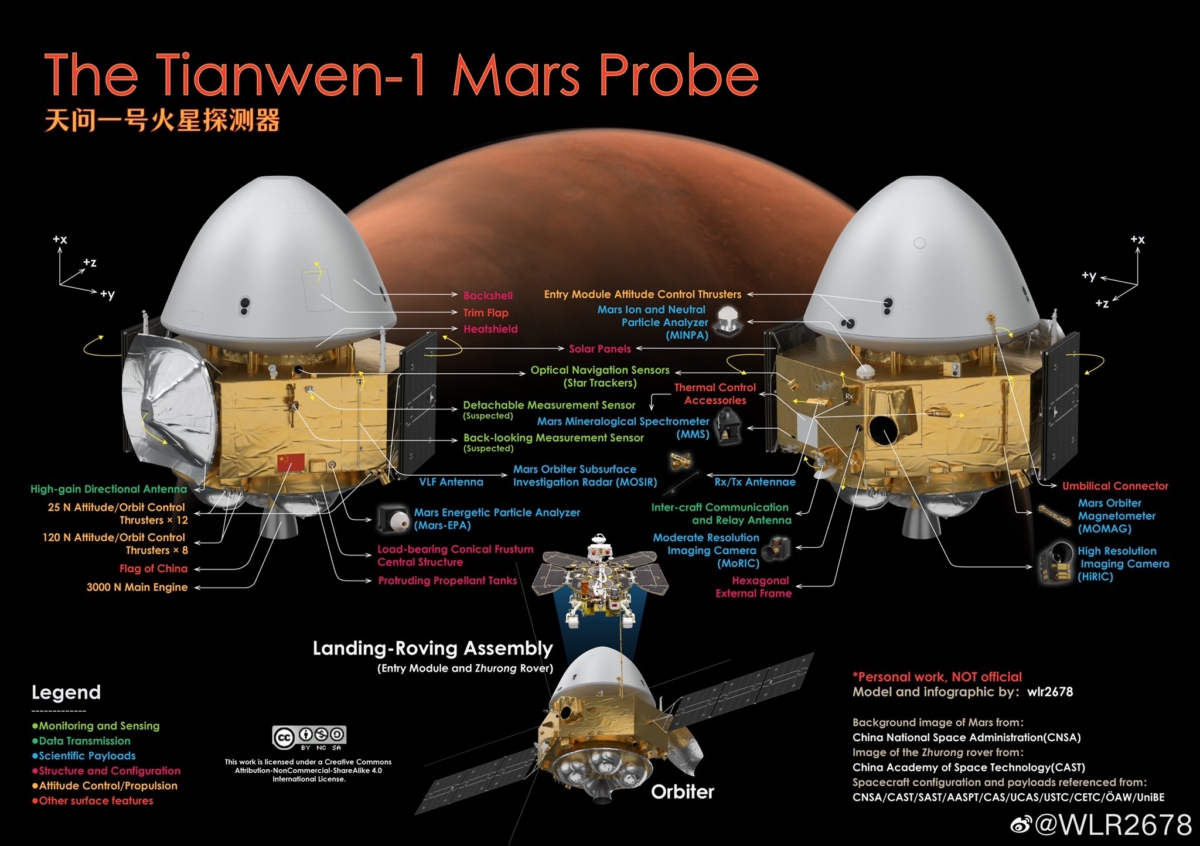
Credit: Weibo wlr2678
“We’re going to conduct the fourth braking near Mars on May 17 and change the orbital period from the current roughly 48 hours to eight hours, which means the orbiter will orbit three times a day. All images captured by the rover on the Mars surface will be sent back to Earth through the orbiter,” said Zhang Yuhua, deputy chief commander of the Tianwen-1 Mars mission.
Rover lifetime
According to the schedule, the rover will transmit data with the orbiter for about an hour a day during its mission on the surface of Mars. The data will be sent back to Earth after the transmission.
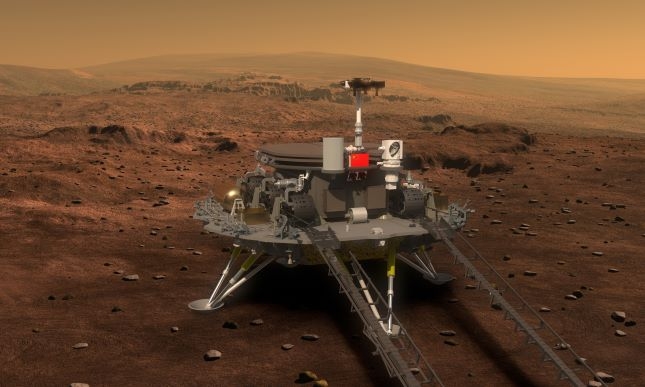
Artwork depicts lander/rover at landing site.
Credit: CAST
The rover is designed to work on the planet for at least 90 Martian days.
Tianwen-1 was launched from the Wenchang Spacecraft Launch Site on the coast of southern Chinese island province of Hainan on July 23, 2020.
The name Tianwen — meaning Questions to Heaven — comes from a poem written by the ancient Chinese poet Qu Yuan (about 340-278 BC).
China’s Zhurong rover is named after the god of fire in ancient Chinese mythology, which echoes with the Chinese name of the red planet: Huoxing (the planet of fire).
Video/Graphic resources
A number of videos and a China Global Television Network (CGTN) graphic detail the Tianwen-1 Mars mission.
Go to:
https://news.cgtn.com/event/2021/tianwen1-to-mars/index.html
 Posted in Space News

